FCS-PH-0129
Photography Wing · Exhibit No. 129
Before the Light Leaves
Before the Light Leaves
FCS-PH-0129
Published
Granada, Andalusia, Spain
April 8, 2014
Available as a Fine Art Print
Acquire a Print ↗About the Work
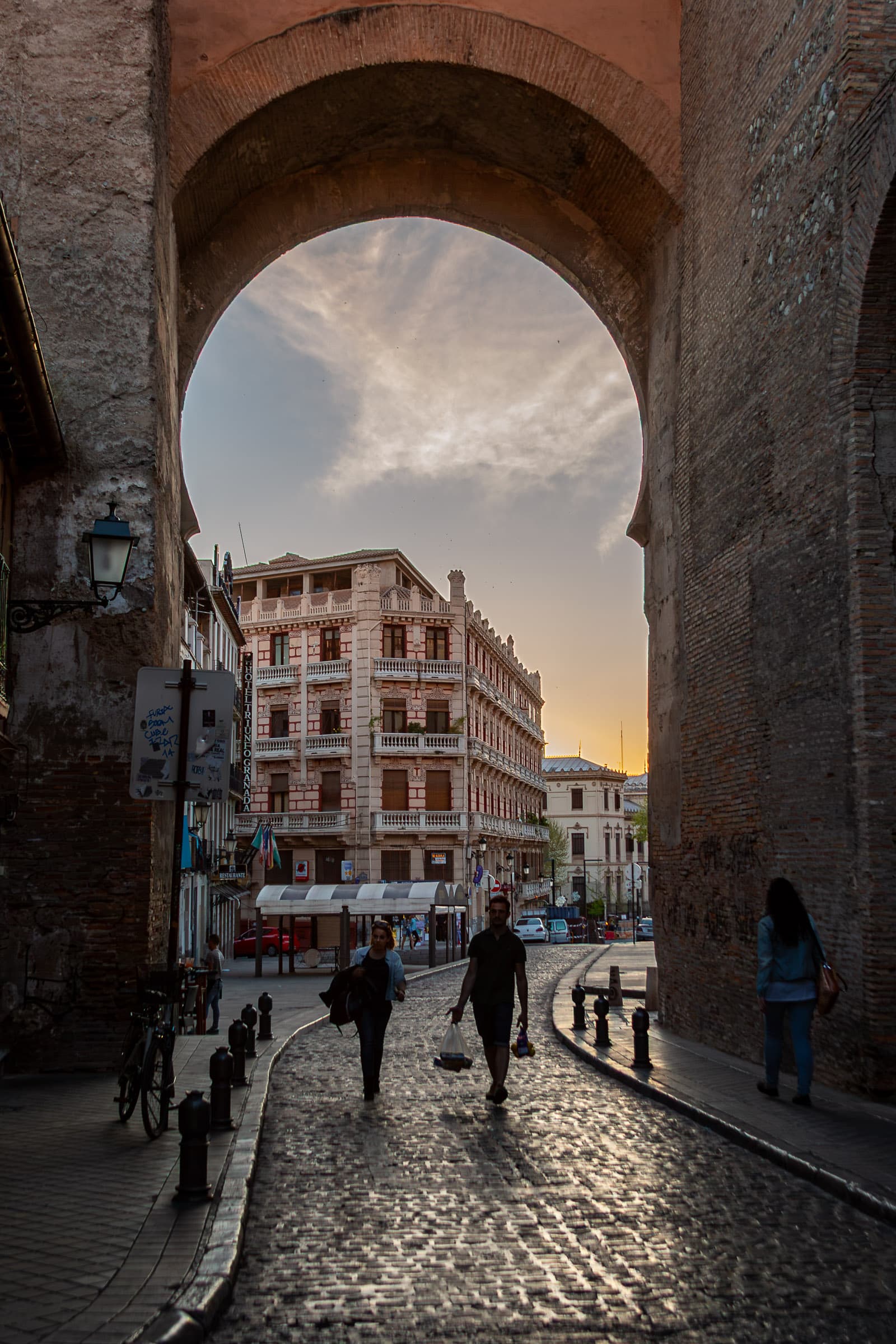
Before the Light Leaves looks through a monumental archway into the streets of Granada, Spain, as the final light of day settles across the city. Massive brick and stone walls frame the view, while pedestrians move along a curving cobblestone street toward the architecture beyond. The remaining sunlight catches the uneven stones beneath their feet, creating a luminous path through an otherwise shadowed passage. Beyond the arch, the city remains open to the fading sky, while the surrounding walls have already begun to surrender to darkness. Earlier that same day, the rising sun had illuminated the mountains above Granada. By evening, the perspective had changed. From high above the city to the streets within it, the landscape had given way to architecture, movement, and everyday life. The photograph holds that final transition—the brief interval when the day has not quite ended, the streets still carry traces of light, and the city continues beneath it. Before the Light Leaves is a photograph of that threshold: not quite day, not yet night, and one last passage through Granada before the light disappears.
The Artist
I began this day high above Granada, watching the sun rise over the mountains and photographing the first light as it reached across the landscape. For much of the day, my relationship with the city was one of elevation and distance. I looked across valleys, rooftops, hillsides, and the city stretching below me.
By the time I made this photograph, that perspective had been completely reversed. I had descended from the heights and was now at street level, surrounded by the physical city itself. The mountains that had dominated the morning were gone from view. In their place were brick and stone, cobblestones, buildings, streetlamps, and people moving through the evening.
The light had changed as well. That morning I had watched it arrive. Now I was watching what remained of it.
What attracted me here was the way the enormous arch enclosed the scene without completely containing it. Beyond the heavy masonry, the street continued. People walked beneath the arch while the remaining daylight reflected from the cobblestones and drew a path toward the city beyond.
There was something satisfying about ending the day at ground level after beginning it so far above the city. I had spent the morning watching Granada receive the light from a distance. By evening, I was walking within the places that light had reached.
I did not set out that morning intending to create a photographic record of a day measured by light. I was simply moving through Granada and responding to what caught my attention. Looking back at the photographs years later, however, I can see the progression more clearly.
Morning had been about arrival. The day became about discovery. And here, beneath this arch, the light was beginning to leave.
The Curator
Before the Light Leaves uses monumental architecture as both subject and framing device. The large masonry arch dominates the upper and lateral portions of the composition, creating a frame within the photographic frame through which the viewer encounters the street and city beyond.
The vertical crop intensifies this relationship. By removing much of the surrounding architecture visible in the original capture, the composition concentrates attention on the arch, the curving street, and the pedestrians passing beneath it. The scale of the masonry becomes more pronounced because of its relationship to the comparatively small human figures below.
The cobblestone street provides the principal line of movement. Beginning near the bottom of the frame, reflected evening light follows the uneven surface as the street curves toward the architecture beyond the arch. The two central pedestrians occupy this illuminated passage, while a third figure along the right wall introduces an asymmetrical counterpoint and reinforces the human scale of the structure.
The opening within the arch functions as an area of visual release. Heavy, textured masonry surrounds a comparatively luminous interior containing sky, architecture, street, and human activity. The pale evening sky provides negative space above the distant building and prevents the substantial architectural mass from overwhelming the composition.
Light is present not as direct spectacle but as residue. It catches the cobblestones, remains in the sky beyond the passage, and separates the distant architecture from the darker walls surrounding it. The resulting photograph depends upon the tension between enclosure and openness, permanence and movement, and the massive physical presence of the city against the temporary passage of people and light.
Reflection
Some photographs become more meaningful when they are considered not only as individual moments, but as parts of the day that surrounded them.
On this day in Granada, I began with sunrise. From high above the city, I watched morning light move across mountains and valleys. The landscape seemed enormous, and much of what I photographed depended upon distance—the relationship between one ridge and another, between shadow and sunlight, and between the city and the geography surrounding it.
Hours later, this photograph finds me in almost the opposite position. I am no longer above Granada looking outward. I am down within it, walking its streets beneath walls that tower overhead. The distant landscape has been replaced by an immediate human environment.
Even the light has reversed its role. In the morning photographs, it was arriving and revealing the world. Here, it is withdrawing. What remains catches the cobblestones and passes through the opening of the arch while darkness begins reclaiming the surrounding masonry.
The people walking through the frame give the photograph another sense of passage. Their destinations are unknown and unimportant to the image. What matters is that they continue through the city while the day changes around them. The architecture may have stood for generations, but the pedestrians, the reflected light, and the moment itself are temporary.
Looking at the photograph now, I see more than an archway in Granada. I see the other end of a day that began with the arrival of light.
Perhaps that is one of photography's quiet gifts. A fraction of a second can preserve something we did not yet realize was part of a larger story.
The Museum
Created in Granada, Spain, on the evening of April 8, 2014, Before the Light Leaves records a street-level passage through the historic city during the transition from daylight toward evening. Monumental masonry architecture frames pedestrians moving along a curving cobblestone street, while residual daylight remains visible in the sky and reflected surfaces beyond the arch.
The photograph is distinguished by its use of architecture as an internal framing structure. The arch creates a contained view of the city beyond, establishing successive spatial layers from the dark foreground masonry to the pedestrians, street, distant architecture, and open sky. Reflected light across the cobblestones reinforces this depth and creates a visual route through the composition.
Human figures provide scale without becoming individualized subjects. Their presence emphasizes the relationship between the enduring physical structure of the city and the temporary movement of people through it. The image consequently operates simultaneously as architectural photography, street observation, and a study of transitional light.
Within the Francisco Colón Studio collection, Before the Light Leaves has a particularly significant relationship with FCS-PH-0127, Where the Street Finds the Light, and FCS-PH-0128, The Reach of the Light. All three photographs were created in Granada on April 8, 2014. The earlier photographs observe morning illumination entering streets and traveling across the surrounding landscape; Before the Light Leaves returns to the city at the opposite end of the day as illumination begins to recede.
Together, the works form an unplanned visual progression through a single day: the arrival of light, its movement through landscape and city, and its eventual departure. The relationship was recognized retrospectively rather than conceived as a formal series at the time of capture, demonstrating how photographic meaning can emerge through later consideration of images originally made as independent observations.
Technical Information
- Camera
- Canon EOS 5D Mark III
- Lens
- EF 28-135mm f/3.5-5.6 IS USM
- Focal Length
- 28mm
- Capture Date
- April 8, 2014
- Capture Time
- 8:29 PM local time
- Location
- Granada, Andalusia, Spain
- Flash
- Did not fire
- Metadata Status
- Original camera clock remained set to New York time. EXIF records 2:29:53 PM; corrected to approximately 8:29 PM local time in Granada.
- Supporting Documentation
- Original EXIF metadata retained. Local capture time corrected from camera time using the six-hour difference between New York and Granada on April 8, 2014.
Collection Record
- Accession Number
- FCS-PH-0129
- Exhibit Number
- 129
- Exhibition
- Cities
- Status
- Published
- Original Capture
- April 8, 2014
- Artist
- Francisco Colón
- Copyright
- © Francisco Colón. All rights reserved.