FCS-PH-0087
Photography Wing · Exhibit No. 87
Between the Passing
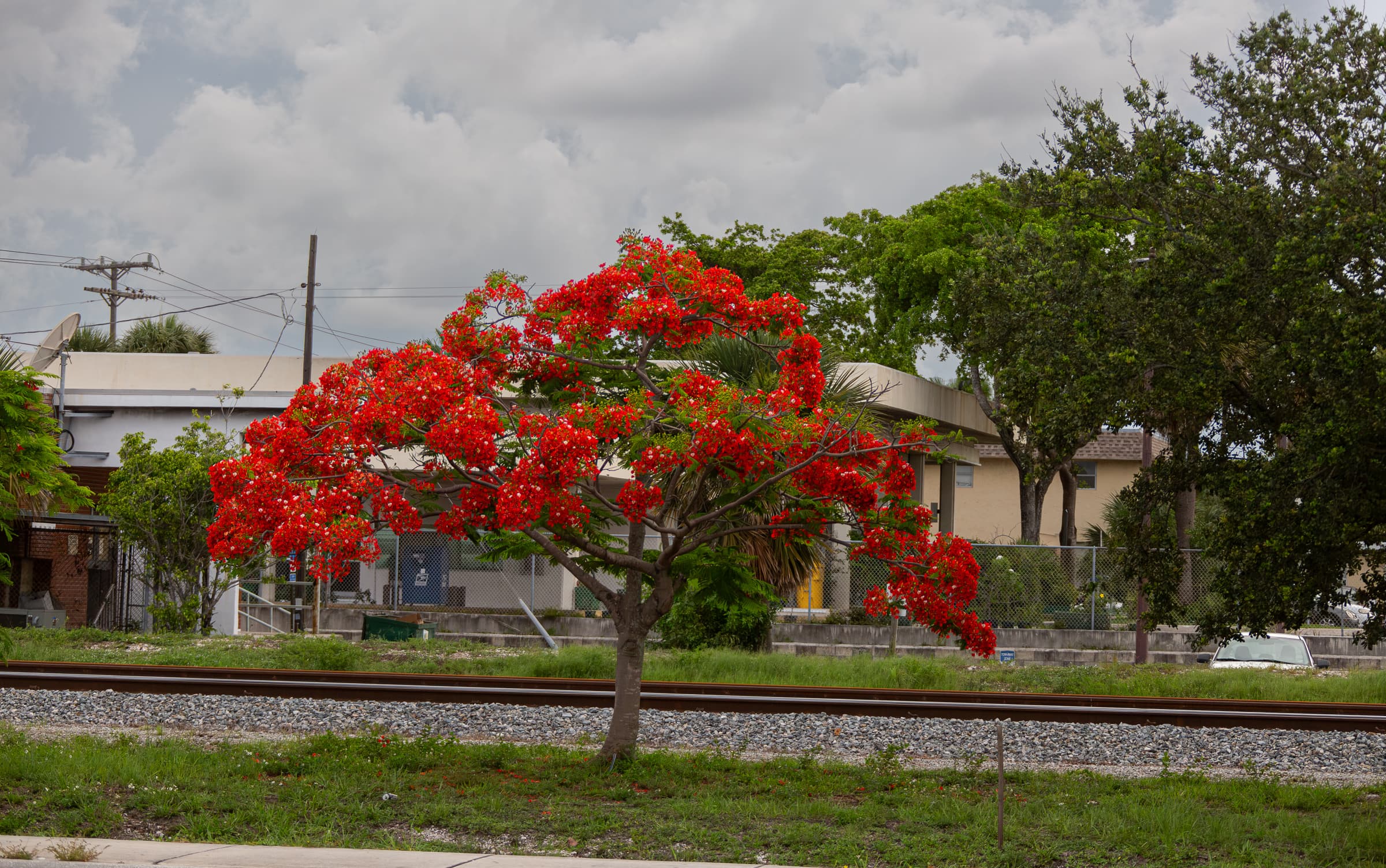
A flamboyán standing still between two corridors of movement.
Between the Passing
FCS-PH-0087
Permanent Collection
Lake Worth, Florida, United States
June 13, 2017
Available as a Fine Art Print
Acquire a Print ↗About the Work
A solitary flamboyán blooms in a narrow strip of land in Lake Worth, Florida, positioned between the railroad tracks and busy Dixie Highway. Surrounded by utility lines, fencing, buildings, traffic, and the infrastructure of everyday movement, the tree remains still—a brilliant presence in a place designed largely for passing through.
The Artist
My connection to the flamboyán goes back much further than this photograph.
When I was a child, my grandfather owned a restaurant in New Jersey called El Flamboyant. Because of him, the name of this tree became part of my family history long before I understood everything it would eventually represent to me. Over the years, the flamboyán became connected in my mind with Puerto Rico, childhood, family, and belonging.
That history is part of why I kept noticing this particular tree in Lake Worth.
I had driven past it many times along Dixie Highway. It stood in this narrow piece of land between the highway and the railroad tracks, surrounded by utility poles, wires, fencing, buildings, gravel, and traffic.
Eventually, passing it wasn't enough.
One day I deliberately went back. I parked across the street at the Walgreens, took my camera, and photographed it from the opposite side of Dixie Highway.
I wasn't discovering the tree that day. I was returning to something that had already been asking for my attention.
Years later, learning about the Japanese concept of Ma gave me another way of understanding why this scene worked so strongly for me. I didn't know the term when I made the photograph, but I recognize the instinct now—the importance of the space around something, the interval between things, and the relationship created by what surrounds a subject.
The flamboyán stood between two corridors of movement. Cars passed on one side. Trains could pass on the other.
And in the middle of all of it was a tree that, for me, carried a history reaching all the way back to childhood.
It was simply standing there, blooming.
The Curator
Between the Passing places a flowering flamboyán within an environment dominated by transportation and ordinary urban infrastructure.
The tree occupies the visual center of the photograph, while the horizontal railroad tracks establish a strong dividing line across the lower portion of the composition. Dixie Highway occupies the foreground, creating a second transportation corridor on the opposite side of the tree.
The flamboyán's irregular red canopy contrasts with the subdued architecture, fencing, utility poles, wires, gravel, and overcast sky surrounding it. Its organic form interrupts an environment largely composed of horizontal lines, constructed surfaces, and functional structures.
The wider composition is essential to the work. Isolated from its surroundings, the flamboyán could become primarily a botanical subject. Here, its environment transforms it into a study of stillness within movement and natural presence within an ordinary urban landscape.
Story Behind the Photograph
Francisco Colón photographed Between the Passing in Lake Worth, Florida, on June 13. 2017.
The photograph was not the result of a chance encounter.
Colón had driven past this particular flamboyán many times along Dixie Highway. Its position was unusual: the tree occupied a narrow strip of land between the railroad corridor and the busy highway. But his attraction to it also came from a much older and more personal connection.
The flamboyán had been part of Colón's visual and emotional vocabulary since childhood. His grandfather owned a restaurant in New Jersey called El Flamboyant, giving the tree an early association with family. As Colón's relationship with Puerto Rico deepened throughout his life, the flamboyán came to carry additional associations with memory, heritage, and belonging.
After repeatedly seeing the Lake Worth tree from the road, Colón eventually decided to return specifically to photograph it. He parked at the Walgreens across Dixie Highway and made the photograph from the opposite side of the street.
The surrounding infrastructure was deliberately retained within the composition. Railroad tracks run behind the tree while Dixie Highway passes in front of it. Utility poles, wires, fencing, buildings, gravel, and roadway remain visible rather than being excluded to create a conventional botanical portrait.
Years later, Colón's study of the Japanese concept of Ma offered another vocabulary through which to understand what had attracted him to the scene. Although he was not consciously applying the concept when the photograph was made, its emphasis on interval, spatial relationships, and the significance of the space between things closely reflects the photographic instinct present here.
Between the Passing therefore connects several threads that recur throughout Colón's work: observation, memory, return, and the relationship between a subject and the space surrounding it.
For another passerby, it may have been a flowering tree beside the railroad tracks.
For Colón, it was something familiar standing in an unfamiliar place.
Reflection
Sometimes noticing happens long before the photograph.
Something enters our vision repeatedly—a tree beside a road, a building passed on a familiar route, a person occupying the same corner—and slowly becomes part of our internal landscape. Eventually, passing is no longer enough. We return.
The Japanese concept of Ma reminds us that meaning does not reside only within objects themselves. It can also exist in the intervals around them and in the relationships created by distance, separation, and space.
Here, the flamboyán occupies such an interval.
Dixie Highway carries movement along one side. The railroad carries movement along the other. Between them stands something rooted.
For the photographer, however, the tree carries another kind of distance: the distance between adulthood and childhood. What appears to another passerby as a flowering tree beside the tracks can simultaneously contain memory, recognition, and return.
Perhaps that is why some things ask us to come back.
We are not always returning to the place.
Sometimes we are returning to what the place awakened in us.
The Museum
Between the Passing is preserved in the Francisco Colón Studio Photography Wing as part of the artist's continuing study of observation, solitude, and overlooked spaces.
The photograph documents a flamboyán growing between the railroad corridor and Dixie Highway in Lake Worth, Florida. The surrounding transportation and utility infrastructure is intentionally retained as part of the photographic record rather than minimized to create a conventional botanical portrait.
Within the collection, the work contributes to a recurring visual language in Colón's photography: solitary subjects discovered within larger environments and photographed because their relationship to the surrounding space caused the artist to stop.
The image is preserved not simply as a record of a flowering tree, but as evidence of the act of noticing something stationary within a landscape built around passing.
Technical Information
- Camera
- Canon EOS 5D Mark III
- Lens
- Canon EF 28–300mm f/3.5–5.6L
- Focal Length
- 110 mm
- Capture Date
- June 13, 2017
- Capture Time
- 6:54:20 PM
- Location
- Lake Worth, Florida, United States
- Flash
- Did not fire
- White Balance
- Auto
- Metadata Status
- Original RAW metadata preserved. ISO 100, 1/640 sec at f/5.6, 110 mm. Shutter Priority exposure program with Pattern metering. Exposure bias +0.67 EV. Original file dimensions 5760 × 3840 pixels; final crop 5760 × 3607 pixels. Final interpretation developed in Adobe Lightroom Classic.
Collection Record
- Accession Number
- FCS-PH-0087
- Exhibit Number
- 87
- Exhibition
- Photography Wing
- Status
- Permanent Collection
- Studio Acquisition
- Francisco Colón Studio Photography Wing
- Artist
- Francisco Colón
- Copyright
- © Francisco Colón. All Rights Reserved.