FCS-PH-0132
Photography Wing · Exhibit No. 132
Between Towers and Windows
Granada, Spain
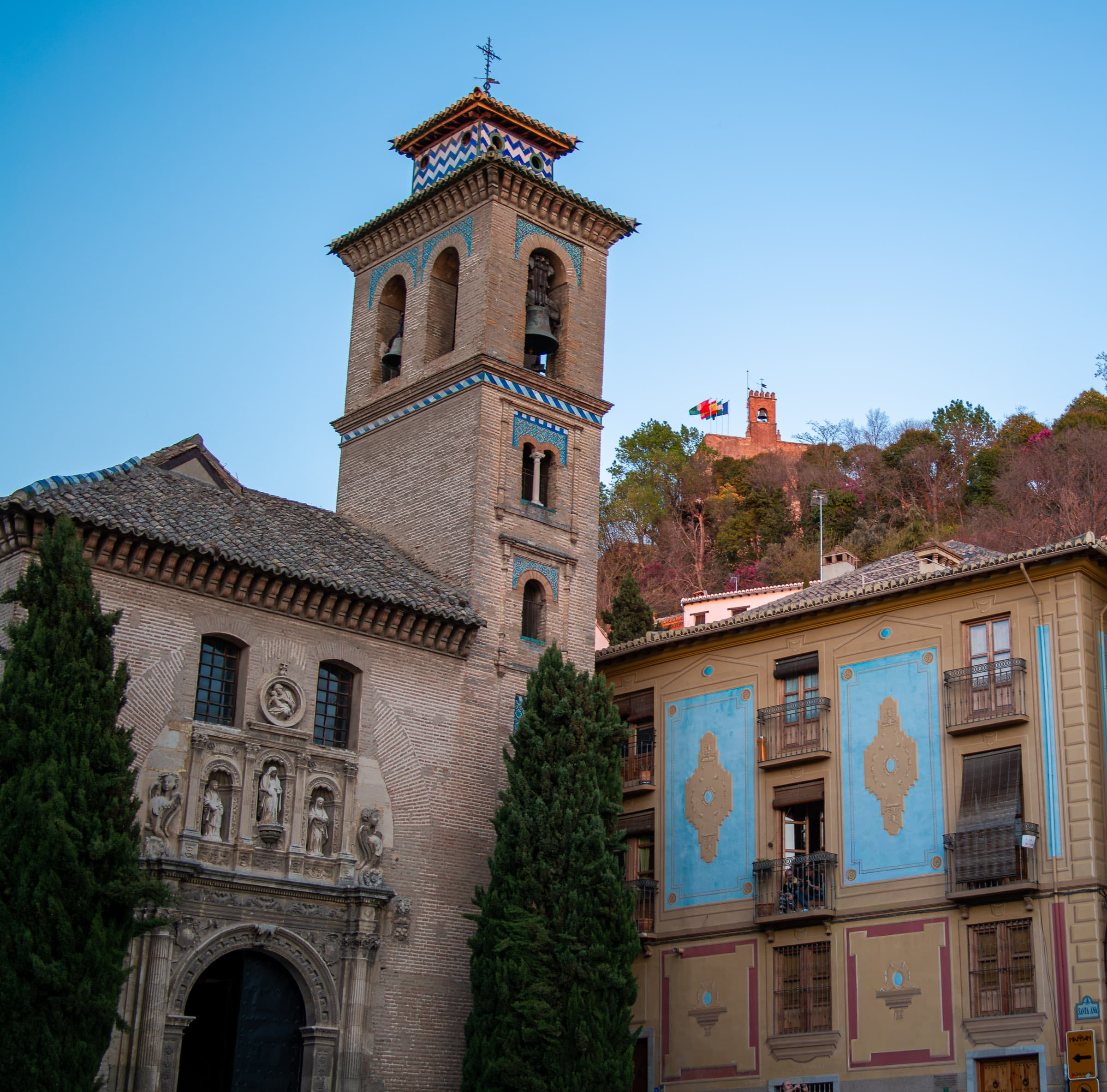
Between Towers and Windows
FCS-PH-0132
Published
Granada, Andalusia, Spain
April 6, 2014
Available as a Fine Art Print
Acquire a Print ↗About the Work
In Granada's historic center, the bell tower of the Iglesia de San Gil y Santa Ana rises beside the richly decorated facade of the neighboring tourism office near Plaza Nueva. What first caught my attention was the architecture—the warm brick of the church set against the distinctive aqua details of the adjoining building. Years later, while revisiting and editing the photograph, other relationships within the scene began to emerge: touches of aqua repeated across the church tower, another tower appearing in the distance, and two men quietly conversing on a balcony between the decorative panels. They were details I had recorded without fully noticing them at the time. The photograph became a reminder that a camera can sometimes preserve more than the photographer consciously sees in the moment. What begins as a broad impression of a place can reveal an entirely different composition when we return to it and look more carefully.
The Artist
When I made this photograph, I remember being attracted to two things: the church and the unusual aqua-colored decoration on the neighboring building.
I was taking in the larger scene rather than consciously isolating every element within it. Years later, when I returned to the photograph and began cropping away what wasn't necessary, I discovered things I had not really seen when I pressed the shutter.
There were two men talking on the balcony. Aqua details on the church tower echoed the color of the neighboring facade. A distant tower appeared between the buildings.
None of these things were added. They had always been there.
The camera had preserved something my attention had not completely processed. Sometimes the camera records what catches our attention before we fully understand why it caught our attention.
The Curator
Between Towers and Windows demonstrates how photographic meaning can emerge through reconsideration of the frame.
The composition is organized around the vertical mass of the church tower and the decorated facade beside it, while a distant tower establishes another architectural layer. Repeated aqua accents create an unexpected visual connection between structures otherwise separated by material, scale, and distance.
The two small figures on the balcony introduce human presence without becoming the primary subject. Their scale allows them to function as a secondary discovery within the architecture.
What is especially significant is that these relationships were not all consciously recognized at the moment of exposure. The original frame contained more visual information than the photographer had deliberately organized. Years later, cropping removed competing elements and allowed the underlying structure of the photograph to become visible.
The resulting image rewards prolonged looking. What first appears to be a study of neighboring architecture gradually becomes a photograph about observation itself—the difference between what the camera records and what the eye consciously notices.
Story Behind the Photograph
The photograph began with a broad impression.
Walking through Granada, my attention was drawn to the church and to the unusual aqua-colored decoration on the building beside it. I made the exposure without consciously identifying every relationship within the scene.
When I returned to the photograph years later, the original frame felt busy. There were too many elements competing for attention, and the reason I had made the photograph was no longer immediately apparent.
Cropping changed that.
As unnecessary elements disappeared from the frame, other things began to reveal themselves. The aqua color of the neighboring building was repeated in architectural details on the church tower. A smaller tower appeared on the hillside in the distance. Most unexpectedly, two men could be seen quietly conversing on a balcony between the large decorative aqua panels.
I had not noticed them when I took the photograph.
Nothing new had entered the image. The process of editing simply allowed me to see more clearly what had been there all along.
Reflection
For years this was simply a photograph I had made in Granada. I remembered the church and the aqua-colored building, but little else about why I had stopped there.
Returning to the image years later changed that.
Cropping away the distractions allowed me to see relationships that had been present from the beginning. Most surprising were the two men on the balcony. I had photographed them without knowing I had photographed them.
That discovery reminded me that seeing does not always happen all at once.
Sometimes we recognize something immediately. Sometimes we take in the larger landscape and only later understand what within it held our attention.
The photograph preserves moments.
Time can also reveal what was hiding inside them.
The Museum
Created in Granada on April 6, 2014, Between Towers and Windows depicts the Iglesia de San Gil y Santa Ana and the neighboring tourism office near Plaza Nueva.
The photograph was revisited years after its original exposure and substantially refined through cropping. That later interpretation revealed repeated aqua architectural details, two figures on a balcony, and multiple layers of architecture that were not consciously recognized by the photographer at the moment of exposure.
Rather than changing the content of the photograph, the later editing process clarified relationships already contained within the original frame.
Within the Francisco Colón Studio archive, the work serves as an example of retrospective seeing—the ability of an existing photograph to disclose visual relationships through renewed attention. It also reflects a recurring idea within the Studio: photography can preserve information beyond what the photographer consciously recognizes at the moment the shutter is released.
Technical Information
- Camera
- Canon EOS 5D Mark III
- Lens
- EF 28-135mm f/3.5-5.6 IS USM
- Focal Length
- 44 mm
- Capture Date
- April 6, 2014
- Capture Time
- 8:35 PM local time
- Location
- Granada, Andalusia, Spain
- Flash
- Did not fire
- Metadata Status
- Original camera EXIF retained. Local capture time corrected from camera time using the six-hour difference between New York and Granada on April 6, 2014.
- Supporting Documentation
- Original Canon EOS 5D Mark III RAW metadata and Francisco Colón Studio archival review.
Collection Record
- Accession Number
- FCS-PH-0132
- Exhibit Number
- 132
- Exhibition
- Photography Wing
- Status
- Published
- Original Capture
- April 6, 2014
- Studio Acquisition
- October 2026
- Artist
- Francisco Colón
- Copyright
- © Francisco Colón. All rights reserved.