FCS-PH-0112
Photography Wing · Exhibit No. 112
Breaking Morning
The final stars of night remain as morning reaches the sea
Breaking Morning
FCS-PH-0112
Available as a Fine Art Print
Acquire a Print ↗About the Work
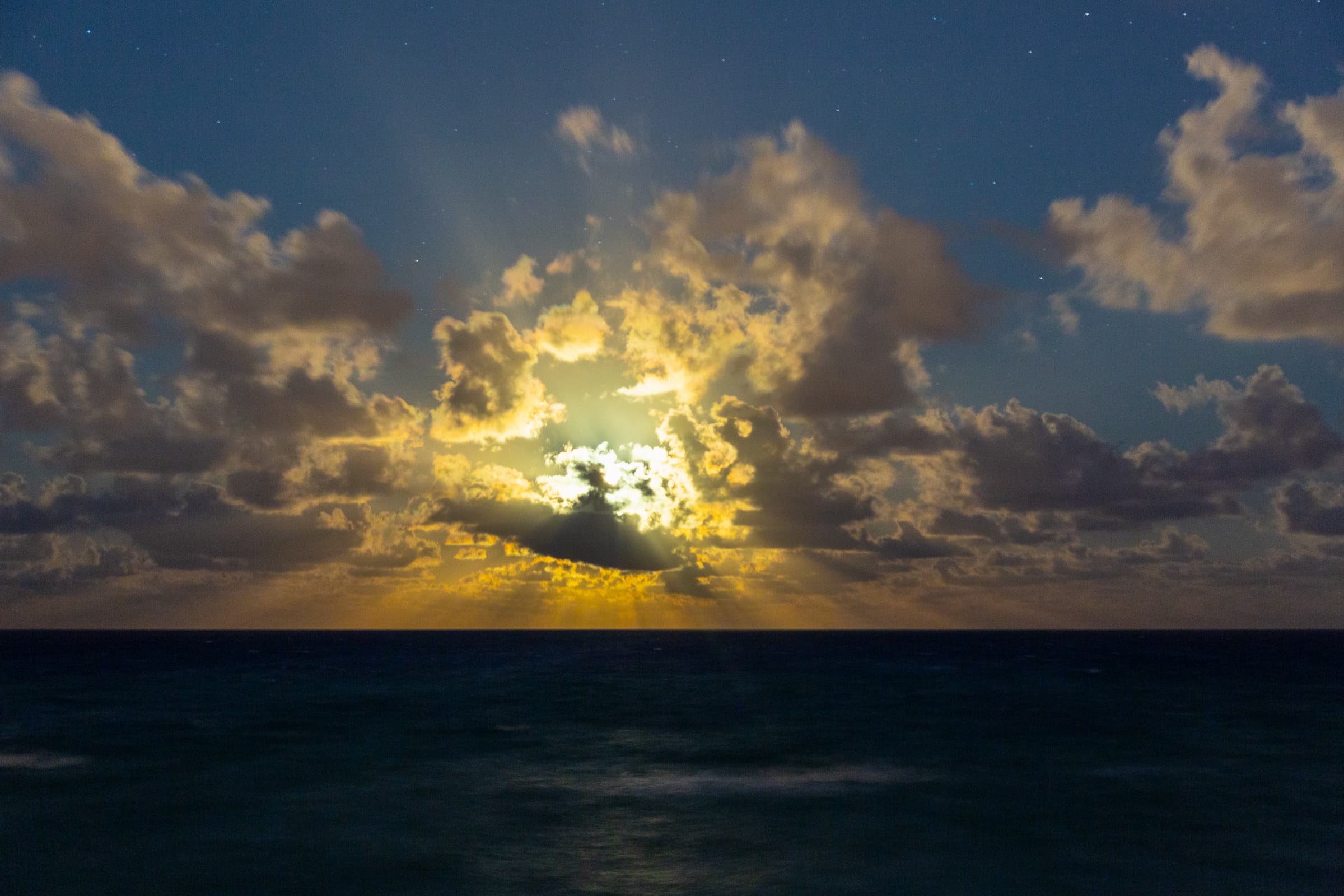
The first light of morning breaks through a turbulent bank of clouds above the Atlantic Ocean at Lake Worth Beach, Florida. Rays of sunlight spread toward the horizon while the final stars of night remain faintly visible overhead. Below, the ocean remains largely within shadow, revealing a subtle trail of light across the moving waves.
The Artist
I have always loved photographing sunrises. There is something about arriving while most people are still asleep and waiting for the horizon to reveal what kind of morning it intends to become.
This sunrise at Lake Worth Beach was no exception. The clouds were heavy, the ocean remained dark, and the morning had not fully announced itself. Then the sunlight began forcing its way through openings in the clouds, sending visible rays toward the water.
What continues to hold my attention is that the stars had not completely disappeared. They remained above the clouds while the first sunlight reached across the horizon. Night and morning were occupying the same photograph.
The ocean is not fully revealed. It remains somewhat obscured, but there is enough light on the waves to let me know it is there—moving beneath everything happening in the sky.
That is what I wanted to preserve: not simply a sunrise, but the moment when darkness had not yet surrendered and morning had already begun.
The Curator
Breaking Morning is constructed around a dramatic division between an expansive sky and a restrained band of ocean. The low horizon gives the clouds visual authority, allowing the unfolding light to become the principal subject.
At the center of the composition, sunlight presses through layered clouds and separates into visible rays. The brightest region is contained rather than allowed to overwhelm the frame, preserving texture along the illuminated cloud edges while maintaining the surrounding darkness.
The remaining stars introduce an unexpected temporal contradiction. Their presence identifies the scene as the final stage of night, while the golden light below announces the approaching day. The photograph therefore records two conditions of time within a single exposure.
The ocean functions as a quiet counterweight. Its surface is mostly concealed, yet a subtle reflection provides a pathway from the lower edge of the frame toward the breaking light. Sky and water are connected without becoming equally descriptive.
The result is a seascape shaped less by geography than by transition: darkness becoming light, concealment becoming revelation, and night slowly releasing its hold on the morning.
Story Behind the Photograph
Francisco Colón made this photograph at Lake Worth Beach, Florida, during the breaking morning of March 2015. He had gone to the shoreline to photograph one of the sunrises he frequently sought along Florida’s Atlantic coast.
The camera recorded March 9, 2015, at 11:08:42 p.m., but that timestamp does not correspond with Francisco’s memory or with the visible sunrise. The camera clock appears to have been incorrectly set. The precise local capture time therefore remains uncertain, although the photograph itself clearly records daybreak.
Using a ten-second exposure, Francisco photographed the movement of the clouds and ocean while retaining the faint stars still visible in the upper sky. The extended exposure softened the waves and allowed the emerging light to register across the water.
During development, the central light was carefully controlled with a radial adjustment. Highlights, whites, and saturation were reduced locally so that the brilliance of the rising sun would remain powerful without becoming visually overwhelming.
What began as another morning visit to the beach produced something less common: a photograph in which the last visible evidence of night survived above the first rays of the coming day.
Reflection
Morning does not arrive all at once.
We often speak of beginnings as though they occur at a precise moment—a door opening, a decision being made, darkness immediately becoming light. Nature rarely works with such certainty. Night does not disappear simply because morning has begun.
In this photograph, the stars remain while sunlight reaches through the clouds. The ocean is still dark even as the horizon begins to glow. Nothing has fully departed, and nothing has completely arrived.
Perhaps transformation always happens this way. The life behind us does not vanish the moment something new begins. For a while, both remain visible: what we have carried and what is now approaching.
Breaking Morning is not only about sunrise. It is about the interval in which darkness and light are both true—and the quiet realization that change may already be underway before we can clearly see it.
The Museum
Breaking Morning belongs to Francisco Colón’s continuing photographic study of thresholds, journeys, and transitional light. Although the work contains no human figure, it reflects the artist’s recurring interest in moments that exist between established states: departure and arrival, memory and discovery, darkness and illumination.
The image is significant within the collection for its simultaneous depiction of faint stars, emerging sunlight, atmospheric rays, and a partially obscured ocean. These elements transform a familiar Florida sunrise into a study of temporal overlap.
Rather than presenting the coast as a conventional scenic destination, Colón uses the horizon as a boundary between conditions. The photograph asks the viewer to remain within that boundary—to witness the morning before it has fully become morning.
Within the Francisco Colón Studio archive, the work contributes to the broader visual language of Because I Looked: photographs created through patience, attention, and the recognition that meaning often appears during moments others might pass without noticing.