FCS-PH-0075
Photography Wing · Exhibit No. 75
Directed Elsewhere
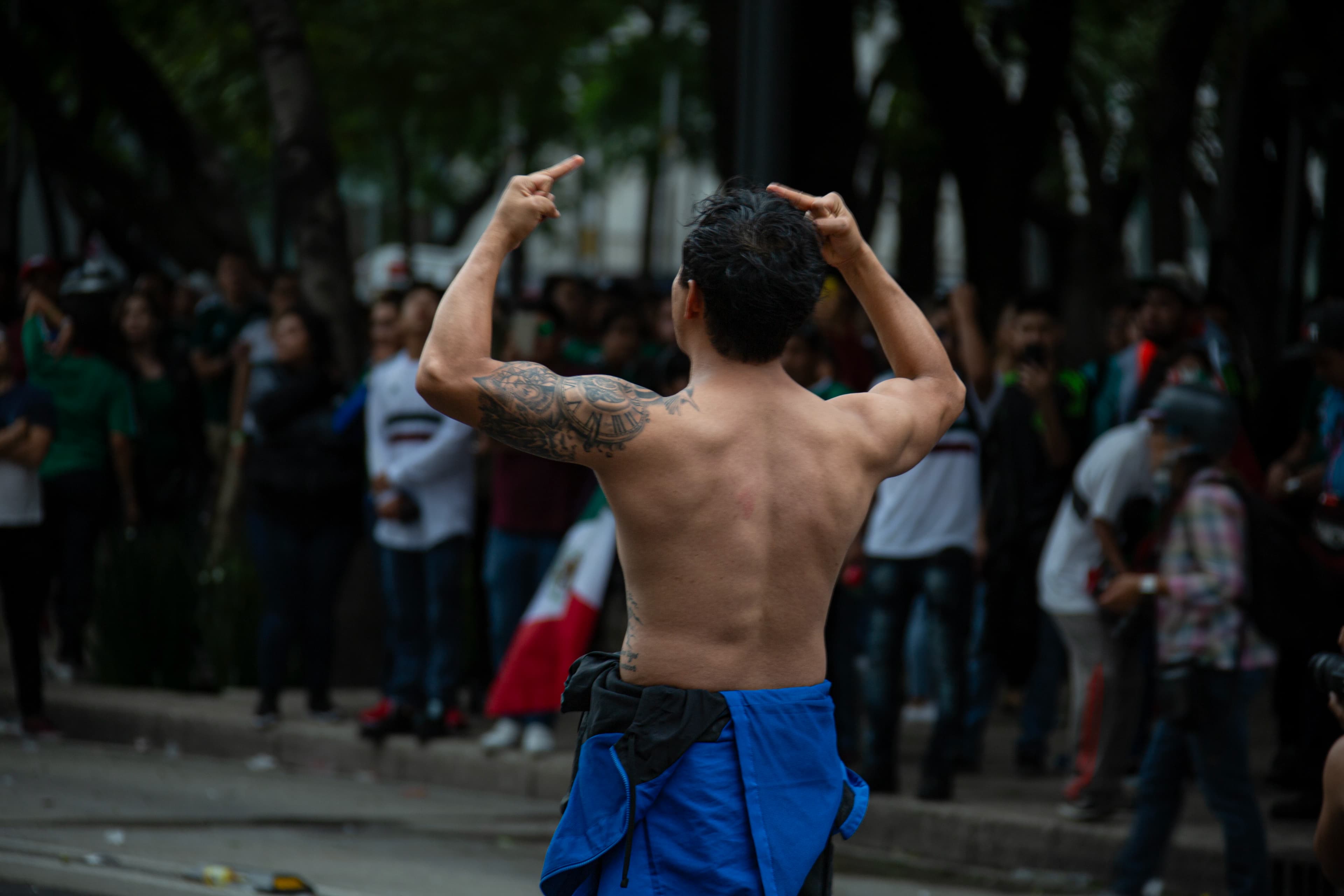
A gesture of defiance aimed beyond the boundaries of the photograph.
Directed Elsewhere
FCS-PH-0075
Permanent Collection
Animal-rights protest, Mexico City, Mexico
Sunday, June 17, 2018
About the Work
During an animal-rights protest in Mexico City, a shirtless demonstrator raises both middle fingers toward a large police presence outside the frame. Photographed from behind, his identity gives way to gesture as the surrounding crowd recedes into shallow focus. The image captures a brief expression of defiance within a larger public demonstration, while the unseen target of the gesture remains beyond the photograph's boundaries.
The Artist
I was photographing a protest in Mexico City concerning the killing of animals.
There was a large police presence.
Then I saw this man.
He had his back toward me and raised both arms, directing both middle fingers toward the police.
I photographed him from behind.
What interests me about the photograph now is that the reason for his gesture is not actually visible.
The police were there.
I saw them.
I knew exactly where he was directing his anger.
But I did not include them in this frame.
All the photograph gives us is his response.
His face is hidden.
His identity is secondary.
His hands tell us almost everything we need to know about what he was feeling at that particular moment.
The target of that emotion exists somewhere beyond the edge of the photograph.
I think that absence makes the gesture more powerful.
I was there, so I know what he was responding to.
The viewer does not have that advantage.
They encounter the gesture first and the history behind it afterward.
The Curator
Directed Elsewhere is structured around an action whose intended recipient remains outside the photographic frame.
A shirtless demonstrator occupies the center of the composition with his back toward the camera.
Both arms rise above his shoulders, creating a nearly symmetrical physical gesture while both hands display raised middle fingers.
The surrounding crowd remains substantially softer, allowing the demonstrator's body, tattoo, arms, and hands to dominate the composition.
A vivid blue garment around his waist provides a strong chromatic anchor against the comparatively subdued background.
The photograph itself does not identify the intended recipient of the gesture.
Artist provenance establishes that the image was made during an animal-rights protest in Mexico City and that the demonstrator was directing the gesture toward a substantial police presence nearby.
That distinction is important to the work.
The photograph records the response.
The photographer's eyewitness account preserves its context.
By excluding the police from this particular frame, the composition shifts attention away from confrontation between identifiable parties and toward the physical language of dissent itself.
Story Behind the Photograph
Colón made this photograph while documenting an animal-rights protest in Mexico City.
The demonstration concerned the killing of animals and was accompanied by a significant police presence.
While observing the activity, Colón noticed a shirtless demonstrator turn his attention toward the police.
With his back facing the photographer, the man lifted both arms and raised both middle fingers toward them.
Colón photographed the gesture.
The resulting composition does not contain the police officers toward whom it was directed.
Instead, the frame isolates the demonstrator against the surrounding crowd.
His face remains unseen.
A tattoo extends across one shoulder and upper arm, while a bright blue garment tied around his waist separates his figure from the darker environment behind him.
The absence of the police creates an important distinction between what the photograph visually documents and what Colón remembers from being present.
Without that provenance, the photograph records an unmistakable gesture of defiance but cannot establish its intended recipient.
With the photographer's eyewitness account, the larger circumstances become known.
The image therefore preserves both a visible action and an invisible relationship extending beyond the boundaries of the frame.
Reflection
A photograph does not always contain everything that was happening.
Sometimes the most important part of a moment is standing just beyond the edge of the frame.
I remember the police presence.
I remember where this man was directing his gesture.
But years later, the photograph itself cannot tell you that.
It shows only his back.
His arms.
His hands.
His response.
There is something interesting about that limitation.
Photography can preserve evidence, but it also preserves fragments.
The camera records what we place inside the rectangle and leaves everything else behind.
I know what was outside this one because I was standing there.
Someone encountering the photograph years later has only the gesture.
Perhaps that is why I continue to find photographs like this interesting.
They remind me that every frame contains both what we chose to show and what remained elsewhere.
The Museum
Preserved as the seventy-fifth accessioned photograph in the Francisco Colón Studio Photography Wing, Directed Elsewhere joins the People collection as a study of protest, gesture, observation, and the limits of the photographic frame.
The photograph depicts an unidentified demonstrator photographed from behind during an animal-rights protest in Mexico City.
Both arms are raised and both hands display middle-finger gestures.
A surrounding crowd is visible but rendered substantially softer than the central figure.
The police presence toward which the gestures were directed is not visible within this particular composition.
That contextual information derives from Colón's eyewitness provenance and is therefore preserved in the Studio record without representing it as independently visible evidence within the photograph.
The distinction between photographic evidence and artist recollection is intentionally maintained.
The image itself documents the demonstrator, his gesture, surrounding participants, and the physical environment contained within the frame.
The circumstances and intended direction of the gesture are documented through the photographer's account of the event.
No people, police officers, protest elements, signs, or environmental details absent from the original photograph were added or reconstructed during restoration.
The original relationship between the sharply rendered demonstrator and the softer surrounding crowd was preserved.
Technical Information
- Camera
- Canon EOS 5D Mark III
- Lens
- Canon EF 28–300mm f/3.5–5.6L IS USM
- Focal Length
- 210 mm
- Capture Date
- Sunday, June 17, 2018
- Capture Time
- 5:17:11 PM (camera-recorded time)
- Location
- Animal-rights protest, Mexico City, Mexico
- Metadata Status
- Original EXIF metadata confirms the Canon EOS 5D Mark III with Canon EF 28–300mm f/3.5–5.6L IS USM lens at 210mm, ISO 125, manual exposure mode, spot metering, automatic white balance, standard scene capture type, normal processing, a maximum aperture value of f/5.7, and that the flash did not fire. The camera recorded the photograph on June 17, 2018, at 5:17:11 PM. Artist provenance identifies the setting as an animal-rights protest in Mexico City and establishes that the demonstrator's visible gesture was directed toward a substantial police presence outside this particular frame.
- Supporting Documentation
- Original Canon image file, surviving EXIF metadata, 2026 restored master, and artist eyewitness provenance narrative preserved in the Francisco Colón Studio archive.
Collection Record
- Accession Number
- FCS-PH-0075
- Exhibit Number
- 75
- Exhibition
- People
- Status
- Permanent Collection
- Studio Acquisition
- Francisco Colón Studio Photography Wing
- Artist
- Francisco Colón
- Copyright
- © Francisco Colón. All Rights Reserved.