FCS-PH-0076
Photography Wing · Exhibit No. 76
Everything Leads There
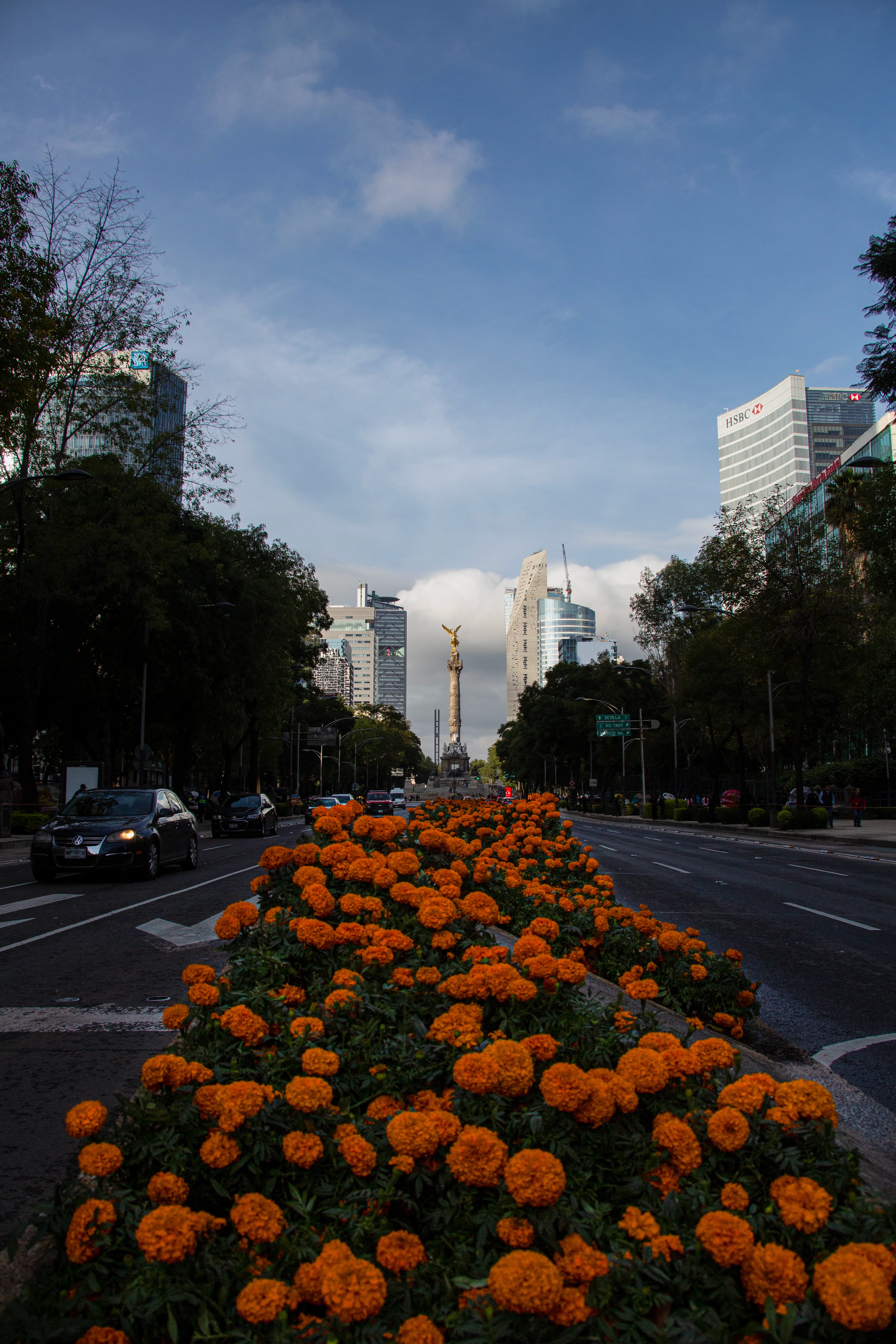
Flowers, roadway, trees, and architecture converge toward the Ángel de la Independencia.
Everything Leads There
FCS-PH-0076
Permanent Collection
Paseo de la Reforma, Mexico City, Mexico
Saturday, October 20, 2018
About the Work
A bed of orange cempasúchil stretches along Paseo de la Reforma toward the Ángel de la Independencia in Mexico City. Flowers, roadway, trees, traffic, and surrounding architecture create overlapping lines of perspective that converge near the distant monument. Though the Ángel occupies only a small portion of the frame, the composition continually draws the eye toward it, transforming an ordinary view along the avenue into a study of distance, perspective, and destination.
The Artist
What attracted me to this scene was the perspective.
The Ángel was there in the distance, but it was not the only thing directing my attention.
The flowers were leading toward it.
The road was leading toward it.
The trees were leading toward it.
Even the buildings seemed to create lines pointing toward the same place.
Almost everything in the photograph appeared to converge near the base of the Ángel.
That was what interested me.
The monument itself occupies only a very small part of the frame, yet the entire photograph seems organized around reaching it.
The cempasúchil begins large in the foreground and becomes progressively smaller as it travels into the distance.
The roads run beside it.
The trees create a darker corridor.
The buildings rise beyond them.
And somewhere near the center of all those lines stands the Ángel.
I wasn't trying simply to make a photograph of a famous monument.
I was photographing the way the city seemed to lead me toward it.
The Curator
Everything Leads There is constructed around multiple systems of perspective converging toward a comparatively small subject.
The Ángel de la Independencia appears in the distance near the central axis of the composition, while a bed of orange cempasúchil dominates the foreground.
The flowers progressively diminish in scale as they recede toward the monument, establishing the photograph's strongest visual pathway.
That movement is reinforced by the parallel roadway, tree lines, traffic, street infrastructure, and surrounding architecture.
Each contributes another directional element toward approximately the same distant point.
The darker trees on either side of the avenue form a natural corridor around the brighter center, while the expansive sky provides vertical scale and prevents the distant monument from visually competing with the foreground.
The result reverses the conventional hierarchy of monumental photography.
The landmark is not made dominant through size.
Instead, its importance is established through perspective.
Nearly every major structural element within the photograph directs the viewer toward it.
Story Behind the Photograph
While photographing Mexico City, Colón encountered a view along Paseo de la Reforma in which the Ángel de la Independencia appeared far in the distance.
What first appears to be a photograph of flowers and an urban avenue reveals a more deliberate spatial structure.
A long bed of orange cempasúchil occupies the center of the roadway.
Beginning prominently in the immediate foreground, the flowers gradually narrow and diminish as they extend toward the Ángel.
Colón recognized that the flower bed was only one of several visual pathways operating within the scene.
The roadways on either side move toward approximately the same point.
Rows of trees create another corridor.
Cars become progressively smaller.
The surrounding buildings contribute additional lines and boundaries that guide the eye inward.
At the distant center of these overlapping systems of perspective stands the Ángel.
Rather than moving closer to make the monument larger, Colón retained the distance.
That decision allowed the surrounding city to become part of the composition and transformed the monument from the largest object in the photograph into its visual destination.
Reflection
Sometimes the smallest thing in a photograph can control everything around it.
The Ángel is not large here.
The flowers occupy far more of the frame.
The sky is larger still.
Buildings rise around it, trees surround it, and traffic moves toward and away from it.
Yet my eye keeps returning to that small golden figure in the distance.
Perhaps that is because almost everything else tells me where to look.
The flowers narrow toward it.
The roads disappear toward it.
The trees open toward it.
The buildings seem to frame the journey.
Perspective becomes a kind of instruction.
Start here.
Follow this.
Keep going.
Eventually, everything leads there.
The Museum
Preserved as the seventy-sixth accessioned photograph in the Francisco Colón Studio Photography Wing, Everything Leads There joins the Cities collection as a study of perspective, urban space, observation, and visual direction.
The photograph depicts Paseo de la Reforma in Mexico City with the Ángel de la Independencia positioned in the distance and a bed of orange cempasúchil extending prominently through the foreground.
Multiple elements within the original composition—including the flower bed, roadway, tree lines, traffic, and surrounding architecture—create converging visual pathways toward the distant monument.
During the 2026 restoration, shadow information within the foreground flowers was carefully recovered while the darker tree-lined corridor surrounding the avenue was retained.
Color within the cempasúchil was clarified without substantially altering the surrounding urban palette.
Highlight information in the sky and distant architecture was controlled, while the natural progression from the darker foreground toward the brighter distant center was preserved.
The Ángel itself was not enlarged or repositioned.
Cars, buildings, road markings, signs, trees, and other contemporary elements of the avenue were retained as part of the documentary circumstances of the scene.
The original vertical composition was preserved to maintain the relationship between foreground, avenue, monument, skyline, and sky.
Technical Information
- Camera
- Canon EOS 5D Mark III
- Lens
- Canon EF 28–300mm f/3.5–5.6L IS USM
- Focal Length
- 28 mm
- Capture Date
- Saturday, October 20, 2018
- Capture Time
- 9:42:25 AM (camera-recorded time)
- Location
- Paseo de la Reforma, Mexico City, Mexico
- Flash
- Did not fire (compulsory mode)
- White Balance
- Auto
- Metadata Status
- Original EXIF metadata confirms the Canon EOS 5D Mark III with Canon EF 28–300mm f/3.5–5.6L IS USM lens at 28mm, ISO 640, manual exposure mode, spot metering, automatic white balance, standard scene capture type, normal processing, a maximum aperture value of f/3.7, and that the flash did not fire. The camera recorded the photograph on October 20, 2018, at 9:42:25 AM.
- Supporting Documentation
- Original Canon image file, surviving EXIF metadata, 2026 restored master, and artist provenance narrative preserved in the Francisco Colón Studio archive.
Collection Record
- Accession Number
- FCS-PH-0076
- Exhibit Number
- 76
- Exhibition
- Cities
- Status
- Permanent Collection
- Studio Acquisition
- Francisco Colón Studio Photography Wing
- Artist
- Francisco Colón
- Copyright
- © Francisco Colón. All Rights Reserved.