FCS-PH-0047
Photography Wing · Exhibit No. 47
Guayaquil in Motion
The camera kept watching while the city moved.
Guayaquil in Motion
FCS-PH-0047
Permanent Collection
Guayaquil, Guayas Province, Ecuador
June 28, 2010
About the Work
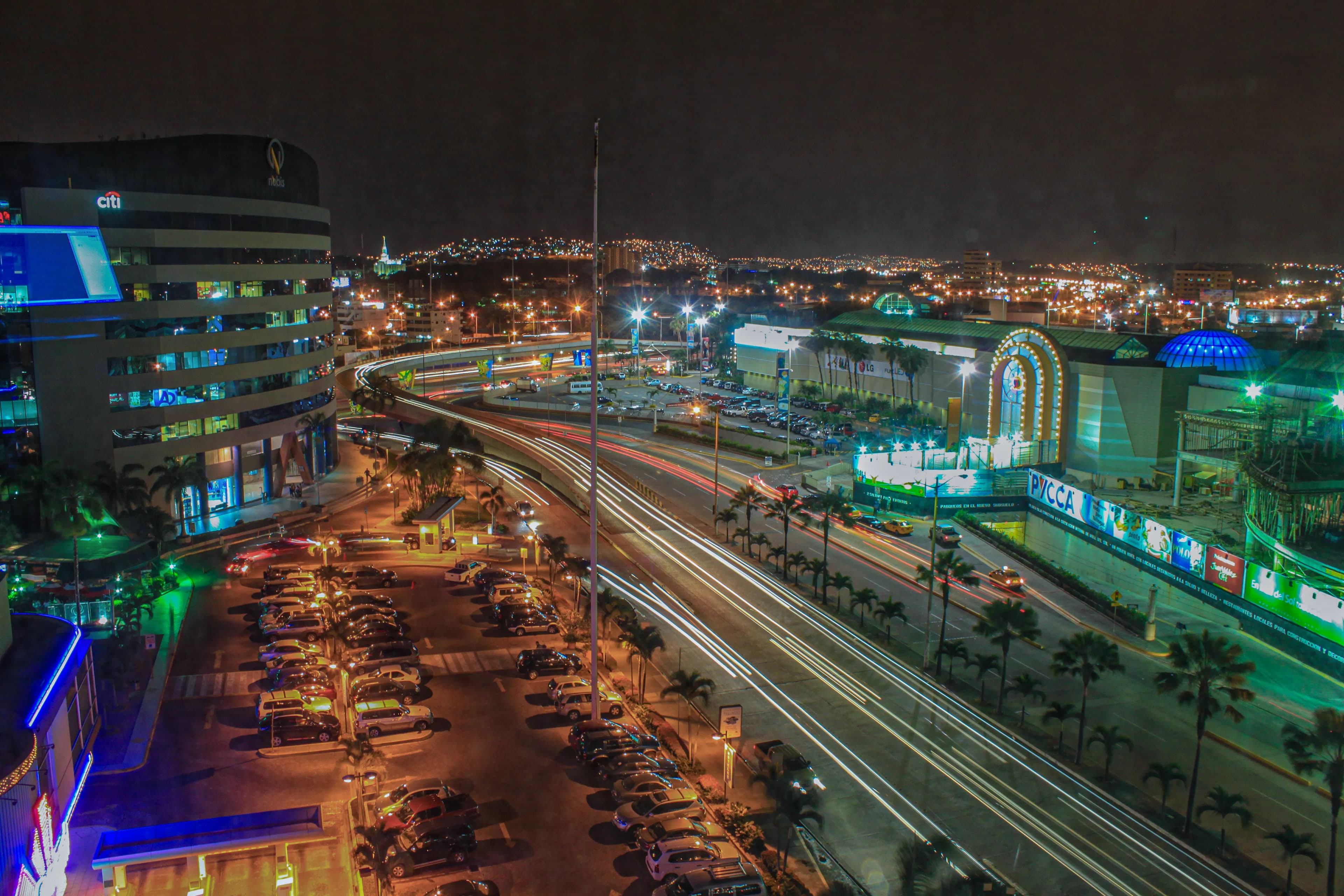
Night traffic moves through Guayaquil, Ecuador, as headlights and taillights trace the curve of a city roadway. Photographed on June 28, 2010, the image is one frame from a larger interval-photography experiment in which a fixed camera repeatedly recorded the movement of traffic through the city after dark.
The Artist
I was in Guayaquil on June 28, 2010, for business.
That evening I was downstairs entertaining customers, but before leaving the room I positioned the camera at the window and aimed it toward the traffic below.
I set it to continue making photographs at intervals of roughly six seconds.
The idea was not simply to make a single nighttime photograph. I wanted a sequence of frames that could later be assembled into a video showing the movement of the traffic and the trails of light created as the vehicles passed through the scene.
So while I was downstairs doing my job, the camera remained upstairs doing its own.
Looking at this single frame years later, I can still see the larger idea behind it.
The city is fixed.
The buildings remain.
The road remains.
But the traffic becomes light, and time becomes visible.
The Curator
Guayaquil in Motion is not simply a nighttime cityscape.
The photograph belongs to a larger experiment in observation and elapsed time.
Colón fixed the camera in position at a window overlooking the traffic below and programmed it to make repeated exposures at intervals of approximately six seconds. The resulting frames were intended to become a moving sequence in which the stationary city would remain constant while vehicles transformed into streams of light.
This frame preserves one moment within that larger process.
The roadway curves through the composition, carrying white and red light trails toward the illuminated urban distance. Buildings, parked vehicles, streetlights, and commercial architecture remain comparatively static while the traffic records the passage of time.
The photographer's physical absence is also significant.
Once the composition and interval sequence had been established, Colón left the camera operating while he returned downstairs to entertain customers.
The camera continued to observe without him.
Story Behind the Photograph
On June 28, 2010, Francisco Colón was in Guayaquil, Ecuador, during a business trip.
Before going downstairs to entertain customers, he positioned his camera at a window overlooking a busy roadway and programmed it to photograph the scene repeatedly at intervals of approximately six seconds.
The purpose was experimental.
Rather than seeking one decisive nighttime exposure, Colón intended to assemble the resulting photographs into a video sequence that would reveal the movement of traffic through trailing headlights and taillights.
While he was away from the camera, vehicles continued to pass through the fixed composition.
Each exposure recorded a slightly different arrangement of movement and light.
Guayaquil in Motion survives as one frame from that larger sequence and as evidence of an early interest in using photography not only to preserve a moment, but also to examine how multiple moments could reveal movement through time.
Reflection
Most photographs depend on the photographer being there at the moment the shutter is released.
This one did not.
I had already chosen the viewpoint, framed the city, and decided how the camera should observe it.
Then I left.
While I was downstairs talking with customers, the camera remained at the window recording the traffic every few seconds.
There is something I like about that now.
The photograph still came from a decision I made, but I was not standing behind the camera when each frame was created.
The city continued moving whether I was watching or not.
The camera simply kept looking.
The Museum
Preserved as the forty-seventh accessioned photograph in the Francisco Colón Studio Photography Wing, Guayaquil in Motion joins the Cities collection as an example of photographic experimentation with time, movement, and automated observation.
Made in Guayaquil, Ecuador, on June 28, 2010, the work originated within a sequence of interval exposures captured from a fixed position overlooking nighttime traffic.
The repeated exposures were intended for assembly into a moving-image experiment in which the changing traffic patterns and resulting light trails would contrast with the stability of the surrounding city.
The photograph therefore occupies an unusual position within Colón's archive.
It records a scene the photographer composed and initiated, but did not continuously witness.
Once the camera was positioned and the interval sequence began, the observation continued independently.
The city moved.
The camera kept watching.
Technical Information
- Camera
- Canon EOS Rebel T1i
- Lens
- Canon EF-S 18–55mm f/3.5–5.6 IS
- Focal Length
- 18 mm
- Capture Date
- June 28, 2010
- Capture Time
- 9:18:33 PM
- Location
- Guayaquil, Guayas Province, Ecuador
- Flash
- Did not fire
- White Balance
- Auto
- Metadata Status
- Original EXIF metadata confirms Canon EOS Rebel T1i, Canon EF-S 18–55mm f/3.5–5.6 IS lens at 18 mm, manual exposure mode, capture on June 28, 2010 at 9:18:33 PM, evaluative metering, auto white balance, and no flash. The approximate six-second interval sequence and intended video use are documented through artist provenance.
- Supporting Documentation
- Original source photograph with preserved EXIF metadata, related interval-sequence frames if preserved, finished digital master, and artist provenance narrative preserved in the Francisco Colón Studio archive.
Collection Record
- Accession Number
- FCS-PH-0047
- Exhibit Number
- 47
- Exhibition
- Cities
- Status
- Permanent Collection
- Original Capture
- June 28, 2010
- Studio Acquisition
- Francisco Colón Studio Photography Wing
- Artist
- Francisco Colón
- Copyright
- © Francisco Colón. All Rights Reserved.