FCS-PH-0090
Photography Wing · Exhibit No. 90
I Disturbed His Sleep
A brief exchange of awareness on a Mexico City night.
I Disturbed His Sleep
FCS-PH-0090
Permanent Collection
Mexico City, Mexico
December 22, 2018
About the Work
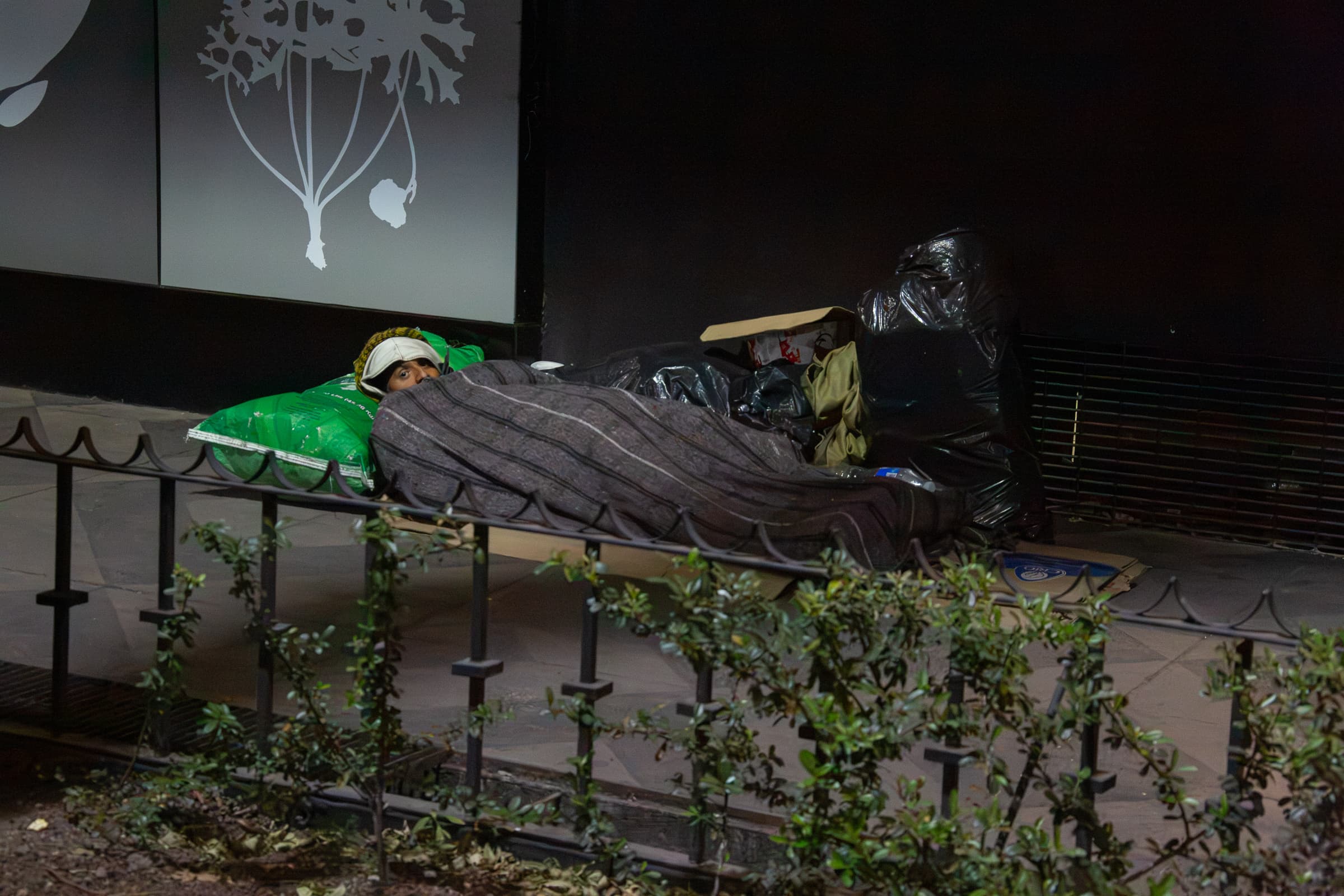
While walking through Mexico City late at night, Francisco Colón encountered an area where several people were sleeping along a wall. As he photographed one man surrounded by his belongings, the man opened his eyes and briefly looked directly toward the camera. Moments later, he covered his face and returned to sleep. Colón never learned his name or circumstances and never saw him again. The photograph preserves only what was witnessed: a stranger, a temporary place to sleep, and a brief moment of awareness between the person being photographed and the person behind the camera.
The Artist
I was walking through Mexico City late at night when I noticed an area where a number of people were sleeping along a wall.
I wanted to document what I was seeing.
This man was lying there beneath a blanket with his belongings gathered around him. His eyes appeared to be closed when I raised the camera.
Then he saw me.
It happened very quickly. I made the photograph before he covered his face, and then he went right back to sleep.
I remember feeling embarrassed afterward.
I had entered his space.
It was a strange realization because his space was outdoors, in a public place, but at that moment it was also where he was sleeping. It was his space for the night, and my camera had disturbed it.
There was another reason the scene stayed with me.
At one point in my own life, I had come very close to homelessness. I knew how easily circumstances could have taken me somewhere very different.
But I don't know this man's circumstances.
I don't know his name. I don't know how he arrived there. I don't know how long he had been sleeping there or what happened to him afterward.
I never saw him again.
That matters to me because I don't want the photograph to pretend that I know his story.
All I know is what happened during those few seconds.
I saw him.
He saw me.
I disturbed his sleep.
The Curator
I Disturbed His Sleep is organized around physical and psychological distance.
The unidentified man occupies the middle portion of the frame, lying horizontally beneath a striped blanket and surrounded by the belongings gathered around his temporary sleeping place. His face occupies only a very small portion of the composition, yet his visible eyes become its principal point of human contact.
A metal railing and vegetation extend across the foreground, establishing a literal boundary between photographer and subject. Rather than being treated as visual obstruction, these elements reinforce the separation between the observer and the space being observed.
Behind the man, a large field of darkness absorbs much of the surrounding environment. Black bags and other possessions partially disappear into it, while an illuminated decorative panel in the upper left introduces an ordered architectural element above the improvised sleeping area.
The photograph does not visually monumentalize its subject. The man remains relatively small within his surroundings, requiring the viewer to discover his gaze rather than immediately encounter a conventional portrait.
Once discovered, however, the eyes alter the photograph. Observation becomes reciprocal. The person being photographed is no longer merely someone being watched; for an instant, he is looking back.
Story Behind the Photograph
Francisco Colón made this photograph in Mexico City during the early morning hours of December 22, 2018.
While walking through the city at night, Colón noticed an area where a number of people were sleeping along a wall. He began photographing what he encountered as part of his continuing documentation of everyday urban life.
One man was lying beneath a blanket with personal belongings gathered around him. Colón recalls that the man's eyes appeared closed when he initially raised the camera.
During the encounter, the man became aware of the photographer and looked toward him. Colón made the photograph during that brief moment of awareness. The man subsequently covered his face and returned to sleep.
Colón did not speak with him, did not learn his name, and never encountered him again.
The Studio therefore does not assign a biography, cause, duration, or specific circumstances to the man's apparent homelessness. Those facts are unknown.
What survives is a single documented encounter and the photographer's recollection of his reaction to it: an awareness that in attempting to document homelessness, he had also interrupted someone's place of rest.
That discomfort became part of the meaning of the photograph.
Reflection
Photography often depends upon permission that is never formally requested.
Street photography makes that tension especially visible. The camera enters spaces that may be legally public while remaining emotionally private.
A sidewalk can become a bedroom.
A blanket can become a wall.
A railing can become a boundary between one person's passage through the city and another person's temporary place within it.
The most consequential detail in this photograph may therefore be the smallest one: the eyes.
For an instant, the direction of observation reverses.
The photographer who had been looking becomes someone who is also being seen.
That exchange does not tell us who this man was. It does not explain why he was there, and it does not give us permission to construct a life for him from a fraction of a second.
Instead, it leaves us with the limits of what a photograph can know.
Sometimes respecting another person's story begins by acknowledging how little of it we actually possess.
The Museum
I Disturbed His Sleep is preserved within the Francisco Colón Studio Photography Wing as a work examining observation, human vulnerability, personal boundaries, and the ethical complexity of photographing strangers in public space.
The unidentified man depicted in the photograph has not been identified by the Studio. No attempt is made within the archival record to infer his background, history, or the circumstances that resulted in his sleeping outdoors.
The designation of homelessness within the work derives from Colón's eyewitness account of encountering multiple people sleeping along the location and from the visible circumstances documented in the photograph. It should not be interpreted as a complete description of the subject's life or circumstances.
The photograph also occupies an important position within Colón's observational work because it records a moment in which the act of photographing itself became part of the artist's memory of the event.
Colón's recollection of having once been personally close to homelessness is preserved as artist provenance explaining why the encounter carried particular resonance for him. It is not presented as evidence concerning the unidentified man's experience.
The original nighttime atmosphere, environmental separation, visible belongings, railing, vegetation, and limited illumination have been retained. Development of the RAW image was deliberately restrained so that the subject would not be artificially isolated or transformed into a conventional portrait.
Within the collection, the work serves as both social observation and self-examination: a record not only of someone Colón encountered, but of the moment when the photographer became conscious of his own presence within the encounter.
Technical Information
- Camera
- Canon EOS 5D Mark III
- Lens
- Canon EF28-300mm f/3.5-5.6L IS USM
- Focal Length
- 80 mm
- Capture Date
- December 22, 2018
- Capture Time
- 1:47:15 AM (camera-recorded time)
- Location
- Mexico City, Mexico
- Flash
- Did not fire
- Metadata Status
- Original RAW metadata preserved. ISO 25600; 80 mm; 1/60 sec at f/9; 0 EV exposure bias; Manual exposure program; Spot metering; flash did not fire. Original dimensions 5760 × 3840 pixels. The very high ISO reflects the extremely limited available light under which the photograph was made. Final interpretation developed in Adobe Lightroom Classic with restrained tonal recovery intended to preserve the original nighttime atmosphere.
Collection Record
- Accession Number
- FCS-PH-0090
- Exhibit Number
- 90
- Exhibition
- Photography Wing
- Status
- Permanent Collection
- Studio Acquisition
- Francisco Colón Studio Photography Wing
- Artist
- Francisco Colón
- Copyright
- © Francisco Colón. All Rights Reserved.