FCS-PH-0046
Photography Wing · Exhibit No. 46
Into Mindo
What waits at the top remains unseen.
Into Mindo
FCS-PH-0046
Permanent Collection
Mindo, Pichincha Province, Ecuador
June 26, 2010
About the Work
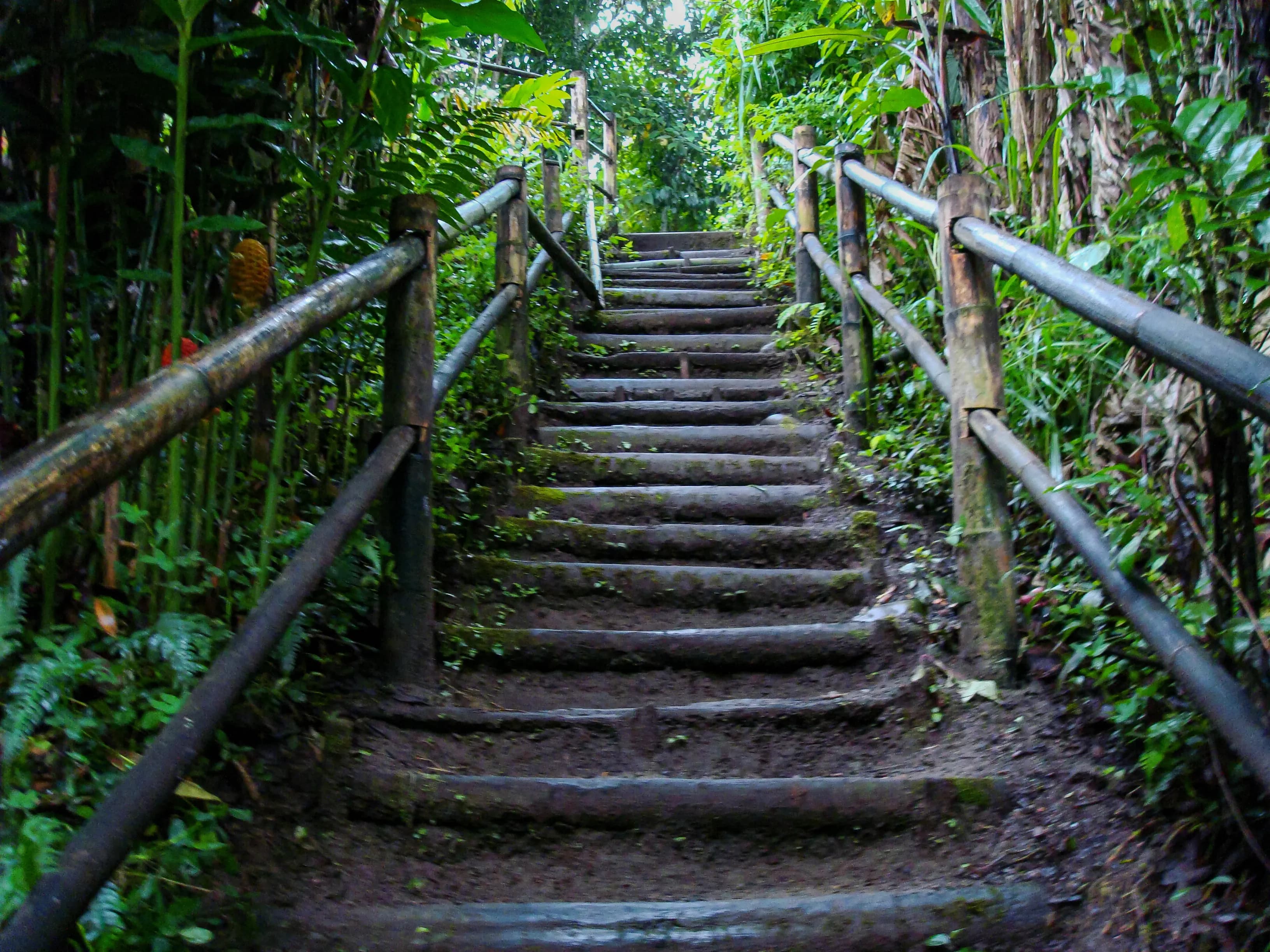
A wooden staircase climbs through dense tropical vegetation in Mindo, Ecuador, disappearing toward an opening just beyond view. Photographed on June 26, 2010, the image records an ordinary passage through the landscape while withholding its destination. The rails lead upward and the steps invite the eye to follow, but whatever waits at the top remains unseen.
The Artist
While staying in Quito in June 2010, I had a free weekend and decided to spend it exploring with my camera.
On June 26, I traveled to Mindo.
What struck me immediately was the contrast. The landscape I had experienced around Quito seemed dry and almost desert-like to me. Mindo felt completely different. It was dense, tropical, green, and filled with butterflies.
I photographed this staircase as it climbed through the vegetation.
Years later, what draws me back to the photograph is remarkably simple.
I don't know what is at the top of the stairs.
The wooden rails enter from opposite sides of the frame and lead upward. The steps continue through the vegetation, but the destination remains hidden.
I know that I climbed those stairs.
I know that somewhere beyond the photograph there was an answer.
But the photograph does not give it to me.
Perhaps that is why I still want to follow it.
The Curator
Into Mindo is built around a destination the photograph refuses to reveal.
Two wooden rails enter from the lower edges of the frame and converge toward a staircase ascending through dense vegetation. Light increases toward the upper portion of the image, encouraging the eye to follow the same path a person would physically travel.
Yet the staircase disappears before its destination becomes visible.
That withholding is central to the photograph.
Across Francisco Colón's archive, passages, stairways, arches, corridors, windows, and openings appear repeatedly. They frequently function not simply as architectural subjects, but as invitations to look beyond the immediate frame.
Into Mindo provides an early example of that recurring visual tendency.
The photograph does not document what was found at the top of the stairs.
It preserves the desire to find out.
Story Behind the Photograph
On June 26, 2010, Francisco Colón traveled from Quito to Mindo while spending a free weekend exploring Ecuador.
The day's photography began with an unexpected limitation. Colón had brought his Canon EOS Rebel T1i on the trip, but its battery had been left charging at the hotel that morning. Rather than abandon the day's photography, he used the Sony DSC-W90 compact camera he had with him.
Mindo presented a dramatic visual contrast to the landscape he had been experiencing around Quito. Dense tropical vegetation and butterflies replaced the comparatively dry highland environment he had left behind.
As he moved through Mindo, Colón repeatedly turned his camera toward the paths and stairways carrying him through the landscape.
Into Mindo emerged from that movement.
The limitation of the equipment became incidental.
The camera changed. The photographer kept looking.
Reflection
I remember being surprised by Mindo.
I had not traveled very far, yet the landscape seemed to have changed completely.
Everything felt greener, denser, and more alive.
But years later, this photograph does not hold me because of the vegetation.
It holds me because I cannot see where the stairs end.
There is enough information to make me follow them.
Not enough to tell me what I will find.
Maybe some photographs remain with us because they preserve what we saw.
Others remain because they preserve what we still want to know.
The Museum
Preserved as the forty-sixth accessioned photograph in the Francisco Colón Studio Photography Wing, Into Mindo joins the Journeys collection as an early expression of a recurring visual language within the artist's archive.
Stairways, passages, corridors, arches, windows, and other transitional spaces repeatedly appear in Colón's photography. Rather than functioning solely as architectural subjects, these structures often direct attention toward something beyond the immediate viewpoint.
In Into Mindo, that destination remains unavailable to the viewer.
The photograph also preserves an element of photographic improvisation. Although Colón had intended to photograph the day's journey with his Canon EOS Rebel T1i, its battery remained charging at his hotel in Quito. The photograph was therefore made with the Sony DSC-W90 compact camera he carried with him.
Sixteen years later, the technical limitation has become secondary to what the photograph reveals about the photographer's way of seeing.
The camera changed.
The photographer kept looking.
Technical Information
- Camera
- Sony DSC-W90
- Capture Date
- June 26, 2010
- Location
- Mindo, Pichincha Province, Ecuador
- Route
- Quito → Mindo
- Metadata Status
- Capture date, location, camera body, and circumstances of capture confirmed through image metadata and artist provenance. Additional exposure and focal-length metadata require verification from the original source file.
- Supporting Documentation
- Original source photograph, finished digital master, image metadata, and artist provenance narrative preserved in the Francisco Colón Studio archive.
Collection Record
- Accession Number
- FCS-PH-0046
- Exhibit Number
- 46
- Exhibition
- Nature
- Status
- Permanent Collection
- Original Capture
- June 26, 2010
- Studio Acquisition
- Francisco Colón Studio Photography Wing
- Artist
- Francisco Colón
- Copyright
- © Francisco Colón. All Rights Reserved.