FCS-PH-0042
Photography Wing · Exhibit No. 42
Into the Memorial
Architecture, movement, and light within the 9/11 Memorial & Museum.
Into the Memorial
FCS-PH-0042
Permanent Collection
National September 11 Memorial & Museum, Lower Manhattan, New York City
Saturday, September 5, 2015
Available as a Fine Art Print
Acquire a Print ↗About the Work
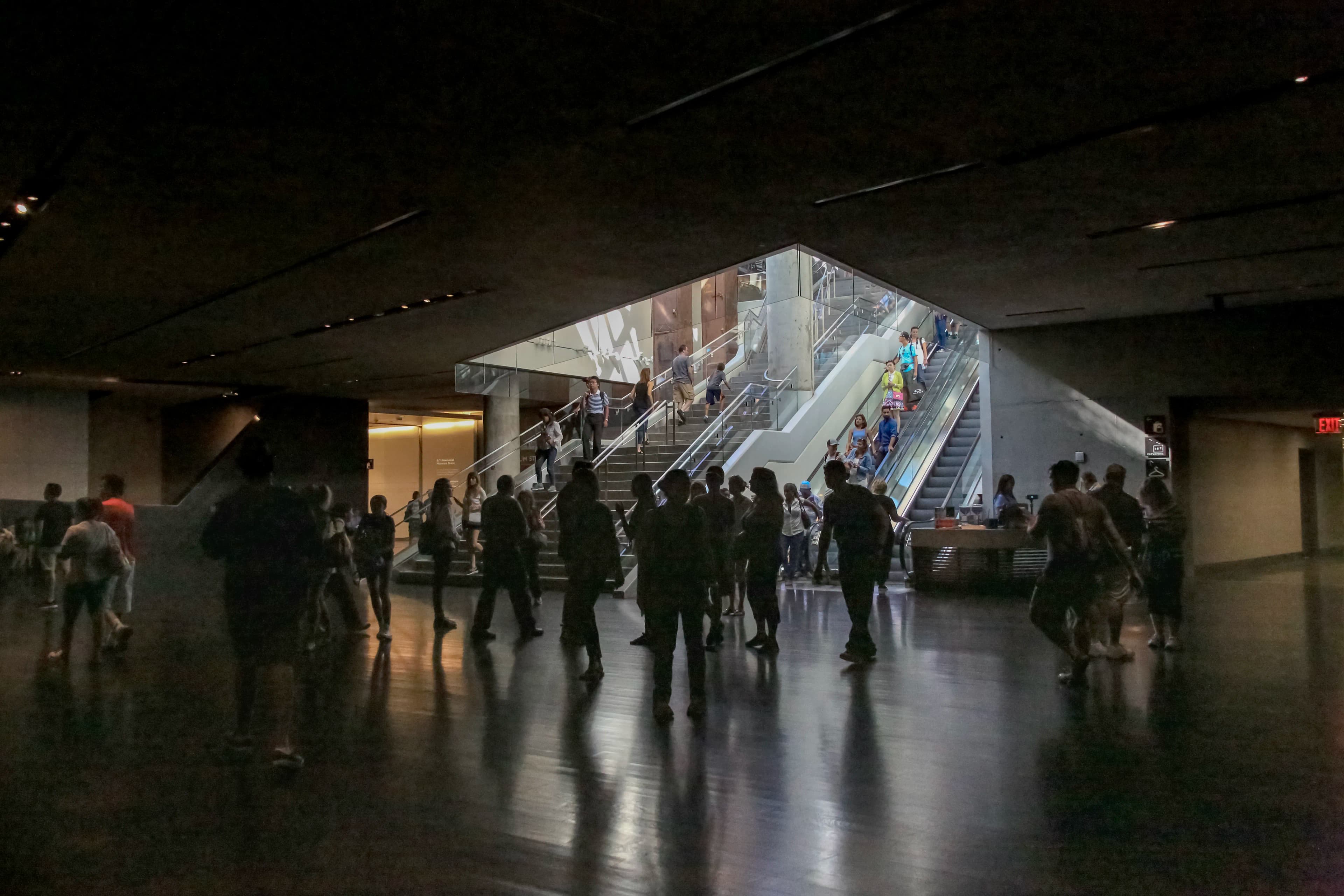
Visitors move through the interior of the 9/11 Memorial & Museum in New York City, where monumental concrete planes frame an illuminated network of stairs and escalators. Silhouetted figures and their reflections cross the dark foreground while the architecture draws the eye toward the brighter interior beyond. The photograph captures the scale, geometry, light, and human movement within the museum space.
The Artist
I made this photograph on September 5, 2015, inside the 9/11 Memorial & Museum while visiting New York City.
I no longer remember the exact moment that caused me to make this particular exposure.
What remains is the photograph.
Looking at it now, what strikes me most is the architecture.
The enormous dark concrete planes seem to close around the space while the illuminated stairs and escalators open toward the center.
People move through the foreground almost as silhouettes.
Others climb and descend within the brighter structure beyond them.
The polished floor carries their reflections back toward the camera.
I did not need to arrange anything.
The architecture, the light, and the movement of the visitors were already creating the composition.
Years later, the photograph allows me to see something I may not have consciously understood when I pressed the shutter: how strongly the building itself shapes the experience of moving through the memorial.
The Curator
Into the Memorial examines the relationship between monumental architecture and human scale within the National September 11 Memorial & Museum.
Created on September 5, 2015, the composition is dominated by massive dark architectural planes that converge around a brightly illuminated central opening.
Within that opening, stairs, escalators, glass, concrete, and moving visitors form a dense network of vertical and diagonal lines.
The foreground remains intentionally dark.
Visitors appear largely in silhouette, while reflections on the polished floor extend their presence through the lower portion of the image.
Rather than isolating individual people, the photograph allows them to function collectively as measures of scale.
Their relatively small forms emphasize the size and weight of the surrounding architecture.
The resulting image is less a portrait of individual visitors than an observation of how people move through a space specifically designed to carry historical memory.
Story Behind the Photograph
On Saturday, September 5, 2015, Francisco Colón photographed the interior of the National September 11 Memorial & Museum in New York City.
As he moved through the museum, he became interested in the contrast between those arriving into the space and those who were already there.
The photograph was made with that distinction consciously in mind.
In the darker foreground, visitors enter and move toward the interior. Beyond them, other visitors already occupy the illuminated stairs, escalators, and surrounding spaces of the museum.
Colón chose to work without flash.
This was not simply a technical decision. He did not want the act of making a photograph to disturb what he perceived as a oneness of purpose among the people who had come to this particular place.
The available light therefore became part of the photograph itself.
The arriving visitors remain largely in shadow, while those farther within the museum appear against the brighter architecture. The monumental concrete planes surround both groups, connecting people at different stages of their movement through the same space.
No individual visitor's thoughts or emotions can be known from the photograph. What Colón observed instead was something collective: people arriving, people already present, and a shared recognition of the importance of the place they had entered.
The photograph preserves that contrast without interrupting it.
Rather than introducing additional light into the scene, Colón allowed the existing darkness, illumination, architecture, and movement of the visitors to describe the experience.
The result became Into the Memorial.
Reflection
This is a place built from loss.
People come here for different reasons.
Some come to learn.
Some come to understand what happened.
Some come to share the experience with someone else.
Some come to mourn.
And some simply come to pay tribute.
I am not a religious person, yet there is something about this place that feels almost holy to me.
Not holiness in a religious sense.
It is quieter than that.
There is a peacefulness created by the understanding that the ground beneath us carries the memory of what happened here.
The stones are still here.
The remains of what once stood here have not disappeared simply because something new has been built around them.
They are part of the place.
Perhaps that is what I felt while walking through the memorial.
Around me were strangers whose stories I did not know, yet for a little while we seemed united by the reason we had entered.
To learn.
To remember.
To mourn.
To pay tribute.
There was no need to speak to one another.
There was a kind of oneness in simply being there.
I did not want my camera to disturb that.
I wanted to photograph the place while allowing the place to remain what it was.
A memorial.
A place where history is not somewhere in the past.
It is beneath your feet.
It surrounds you.
And for a little while, you become quiet enough to listen.
The Museum
Within the Francisco Colón Studio Photography Wing, Into the Memorial is retained as part of the archive as evidence of the photographer’s recurring way of seeing. Its importance is therefore not measured only by subject matter or visual appeal. The work helps establish a recurring Studio principle: personal history can be preserved with emotional depth while the archive remains disciplined about the difference between what the photograph shows, what the artist remembers, and what later interpretation can responsibly infer.
Technical Information
- Camera
- Canon EOS 5D Mark III
- Lens
- Canon EF 28-135mm
- Focal Length
- 28mm
- Capture Date
- Saturday, September 5, 2015
- Location
- National September 11 Memorial & Museum, Lower Manhattan, New York City
- Metadata Status
- Capture date, camera metadata, National September 11 Memorial & Museum location, and artist provenance preserved. Camera metadata confirms ISO 12800, 28mm, f/5.6, and 1/1000 sec. Exact capture time requires verification from the original source file.
- Supporting Documentation
- Original source photograph, edited master, Adobe Camera Raw development record, and artist provenance narrative preserved in the Francisco Colón Studio archive.
Collection Record
- Accession Number
- FCS-PH-0042
- Exhibit Number
- 42
- Exhibition
- Cities
- Status
- Permanent Collection
- Original Capture
- September 5, 2015
- Studio Acquisition
- Francisco Colón Studio Photography Wing
- Artist
- Francisco Colón
- Copyright
- © Francisco Colón. All Rights Reserved.