FCS-PH-0045
Photography Wing · Exhibit No. 45
Life Inside the Caldera
An enormous volcanic landscape that is also somebody's home.
Life Inside the Caldera
FCS-PH-0045
Permanent Collection
Pululahua Geobotanical Reserve, Pichincha Province, Ecuador
June 26, 2010
About the Work
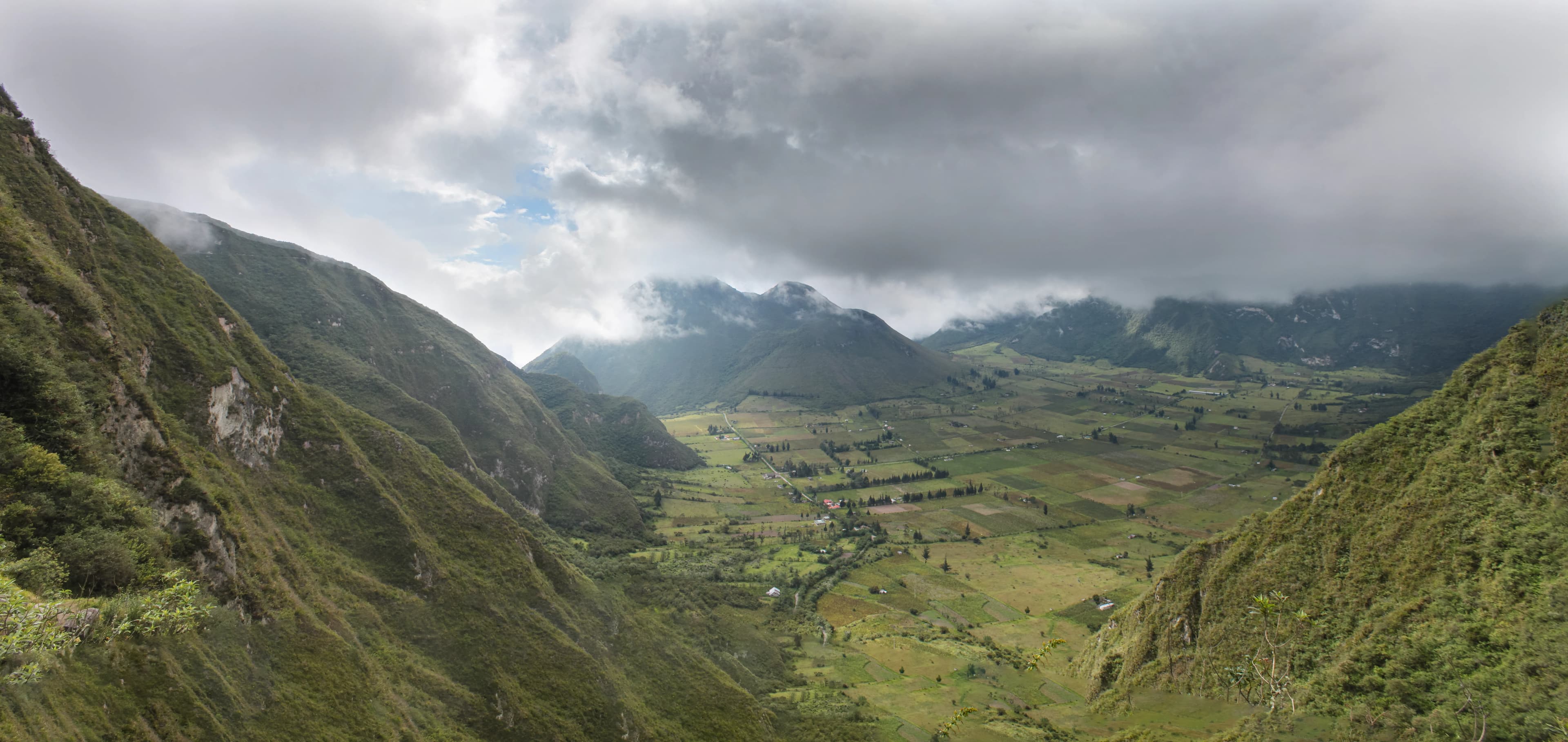
Clouds descend across the steep walls of the Pululahua volcanic caldera in Ecuador while patches of sunlight reveal farms, roads, homes, and cultivated fields across the valley floor. The panoramic photograph contrasts the immense scale of the volcanic landscape with the quiet evidence of everyday human life continuing within it.
The Artist
I was in Quito in June 2010 and stayed through the weekend. With no business obligations for the day, I decided to spend the time with my camera.
My taxi driver took me to Pululahua for lunch. I had not gone there specifically intending to make this photograph. I simply arrived at a place that immediately made me want to stop and look.
Below me was an enormous volcanic caldera. Its steep green walls disappeared into clouds, while farms, roads, homes, and individual fields spread across the floor below. Light moved through openings in the clouds and illuminated portions of the landscape while other areas remained in shadow.
I photographed what I was seeing as a panorama using bracketed exposures because a single exposure could not hold the range of light across the scene.
Sixteen years later, while returning to the original photographs, I reconstructed the panorama from three separately stitched bracketed versions and blended their exposures by hand.
What continues to hold my attention is not simply the size of Pululahua.
It is the discovery that inside this enormous volcanic landscape, people are living ordinary lives.
What first appears to be wilderness is also somebody's home.
The Curator
Life Inside the Caldera examines scale through observation.
The photograph initially presents Pululahua as an immense natural formation: steep volcanic walls, shifting clouds, mist, and changing light. Only after the eye moves deeper into the image do roads, agricultural fields, buildings, and cultivated boundaries reveal another dimension of the landscape.
Human presence is not dominant. It is discovered.
This relationship between the monumental and the ordinary is characteristic of Francisco Colón's observational approach. The camera records the remarkable landscape, but attention eventually settles on the quieter evidence of people living within it.
The work also reflects the circumstances under which many of Colón's photographs were made. A free weekend during a business trip became an opportunity to explore with a camera, allowing an unexpected destination to become part of the visual record.
Story Behind the Photograph
On June 26, 2010, Francisco Colón was staying in Quito, Ecuador, and remained in the city through the weekend.
He chose to spend the day exploring with his camera. A local taxi driver took him to Pululahua for lunch, bringing him to an overlook above the volcanic caldera.
The landscape immediately attracted his attention.
Because of the extreme difference between the bright clouds and the shadowed mountains and valley, Colón photographed the scene using bracketed exposures across a multi-frame panorama.
The bracketed sequences were originally stitched separately, producing three panoramic images with slightly different dimensions and geometry.
When the photograph was revisited in 2026, the three panoramas could not be automatically registered. Colón manually aligned them using a fixed structure within the caldera as a reference point, then selectively blended the darker exposure for cloud detail and the brighter exposure for information within the shadows.
The reconstruction preserved the atmospheric character of the original scene rather than pursuing a conventional HDR appearance.
The finished photograph therefore represents two moments of observation: the afternoon in 2010 when the landscape first demanded the camera's attention, and the return to the image sixteen years later when its full visual record was finally reconstructed.
Reflection
Sometimes we understand why we made a photograph immediately.
Sometimes the explanation arrives years later.
I did not travel to Pululahua that morning with a photograph already in mind. I was simply spending a free day with my camera when a taxi driver brought me somewhere for lunch.
Then I saw this.
The mountains were enormous. Clouds moved through them. Light appeared and disappeared across the valley.
But when I look more closely now, what stays with me are the smaller things.
The fields. The roads. The houses.
Life continuing inside something ancient and immense.
In 2010, I did not have a name for the way I photographed.
I only knew when something made me look.
The camera apparently understood the rest.
The Museum
Preserved as the forty-fifth accessioned photograph in the Francisco Colón Studio Photography Wing, Life Inside the Caldera joins the Nature collection as both landscape and record of observation.
The work documents the Pululahua volcanic caldera in Ecuador while directing attention toward the relationship between geological scale and everyday human habitation.
Its technical history is also preserved as part of the work. Multiple bracketed panoramic sequences made in 2010 were manually reconstructed and exposure-blended in 2026 after independent panorama stitching produced incompatible geometries.
The finished image retains the natural differences between illuminated farmland, shadowed volcanic walls, mist, and cloud rather than equalizing those elements through an exaggerated HDR treatment.
Within the broader Photography Wing, the photograph provides early evidence of a visual tendency that would become increasingly visible across Colón's archive: attention not only to destinations, but to what unexpectedly reveals itself while moving through the world.
Technical Information
- Camera
- Canon EOS Rebel T1i
- Lens
- 18–55mm zoom lens
- Focal Length
- 18 mm
- Capture Date
- June 26, 2010
- Location
- Pululahua Geobotanical Reserve, Pichincha Province, Ecuador
- Route
- Quito → Pululahua
- Metadata Status
- Camera body confirmed by artist provenance. Visible image metadata records ISO 100, 18 mm, f/10, and 1/250 sec. Exact lens model, capture time, flash status, and white balance require verification.
- Supporting Documentation
- Original bracketed source photographs, three independently stitched panoramic exposures, reconstructed layered Photoshop master, and artist provenance narrative preserved in the Francisco Colón Studio archive.
Collection Record
- Accession Number
- FCS-PH-0045
- Exhibit Number
- 45
- Exhibition
- Nature
- Status
- Permanent Collection
- Original Capture
- June 26, 2010
- Studio Acquisition
- Francisco Colón Studio Photography Wing
- Artist
- Francisco Colón
- Copyright
- © Francisco Colón. All Rights Reserved.