FCS-PH-0135
Photography Wing · Exhibit No. 135
On This Side of the Glass
The glass was the barrier then. Time is the barrier now.
On This Side of the Glass
FCS-PH-0135
Permanent Collection
August 9, 2015
Available as a Fine Art Print
Acquire a Print ↗About the Work
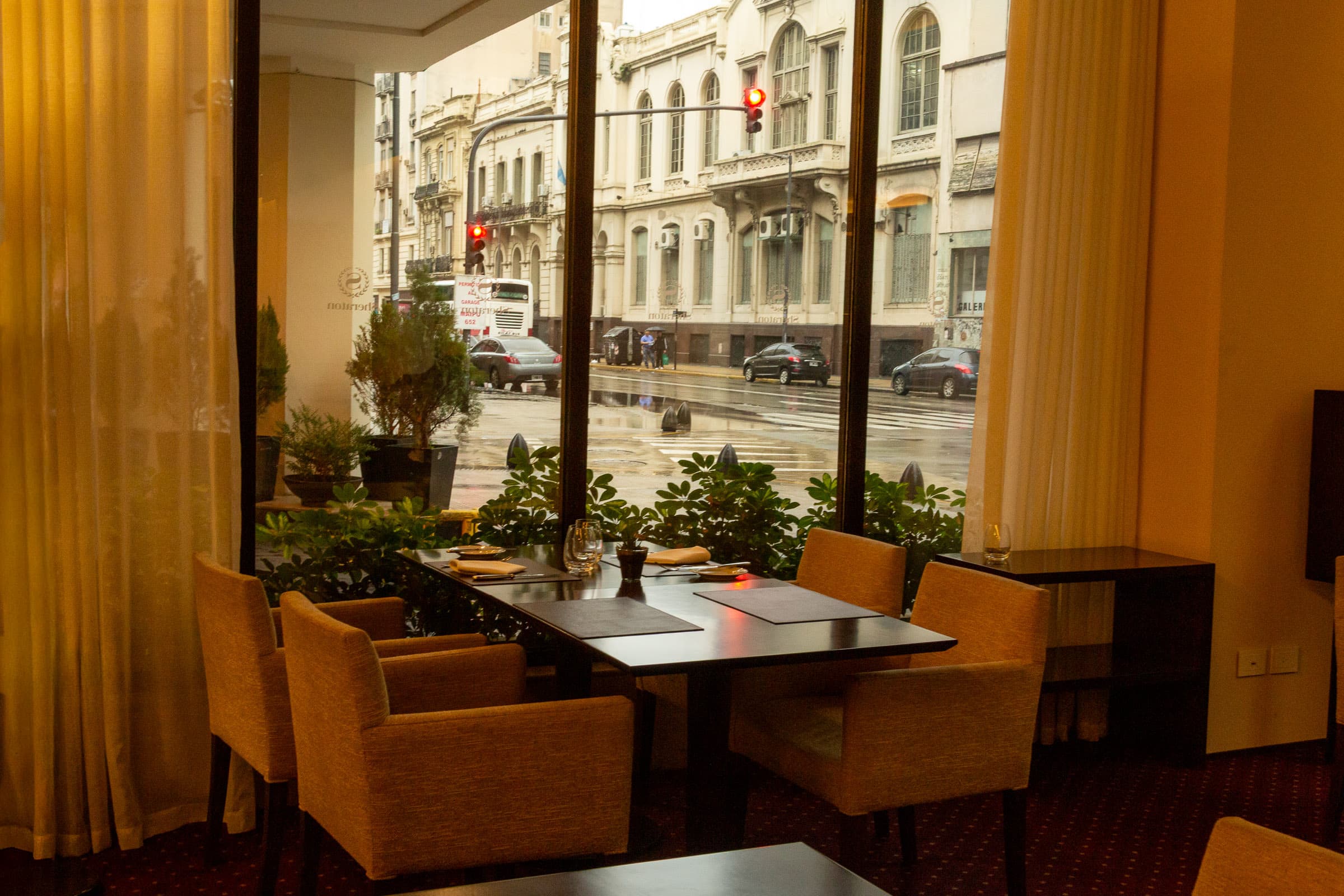
From the warm interior of a hotel in Buenos Aires, Francisco Colón looks through a wall of glass toward a rain-soaked city street. Tables, upholstered chairs, curtains, and amber light occupy one side of the window, while wet pavement, traffic, pedestrians, architecture, and red traffic signals occupy the other. The glass allows both environments to exist within the same view while keeping them physically apart. Years later, the photograph acquired another dimension for Colón. The glass remains the visible barrier within the image, but time has become the barrier between the photographer and the familiar room he now wishes he could occupy again.
The Artist
I remember this part of the hotel.
When I traveled to Buenos Aires, there were two Sheraton hotels where I would stay depending on availability. I preferred this one because it was closer to the areas where I normally liked to walk.
This section of the lobby was adjacent to the restaurant. Sometimes I would come downstairs and have a cup of coffee. Other times it might be a glass of wine.
I remember the atmosphere.
The street outside could be busy. It could be raining, as it was here, or the weather could be completely different. But inside, the character of the room remained remarkably consistent.
There was warmth in the colors, the curtains, the chairs, the tables, and the light.
In this photograph, the glass creates a clear division between two environments.
Outside is wet, cooler, and exposed to the weather. Cars move along the street. Pedestrians continue through the rain. Traffic lights punctuate the view.
Inside is dry, warm, quiet, and sheltered.
The glass separates the two, but it also allows both worlds to occupy the same photograph.
That contrast is what gives the image its structure: two environments existing only inches apart, each visible from the other side.
The Curator
On This Side of the Glass is constructed around a physical boundary.
A broad wall of windows divides the composition into two distinct environments. The interior is dominated by warm amber tones, upholstered furniture, curtains, prepared tables, and controlled light. Beyond the glass, the palette becomes cooler and more restrained as rain, wet pavement, traffic, pedestrians, and architecture establish the conditions of the city outside.
The photograph does not require either environment to dominate the other. Its visual tension comes from their coexistence.
The window mullions make the boundary explicit, while reflections across the glass prevent the exterior from reading as a separate image. The viewer remains conscious of standing inside and looking outward.
Two red traffic signals provide small but significant points of continuity across the composition. Their color belongs naturally to the warmer palette of the interior even though the signals physically exist outside it. A small red reflection reaching the tabletop further complicates the division between the two spaces.
The photograph therefore depends upon both separation and connection.
Its later significance introduces another boundary that cannot be photographed directly. The physical separation represented by glass remains fixed within the image, while the passage of time changes the position from which the photographer encounters the scene.
Reflection
When I look at this photograph now, I find myself wishing I were there.
It doesn't really matter whether it was raining that day or whether the sun might have been shining on another visit.
What I miss is being in that space.
I remember coming downstairs. I remember the restaurant beside the lobby. I remember sitting there for a cup of coffee or perhaps a glass of wine.
I remember the atmosphere and the familiarity of the room.
When I was there, I was on this side of the glass.
I could sit inside the warmth of the hotel and look through the windows at Buenos Aires. The glass was the barrier between where I was and the weather, traffic, and movement outside.
Looking at the photograph now, something has reversed.
I am no longer sitting inside that room looking out through the glass.
I am somewhere else, looking into the photograph at the room.
And I wish I were there.
The barrier now is time.
That realization changes the way I experience the photograph. If I could somehow cross that barrier and return to this room, I would once again find myself on the other side of the original barrier—sitting inside and looking out through the glass.
The glass separated me from the weather.
Time separates me from the moment.
The photograph sits somewhere between the two.
It allows me to see the chairs, the tables, the curtains, the rainy street, and the traffic lights. It brings back the familiarity of being there.
But I cannot step through it.
Perhaps that is one of the things photography eventually teaches us.
When we make a photograph, we preserve what is in front of us.
Years later, we may discover that we also preserved a place from which time would eventually separate us.
When I was there, I looked through the glass at Buenos Aires.
Now I look through the photograph, wishing I could look out through that glass again.
The Museum
Preserved as the one hundred thirty-fifth accessioned photograph in the Francisco Colón Studio Photography Wing, On This Side of the Glass was made in Buenos Aires, Argentina, on August 9, 2015.
The photograph records the relationship between the warm interior of a familiar hotel space and the rain-soaked city immediately beyond its windows.
For Colón, the location was part of repeated travel to Buenos Aires. The hotel provided convenient access to areas of the city he enjoyed exploring on foot, while this particular lobby and restaurant area became a familiar place to stop for coffee, a glass of wine, or simply time indoors.
Within the photograph, glass provides the physical boundary between two simultaneous environments: shelter and weather, interior and exterior, stillness and movement.
Viewed years later, the work has acquired an additional relationship to distance.
The photographer who once occupied the interior and looked outward now encounters that same room through the photograph. The visible barrier remains glass; the invisible barrier has become time.
The work therefore occupies the Reflections collection not simply because it contains a remembered place, but because the act of returning to the photograph has changed the photographer's relationship to the moment it preserves.
Photography holds the appearance of the room unchanged.
The person returning to it continues to change.
Technical Information
- Camera
- Canon EOS 5D Mark III
- Lens
- Canon EF 28-135mm f/3.5-5.6 IS USM
- Focal Length
- 44 mm
- Capture Date
- August 9, 2015
- Flash
- Did not fire
Collection Record
- Accession Number
- FCS-PH-0135
- Exhibit Number
- 135
- Exhibition
- Reflections
- Status
- Permanent Collection
- Original Capture
- August 9, 2015
- Studio Acquisition
- Francisco Colón Studio Photography Wing
- Artist
- Francisco Colón
- Copyright
- © Francisco Colón. All Rights Reserved.