FCS-PH-0060
Photography Wing · Exhibit No. 60
Small Against the Night
A small presence discovered during a long walk across London.
Small Against the Night
FCS-PH-0060
Permanent Collection
Chelsea, London, United Kingdom
Friday, April 4, 2014
About the Work
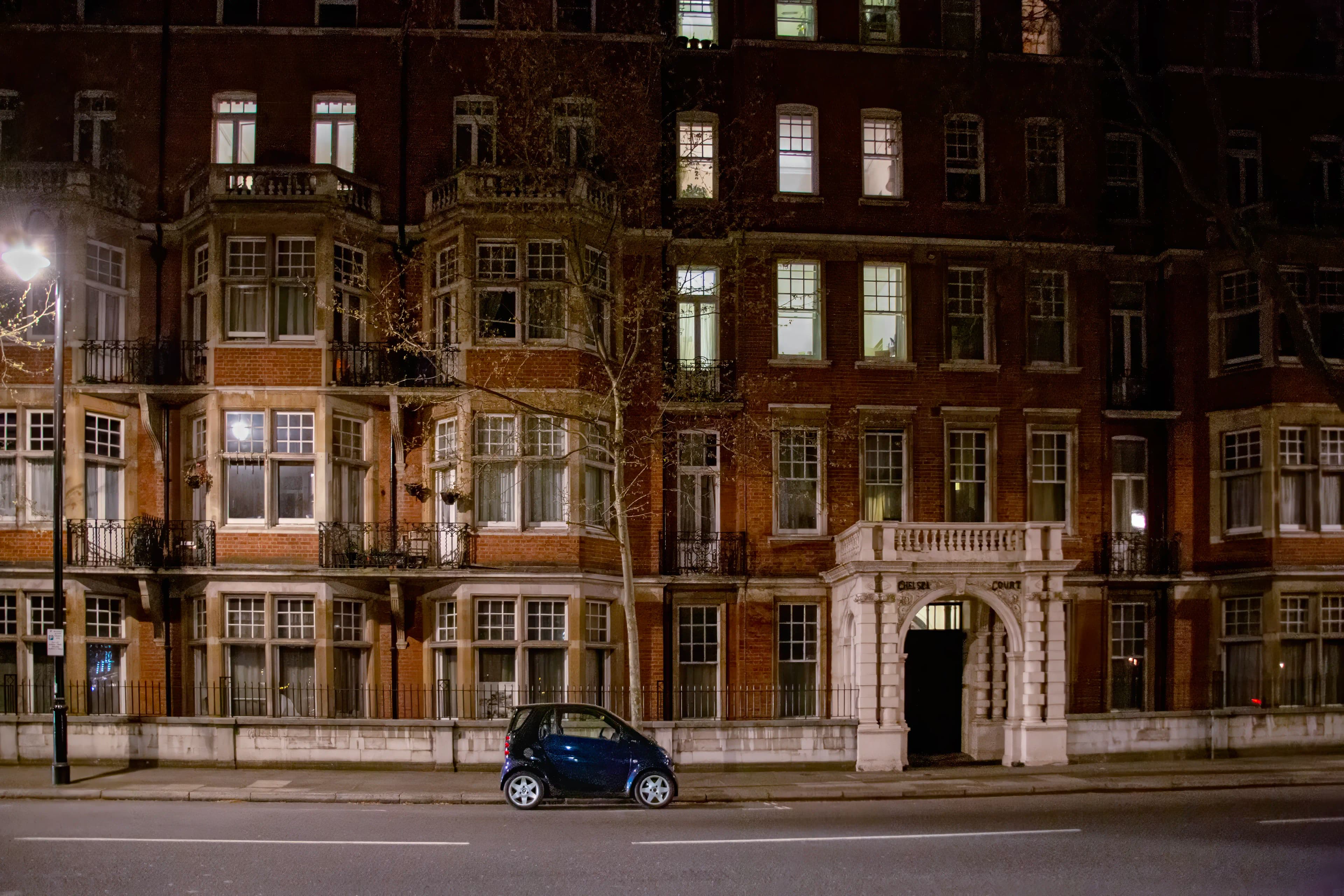
A solitary compact car rests beneath the towering façade of a residential building in Chelsea, London. Rows of windows and scattered interior lights emphasize the immense scale of the architecture, making the little vehicle appear almost toy-like beneath it. Discovered during a long walk from Hammersmith toward the Tower of London, the ordinary nighttime scene became a quiet study of scale, solitude, and urban stillness.
The Artist
I created this photograph during a long walk through London on April 4, 2014.
I had decided to walk from Hammersmith toward the Tower of London, following the Thames as much as the available route allowed.
At some point, the road caused me to deviate from the river and brought me into Chelsea.
That deviation led me to this building.
What first caught my attention was the contrast in size. The building seemed enormous, extending across the frame and rising into the darkness. Beneath it was this little car, parked by itself along the street.
Against the architecture, it appeared almost like a toy.
Lights were visible through several windows, suggesting that people were inside living their own lives. The building was occupied, and the city surrounded the car, yet the little vehicle still appeared completely alone.
Another car was originally entering the frame from the left. It introduced movement, but the little parked car remained where it was.
When I revisited the photograph in 2026, I removed the passing vehicle. That decision allowed the image to concentrate more fully on what had originally made me stop: one small object standing quietly beneath something overwhelmingly large.
Had I remained directly beside the Thames, I might never have encountered this scene.
The photograph became one of those unexpected discoveries created by leaving the intended route.
The Curator
Curatorially, Small Against the Night is strongest when read through the discipline of noticing what might otherwise pass without emphasis. The composition does not require a dramatic event to justify its place in the collection; its meaning develops through relationships inside the frame—distance, scale, structure, atmosphere, and the distribution of visual weight. That restraint is important. It allows the photograph to carry the theme of observation through form as well as through biography, giving the work an independent visual life while remaining connected to the artist’s experience.
Story Behind the Photograph
On April 4, 2014, Francisco Colón undertook an ambitious walk across London.
Beginning in Hammersmith, he intended to travel on foot toward the Tower of London while following the Thames River as closely as possible.
The route did not always remain beside the water.
Roads, buildings, and the structure of the city occasionally forced him to move away from the river. One of those deviations brought him through Chelsea, where he encountered a compact car parked beneath an immense residential building.
The difference in scale was immediate.
The car appeared unusually small against the building’s many floors, repeated windows, projecting bays, balconies, and monumental entrance. Several windows were illuminated, suggesting the presence of unseen residents within the enormous structure.
At street level, however, the little car stood alone.
Another vehicle was entering the original frame from the left. It suggested the continuing movement of London while the parked car remained stationary beneath the building.
When Colón revisited the photograph in 2026, he removed the passing vehicle. The change simplified the composition and strengthened the quality that had first attracted him to the scene.
Without the other vehicle, the photograph became quieter. The compact car emerged as a solitary presence surrounded by architecture, darkness, and the distant evidence of human life.
The photograph also preserves an unexpected consequence of travel on foot. Colón did not enter Chelsea searching for this building. He encountered it because the road carried him away from his intended path along the Thames.
The deviation became the discovery.
Reflection
A journey does not always remain on the route we imagined.
I intended to follow the Thames from Hammersmith toward the Tower of London. When the road moved me away from the river, I followed it into Chelsea.
That was where I found this little car.
The difference in size made me notice it, but its loneliness made the photograph remain with me.
The building appeared capable of containing hundreds of stories. Lights in its windows suggested people living behind the glass. Beneath all of them, one small car rested alone.
Had the route continued exactly as planned, I might never have seen it.
Sometimes leaving the path does not take us away from the journey.
It gives the journey something unexpected to reveal.
The Museum
Preserved as the sixtieth accessioned photograph in the Francisco Colón Studio Photography Wing, Small Against the Night joins the Cities collection as a study of architectural scale, urban solitude, and discovery through movement.
The photograph was created in Chelsea on April 4, 2014, during Colón’s attempt to walk from Hammersmith to the Tower of London while following the Thames River.
A deviation from the riverside route brought the photographer into the neighborhood where he encountered the scene.
The compact automobile’s unusually small scale in relation to the building establishes the central visual relationship. Repeated windows and architectural details reinforce the structure’s size, while scattered interior lights indicate human presence without revealing individual occupants.
The photograph was revisited and restored in 2026. During that process, a passing vehicle entering from the left side of the original frame was removed. The revision concentrated attention on the stationary car and clarified the relationship between scale, stillness, and solitude.
Within Colón’s larger archive, the work demonstrates how walking allows an unplanned route to become part of the photographic process. The intended destination initiated the journey, but a temporary departure from that route produced the photograph.
Technical Information
- Camera
- Canon EOS 5D Mark III
- Lens
- Canon EF 28–135mm f/3.5–5.6 IS USM
- Focal Length
- 28 mm
- Capture Date
- Friday, April 4, 2014
- Capture Time
- Approximately 10:42:22 PM London local time; camera recorded 5:42:22 PM New York time
- Location
- Chelsea, London, United Kingdom
- Route
- Walking from Hammersmith toward the Tower of London, with a deviation from the Thames through Chelsea
- Flash
- Did not fire (compulsory mode)
- White Balance
- Auto
- Metadata Status
- Original EXIF metadata confirms the camera, lens, focal length, camera-recorded date and time, flash status, white balance, and evaluative metering. The camera remained set to New York time while the photographer traveled. London was approximately five hours ahead on April 4, 2014.
- Supporting Documentation
- Original image file, surviving EXIF metadata, 2026 restored master, visible architectural signage, travel chronology, and artist provenance narrative preserved in the Studio archive.
Collection Record
- Accession Number
- FCS-PH-0060
- Exhibit Number
- 60
- Exhibition
- Cities
- Status
- Permanent Collection
- Original Capture
- April 4, 2014
- Studio Acquisition
- Francisco Colón Studio Photography Wing
- Artist
- Francisco Colón
- Copyright
- © Francisco Colón. All Rights Reserved.