FCS-PH-0085
Photography Wing · Exhibit No. 85
Standing His Ground
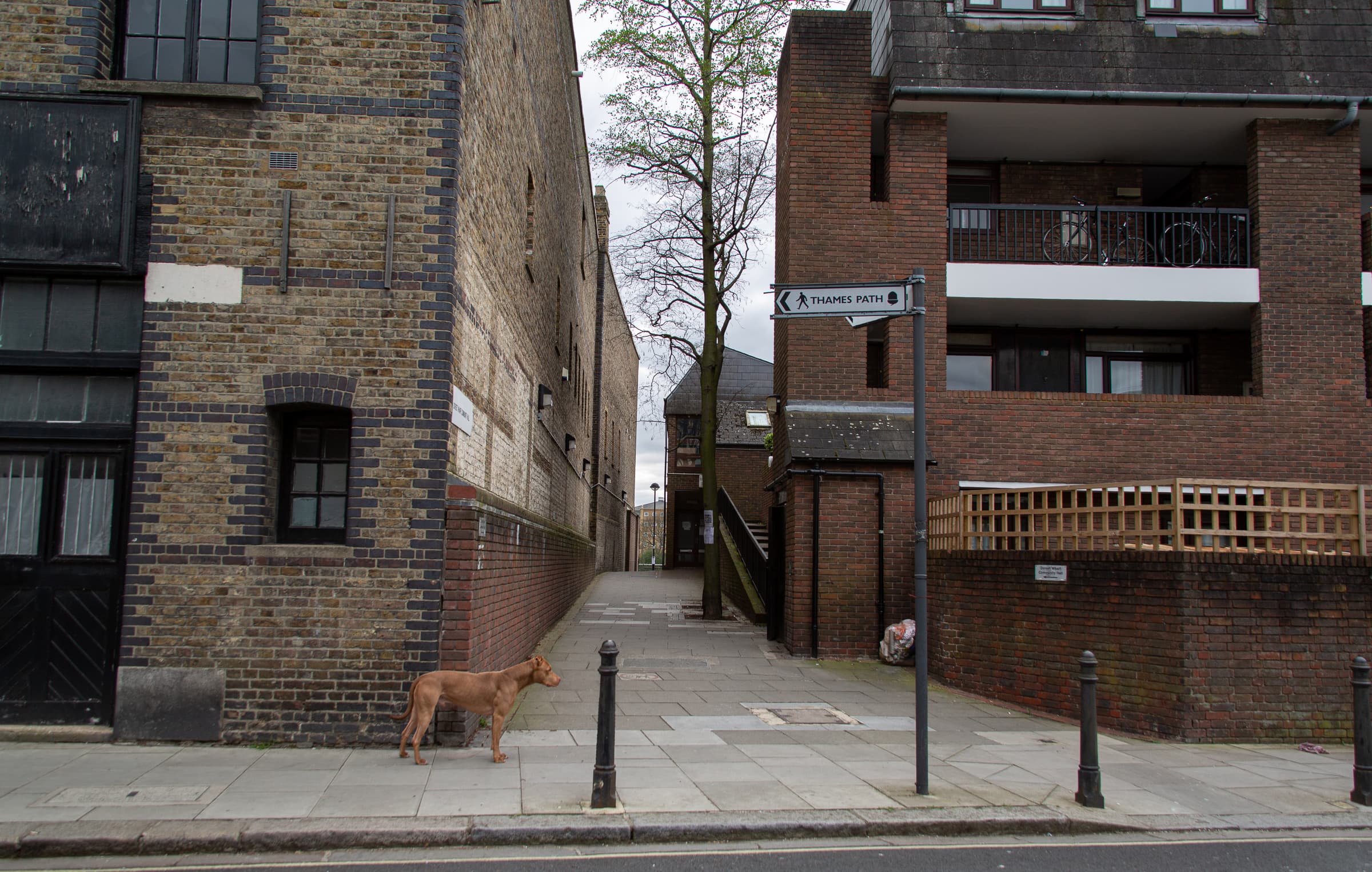
A quiet encounter at the entrance to the Thames Path.
Standing His Ground
FCS-PH-0085
Permanent Collection
Thames Path, London, United Kingdom
April 4, 2014
Available as a Fine Art Print
Acquire a Print ↗About the Work
A lone dog stands at the entrance to a narrow passage leading toward the Thames Path in London. Framed between contrasting brick buildings, the animal appears almost stationed at the threshold, transforming an ordinary passageway into a moment of quiet uncertainty and observation.
The Artist
I was walking toward the Thames and had already been out for about half an hour when I came to this passageway.
To continue toward the river, I had to go through it.
The dog was standing there exactly as he appears in the photograph. I took the picture, but I didn't immediately continue walking. I didn't know what kind of dog he was or whether he might be aggressive, so I stood there for a few minutes and watched him.
What interested me was not only the dog. It was where he was standing. He was positioned between these two buildings at the entrance to the passage, almost as though he were standing his ground.
Eventually he began to move forward. Once he did, I stepped across the street and continued toward the Thames.
It was a very small encounter, but the position of the dog within that space stayed with me.
The Curator
Standing His Ground depends upon the relationship between subject and architecture.
The dog occupies only a small portion of the frame, yet its placement near the entrance to the passage gives it disproportionate visual importance. The surrounding brick buildings rise on either side, creating a narrow corridor that pulls the eye inward while simultaneously establishing the animal as a figure positioned at its threshold.
The Thames Path sign introduces another visual instruction: movement is expected. The sign points toward a destination, the passage recedes into the distance, and yet the dog introduces hesitation.
Rather than isolating the animal through a tight crop, the photograph preserves the surrounding architecture and negative space. This allows the encounter to remain what it originally was—not a portrait of a dog, but a moment in which an ordinary route briefly became uncertain.
Story Behind the Photograph
Francisco Colón made this photograph in London in April 2014 while walking toward the River Thames.
Approximately half an hour into the walk, his route brought him to a narrow passage between two brick buildings marked by a Thames Path sign.
A dog was standing near the entrance.
Francisco photographed the scene before proceeding. Because he did not know the animal's temperament, he remained at a distance for several minutes and watched.
The dog eventually began moving forward. Francisco then crossed the street and continued through the passage toward the Thames.
The encounter lasted only a few minutes. What gave the scene its photographic significance was the relationship between the animal and its surroundings: the dog appeared almost deliberately positioned at the entrance, while the architecture behind it formed a corridor leading toward Francisco's intended destination.
Reflection
Sometimes a journey is interrupted by something that has no intention of becoming part of it.
A route is chosen. A destination exists. The signs tell us where to go.
Then something occupies the space between where we are and where we intended to be.
For a moment, movement becomes observation.
The dog did not block the passage. It simply stood there. Yet its presence changed the meaning of the space around it. An ordinary alley became a threshold, and walking became waiting.
Perhaps photographs often begin in precisely that interval—the brief moment when continuing forward is replaced by paying attention.
The Museum
Standing His Ground is preserved in the Francisco Colón Studio Photography Wing as part of the artist's photographic record of London and his broader exploration of observation during travel.
The photograph is significant not simply for its subject but for the relationship between subject, place, and movement. The Thames Path sign establishes the intended journey, while the dog introduces an unscripted interruption within it.
The work also reflects a recurring characteristic of Colón's photography: subjects discovered rather than arranged, often becoming meaningful because of their position within an otherwise ordinary environment.
Preserving the wider architectural frame is essential to the work. The surrounding buildings, passageway, street furniture, and directional sign provide the spatial context that transforms the animal from an isolated subject into part of a larger narrative about movement, hesitation, and observation.
Technical Information
- Camera
- Canon EOS 5D Mark III
- Lens
- Canon EF 28-135mm f/3.5-5.6 IS USM
- Focal Length
- 28 mm
- Capture Date
- April 4, 2014
- Location
- Thames Path, London, United Kingdom
- Flash
- Did not fire
- Metadata Status
- Original RAW metadata preserved. ISO 100, 1/100 sec at f/6.3. Lens profile corrections applied during RAW development. Final interpretation developed in Adobe Lightroom Classic.
Collection Record
- Accession Number
- FCS-PH-0085
- Exhibit Number
- 85
- Exhibition
- Photography Wing
- Status
- Permanent Collection
- Studio Acquisition
- Francisco Colón Studio Photography Wing
- Artist
- Francisco Colón
- Copyright
- © Francisco Colón. All Rights Reserved.