FCS-PH-0130
Photography Wing · Exhibit No. 130
Still, the Sky Was Higher
Still, the Sky Was Higher
FCS-PH-0130
Published
Mathildenhöhe, Darmstadt, Germany
June 18, 2014
Available as a Fine Art Print
Acquire a Print ↗About the Work
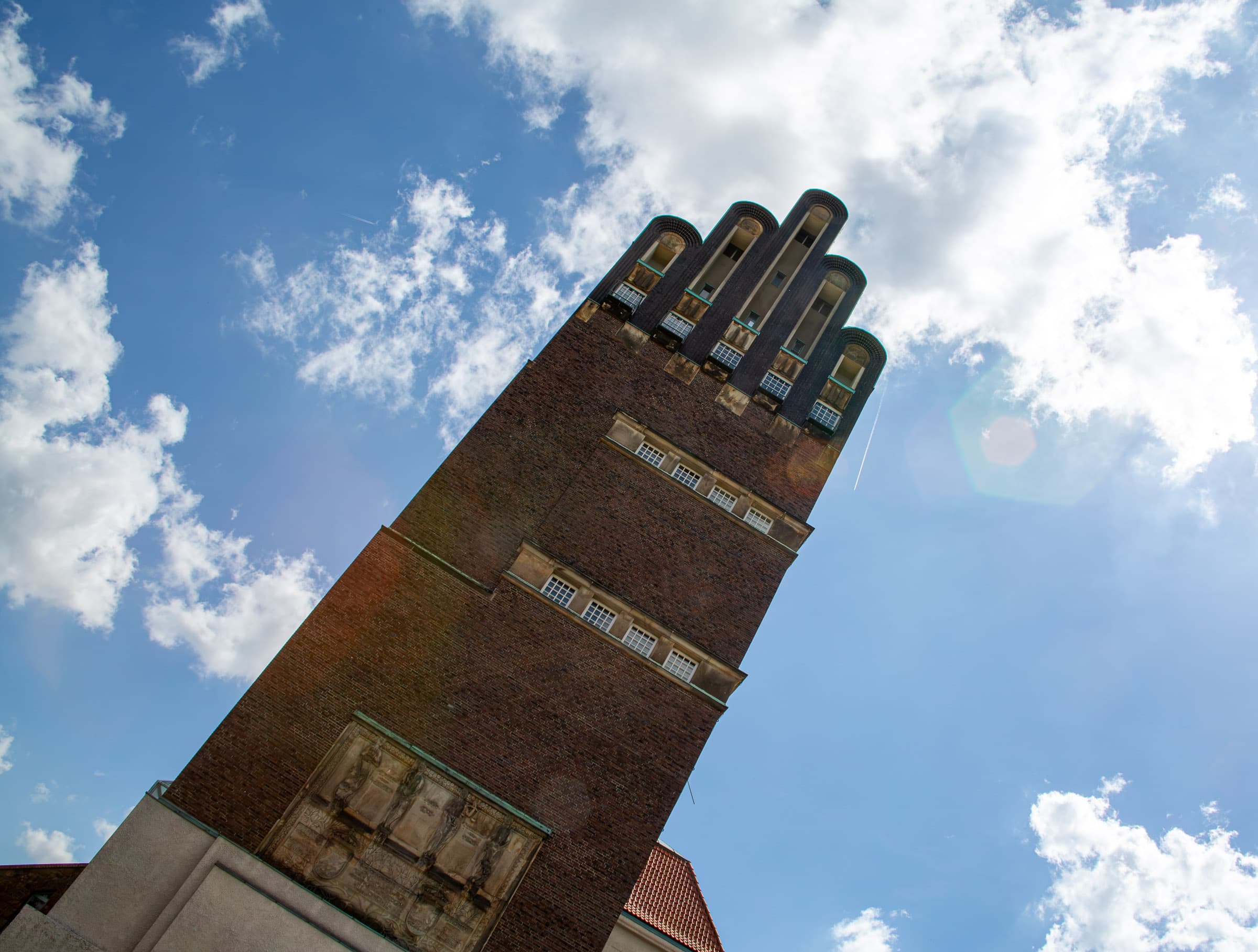
Still, the Sky Was Higher looks upward at Darmstadt's Wedding Tower on the Mathildenhöhe, its massive brick structure rising diagonally into an open field of blue sky and passing clouds. From this low perspective, the tower appears to reach beyond the frame, its distinctive five-part crown standing against the brightness above. Known as the Wedding Tower, the Darmstadt landmark commemorates the 1905 marriage of Grand Duke Ernst Ludwig and Princess Eleonore zu Solms-Hohensolms-Lich. Yet here, the building is presented less as a historical monument than as an encounter with scale—the weight and permanence of architecture set against the seemingly limitless space above it. The photograph was made during a return to Darmstadt with my daughter, a city where we had once lived when she was only a baby. Years had passed, lives had changed, and we were returning to a place that belonged to an earlier chapter of our shared history. Standing beneath the tower and looking upward, the architecture seemed immense. But beyond everything that had been built, everything that had endured, and everything to which we had returned, there was still something larger. Still, the sky was higher.
The Artist
Returning to Darmstadt with my daughter was different from simply visiting another city. We had lived there when she was only a baby, and coming back meant walking through a place that belonged to an earlier period of both of our lives.
There is something unusual about returning to a place after enough time has passed. The streets and buildings may still be there, but the people returning to them are no longer the same people who left. My daughter, whom I remembered carrying through this city as a baby, was now beside me experiencing Darmstadt from an entirely different point in her life.
When I stood beneath the Wedding Tower, I did not want to photograph it from a comfortable distance as a straightforward architectural record. I looked upward. From that position, the tower seemed to rise almost endlessly above me. The perspective exaggerated its height, the brick structure narrowing as it climbed toward its distinctive crown.
But the tower did not exist alone. Above and around it was an enormous sky filled with blue, clouds, and intense sunlight. No matter how monumental the architecture appeared from where I stood, the space beyond it remained larger.
That relationship between the tower and the sky is what stayed with me. Human beings build upward. We create monuments intended to endure. We attach history, memory, celebration, and meaning to them. Yet there is always something beyond what we build.
Years later, I also recognize another meaning in the photograph. The tower was still there when we returned, but my daughter and I had traveled through years of our own lives before standing beneath it again.
The building gave me a measure of height. Returning gave me a measure of time.
The Curator
Still, the Sky Was Higher departs from conventional architectural documentation by embracing rather than correcting the extreme convergence created by a close, low-angle viewpoint. The Wedding Tower enters the composition from the lower-left portion of the frame and rises diagonally toward the center, transforming the structure from a static architectural subject into a strong directional form.
The tower's substantial brick mass is counterbalanced by an unusually large expanse of open sky. This negative space is essential to the composition. Rather than functioning merely as background, the sky establishes the scale against which the architecture is perceived. The building appears monumental in relation to the photographer's position, yet comparatively finite against the space surrounding it.
The five rounded vertical elements crowning the tower create a distinctive rhythm at the point where architecture meets sky. Their repeated forms interrupt the otherwise massive geometry of the brick shaft and provide a visual termination to the upward movement of the structure.
Cloud formations introduce a second, less predictable geometry. Their brightness and softness contrast with the dark, rectilinear masonry, while the intense sunlight toward the upper-right creates a visual force opposing the tower's diagonal ascent. Lens flare remains visible within the frame, preserving evidence of the camera's direct relationship with the strong overhead light.
The resulting image depends upon opposition: mass against openness, permanence against changing atmosphere, human construction against natural scale. The tower rises forcefully, but the composition deliberately leaves enough sky to remind the viewer that its ascent has limits.
Reflection
A photograph of a place can sometimes become a photograph of time without anything in the image visibly changing.
The Wedding Tower belongs to Darmstadt's history, but Darmstadt also belongs to part of my family's history. My daughter had lived there when she was a baby. Returning with her years later meant that I was experiencing two versions of the city simultaneously—the place in front of me and the place I remembered.
That is part of what I now see when I look at this photograph. The tower appears permanent. It had stood there before our earlier life in Darmstadt, remained after we left, and was waiting when we returned. Against that apparent permanence were two people whose lives had continued moving forward.
My daughter was no longer the baby I remembered in this city. I was no longer the father who had first known Darmstadt with her. The distance between those two moments could not be measured in streets or kilometers. It could only be measured in time.
Perhaps that is why the upward perspective feels appropriate to me now. The tower provides something solid against which scale can be understood, yet the sky refuses to be contained by it.
Buildings can remain. Places can wait. Memory can carry an earlier version of them for decades. But life continues beyond all of those things.
We had returned to the same city, but we had not returned as the same people.
The Museum
Created in Darmstadt, Germany, on June 18, 2014, Still, the Sky Was Higher presents the Hochzeitsturm, or Wedding Tower, on the Mathildenhöhe from an intentionally dramatic low-angle perspective. The landmark is associated with the 1905 marriage of Grand Duke Ernst Ludwig and Princess Eleonore zu Solms-Hohensolms-Lich and is distinguished visually by the five rounded vertical forms at its crown.
Rather than providing a conventional descriptive view of the monument and its surroundings, the photograph isolates the tower against a broad expanse of sky. The exaggerated convergence of the architecture results from the photographer's close position beneath the structure and is retained as a central expressive component of the image rather than corrected as an architectural distortion.
The tower's diagonal ascent establishes the primary visual movement, while clouds and intense sunlight provide a contrasting atmospheric field. The large proportion of negative space emphasizes both the apparent height of the building and the greater scale of the sky surrounding it. Visible lens flare further records the optical conditions produced by photographing toward the strong daylight.
Within the Francisco Colón Studio collection, the work also contributes to a recurring examination of return, memory, architecture, and the changing meaning of places encountered at different stages of life. Darmstadt was not an unfamiliar destination for the photographer and his daughter, but a city in which they had previously lived when she was an infant. Their later return therefore gives the photograph an autobiographical dimension separate from the historical significance of the monument itself.
The resulting work operates on two scales. Architecturally, it examines the relationship between a monumental human structure and the apparently limitless space above it. Biographically, it considers the relationship between a place that endured and the people who returned to it after time had transformed their lives.
Technical Information
- Camera
- Canon EOS 5D Mark III
- Lens
- EF 28-135mm f/3.5-5.6 IS USM
- Focal Length
- 28mm
- Capture Date
- June 18, 2014
- Capture Time
- 11:16 AM local time
- Location
- Mathildenhöhe, Darmstadt, Germany
- Flash
- Did not fire
- Metadata Status
- Original camera clock remained set to New York time. EXIF records 5:16:30 AM; corrected to approximately 11:16 AM local time in Darmstadt.
- Supporting Documentation
- Original EXIF metadata retained. Local capture time corrected from camera time using the six-hour difference between New York and Darmstadt on June 18, 2014.
Collection Record
- Accession Number
- FCS-PH-0130
- Exhibit Number
- 130
- Exhibition
- Cities
- Status
- Published
- Original Capture
- June 18, 2014
- Artist
- Francisco Colón
- Copyright
- © Francisco Colón. All rights reserved.