FCS-PH-0072
Photography Wing · Exhibit No. 72
The City Carries On
Monumental architecture surrounded by the ordinary rhythm of a city beginning another day.
The City Carries On
FCS-PH-0072
Permanent Collection
Palacio de Bellas Artes, Mexico City, Mexico
Saturday, October 20, 2018
About the Work
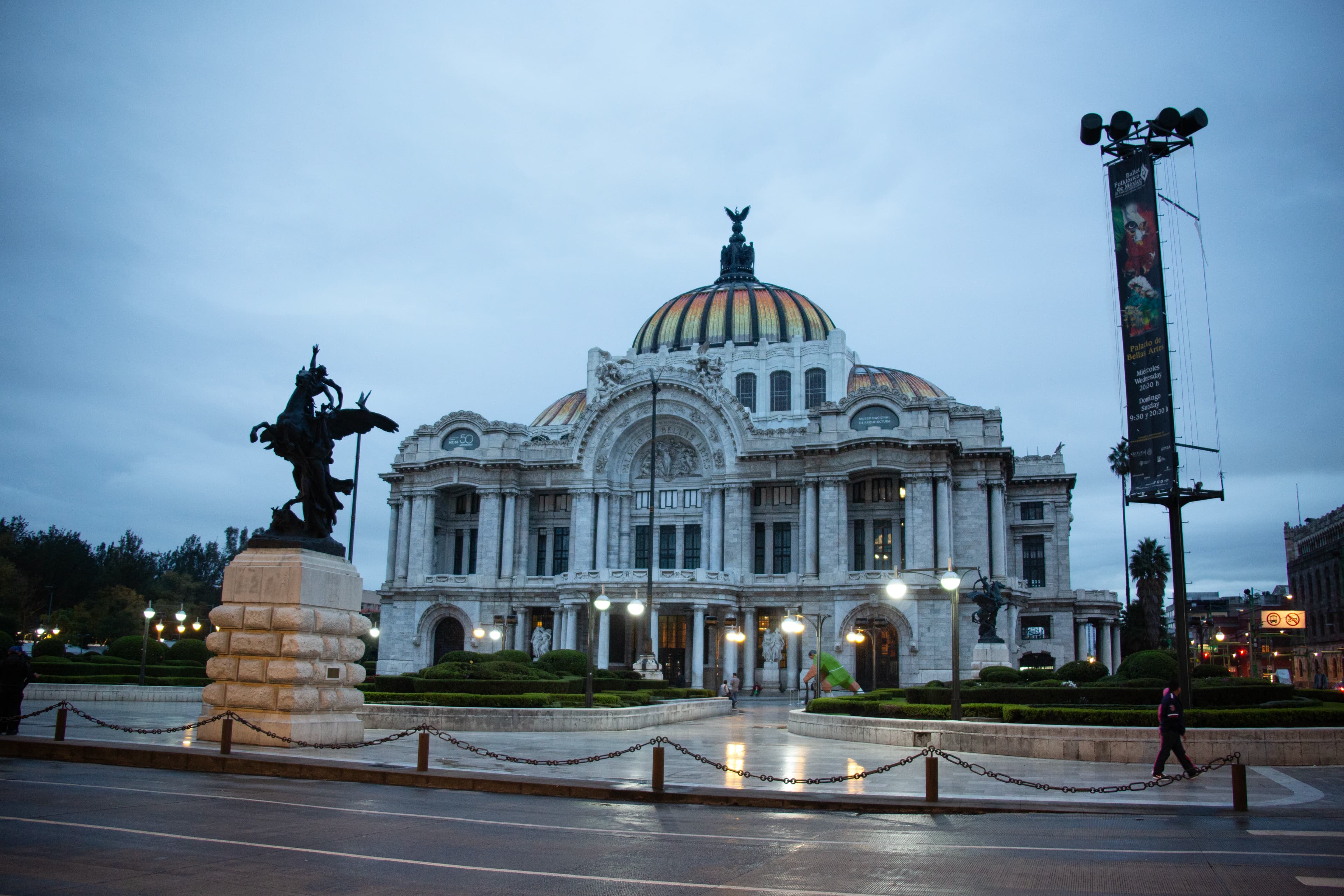
The Palacio de Bellas Artes stands beneath a cool, overcast morning sky in Mexico City as the city begins another day around it. Rain-darkened pavement reflects the glow of streetlights still illuminated in the early morning, while a solitary pedestrian crosses the frame and temporary structures, signs, and contemporary city infrastructure surround the historic landmark. The photograph captures Bellas Artes not in isolation, but as part of a living city—monumental, enduring, and surrounded by the ordinary rhythms of everyday life.
The Artist
It was early in the morning in Mexico City.
Rain had passed through, the pavement was still wet, and the heavy cloud cover kept the city in that subdued light that sometimes makes morning feel as though the day has not completely begun.
It was approximately 7:16 in the morning when I photographed the Palacio de Bellas Artes.
The streetlights were still glowing.
Their reflections appeared across the wet pavement while the cool morning sky settled over the building.
I could have wished the lighting tower away.
It interrupts the architecture.
It rises beside one of Mexico City's most recognizable buildings and refuses to disappear from the photograph.
But it was there.
So was the pedestrian crossing the frame.
So were the streetlights, signs, wet pavement, traffic, and everything else that belonged to Mexico City at that particular moment.
When I returned to this photograph years later, I realized that removing those things would create a cleaner photograph of Bellas Artes.
But it would not create a more truthful photograph of what I saw that morning.
I was not standing before an isolated monument.
I was standing in Mexico City.
The rain had passed.
The pavement was still wet.
The lamps remained illuminated against the cool morning.
Someone was already walking through the city while this magnificent building simply remained where it had been through countless ordinary mornings.
That became more interesting to me than architectural perfection.
The building may dominate the photograph.
But life does not stop for it.
The city carries on.
The Curator
The City Carries On deliberately resists the visual language of idealized architectural photography.
The Palacio de Bellas Artes remains the dominant element of the composition, but Colón allows the contemporary city to remain visible around it.
A dark monument anchors the left side of the frame.
On the right, a temporary lighting structure and event banner rise beside the historic building.
A solitary pedestrian moves toward the edge of the composition while streetlights, still illuminated in the early morning, reflect across rain-darkened pavement below.
These elements might conventionally be regarded as distractions.
Here, they establish the photograph's central tension.
The monumental and temporary occupy the same space.
Historic architecture exists beside contemporary infrastructure.
Stillness exists beside movement.
The palace appears permanent while the people, equipment, weather, artificial light, and activity surrounding it are transient.
The early hour adds another transition to the photograph: the remaining illumination of night exists alongside the emerging natural light of morning.
Rather than removing these contradictions, the photograph depends upon them.
Story Behind the Photograph
Colón made this photograph on the morning of October 20, 2018, while living in Mexico City.
It was approximately 7:16 AM local time.
Rain had left the pavement wet, heavy clouds remained over the city, and artificial lights were still illuminated around the Palacio de Bellas Artes.
Those conditions created an unusual transition between night and day.
Cool morning light filled the sky while the remaining streetlights produced small areas of warmth and reflection across the plaza.
A temporary lighting tower and event banner occupied the right side of the scene. A pedestrian crossed beneath it while the historic building remained at the center of ordinary city activity.
When the photograph was revisited for the Francisco Colón Studio archive in 2026, the lighting structure initially appeared to be an obvious candidate for removal.
The decision was ultimately made to preserve it.
That decision changed the interpretation of the photograph.
Rather than presenting Bellas Artes as though the surrounding city had been cleared away for the camera, the photograph preserves the building as Colón encountered it on that particular morning: after rain, before the city had fully brightened, surrounded by temporary infrastructure and the first movements of another day.
This was not an architectural commission made after waiting for the surroundings to become perfect.
It was street photography.
The photograph became less about documenting a famous building and more about observing the relationship between permanence and everyday life.
The architecture remained still.
Around it, Mexico City was already beginning again.
Reflection
Cities begin moving before we notice that the day has begun.
Lights remain illuminated.
Someone is already walking somewhere.
Workers have already prepared spaces for whatever will happen later.
Rainwater from the night remains on the pavement.
And buildings that have watched thousands of mornings arrive simply wait for another one.
Looking at this photograph now, I think that is what interests me most.
Bellas Artes does not need the city to become quiet in order to be magnificent.
The temporary tower will eventually disappear.
The rainwater will evaporate.
The pedestrian will leave the frame.
The lamps will switch off.
Another day will take their place.
The building remains.
The temporary things surrounding a place help us understand what permanence means.
And around it, the city carries on.
The Museum
Preserved as the seventy-second accessioned photograph in the Francisco Colón Studio Photography Wing, The City Carries On joins the Cities collection as a study of architecture, continuity, observation, time, and contemporary urban life.
The photograph was created on the morning of October 20, 2018, at the Palacio de Bellas Artes in Mexico City.
Artist provenance establishes the local time of capture as approximately 7:16 AM. The camera's internal clock recorded 8:16:21 AM, one hour ahead of the local Mexico City time identified by the artist.
Rain had recently passed through the area. Wet pavement, illuminated streetlights, a public monument, temporary event infrastructure, and pedestrian activity remain visible within the composition.
The combination of lingering artificial illumination, reflective pavement, heavy cloud cover, and emerging morning light records the city during a transitional period between night and full daylight.
During the 2026 restoration, highlight intensity from artificial lights was controlled while shadow information and architectural detail within the Palacio de Bellas Artes were carefully recovered.
The cool character of the overcast morning sky was retained while excessive cyan saturation was reduced locally. Reflections across the rain-darkened pavement were preserved and subtly clarified.
A temporary lighting tower and banner visible at the right side of the photograph were intentionally retained. Although initially considered visually distracting, their removal would have altered the documentary circumstances of the scene.
The pedestrian, street furniture, traffic elements, lighting equipment, monument, and other contemporary features were similarly preserved.
No architectural elements or significant documentary features were removed or reconstructed.
Within the Studio archive, the work represents the historic city not as a preserved environment separated from contemporary life, but as a place where permanence and transience continually occupy the same frame.
Technical Information
- Camera
- Canon EOS 5D Mark III
- Lens
- Canon EF 28–300mm f/3.5–5.6L IS USM
- Focal Length
- 28 mm
- Capture Date
- Saturday, October 20, 2018
- Capture Time
- 7:16:21 AM Mexico City local time; camera recorded 8:16:21 AM
- Location
- Palacio de Bellas Artes, Mexico City, Mexico
- Flash
- Did not fire (compulsory mode)
- White Balance
- Auto
- Metadata Status
- Original EXIF metadata confirms the Canon EOS 5D Mark III with Canon EF 28–300mm f/3.5–5.6L IS USM lens at 28mm, ISO 2500, manual exposure mode, spot metering, automatic white balance, standard scene capture type, normal processing, a maximum aperture value of f/3.7, and that the flash did not fire. The camera recorded the photograph on October 20, 2018, at 8:16:21 AM. Artist provenance establishes the actual local time in Mexico City as approximately 7:16:21 AM; the camera clock was one hour ahead of local time.
- Supporting Documentation
- Original Canon image file, surviving EXIF metadata, 2026 restored master, and artist provenance narrative preserved in the Francisco Colón Studio archive.
Collection Record
- Accession Number
- FCS-PH-0072
- Exhibit Number
- 72
- Exhibition
- Cities
- Status
- Permanent Collection
- Original Capture
- October 20, 2018
- Studio Acquisition
- Francisco Colón Studio Photography Wing
- Artist
- Francisco Colón
- Copyright
- © Francisco Colón. All Rights Reserved.