FCS-PH-0055
Photography Wing · Exhibit No. 55
The City Keeps Walking
One figure pauses while Paris continues around them.
The City Keeps Walking
FCS-PH-0055
Permanent Collection
Near the Seine, Paris, France
February 26, 2013
About the Work
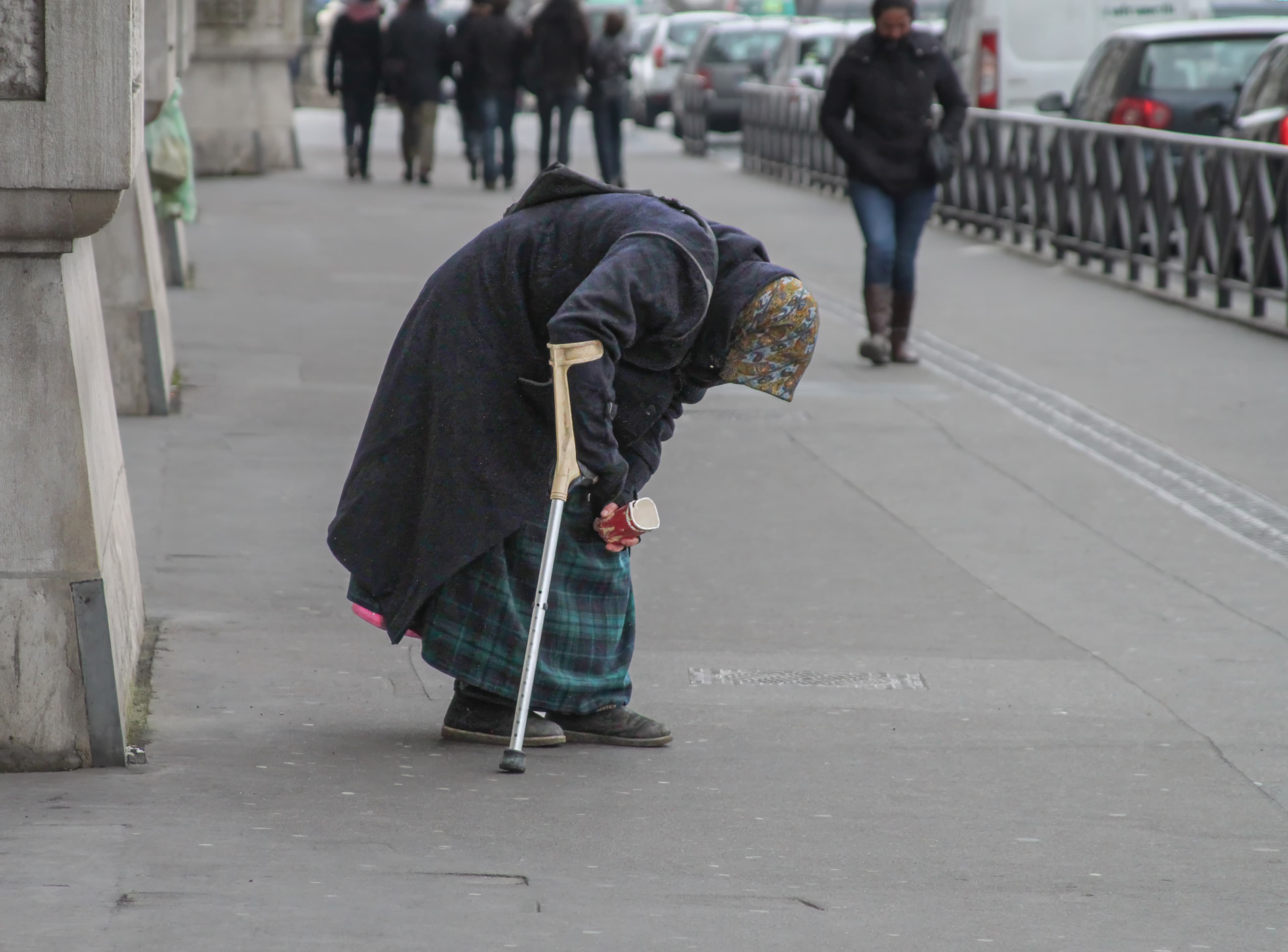
An unidentified person bends over a crutch while holding a small cup on a Paris sidewalk as pedestrians continue with their daily lives. Photographed near the Seine on February 26, 2013, the scene presents a quieter contrast to the familiar image of Paris as the City of Love and the City of Light. Whether the person was experiencing pain, disability, poverty, or performing a practiced role remains unknown. The photograph preserves what could be observed without claiming what could not be known.
The Artist
I went to Paris intending to walk.
I wanted to see the Eiffel Tower, Notre-Dame, and the places that make the city immediately recognizable. But I also wanted everything to remain within walking distance because what interested me was not only where I was going. I wanted to photograph whatever caught my attention along the way.
This person stood on a main road with the Seine across the street. Their body was bent forward over a crutch, their face concealed beneath layers of clothing, and a cup rested in one hand.
I could not determine whether the person was a man or a woman. I did not know whether they were injured, living with a disability, experiencing pain, asking for help, or performing a role intended to attract the attention of those passing by.
I had encountered scams during my travels, so I could not ignore that possibility. But I also could not use that uncertainty to dismiss what was in front of me.
Around this person, everyone continued walking. They may have been going to work, returning home, or simply moving through their own lives.
Paris is called the City of Love and the City of Light. Yet poverty does not disappear beneath those names. It has its own clothing, posture, and equipment, just as other roles within society do.
I photographed the moment because it was part of the Paris I encountered—neither the Paris I expected nor one I could fully explain.
Poverty looks the same wherever we go.
The Curator
The City Keeps Walking presents a contrast between stillness and movement, visibility and anonymity, observation and uncertainty.
The central figure is bent forward over a crutch, holding a small cup while pedestrians continue along the sidewalk. The surrounding people remain upright and in motion. Their destinations are unknown, but their movement establishes the rhythm against which the central figure is understood.
The photograph offers visual evidence without providing a complete explanation.
The figure's identity, gender, physical condition, and circumstances remain concealed. The image may suggest pain, disability, poverty, solicitation, or performance, but it cannot confirm any of them.
That uncertainty is central to the work.
Rather than resolving the person into a familiar social category, the photograph asks the viewer to consider how quickly appearance becomes interpretation.
The title shifts attention toward the larger environment. Whatever this person’s circumstances may have been, Paris continued around them.
The city did not stop.
The photographer did.
Story Behind the Photograph
Francisco Colón traveled to Paris intending to experience the city on foot.
The major landmarks formed part of the journey. He wanted to see the Eiffel Tower, Notre-Dame, the Seine, and the places through which Paris presents itself to the world.
Walking allowed something else to happen.
Between destinations, the city revealed scenes that no itinerary could have predicted.
On February 26, 2013, Colón noticed an unidentified person on a main road near the Seine. The person was bent forward, supported by a crutch, with layers of clothing covering the body and head. A small cup was held in one hand.
Pedestrians continued along the sidewalk. Some moved away from the camera. Another approached from the opposite direction. Vehicles filled the street beyond the railing.
Colón could not determine the person's gender or circumstances.
The posture suggested discomfort or physical limitation, but the photograph could not establish whether the person was injured, disabled, experiencing poverty, soliciting assistance, or performing a practiced role.
Colón had encountered scams during his travels, making that possibility part of his response. Yet suspicion could not erase the human figure before him or the contrast created by everyone continuing around them.
He raised the camera and made the photograph.
The resulting image became part of the Paris he had come to document—not only the monumental city but also the uncertain human realities encountered while walking through it.
Reflection
Cities are often introduced through the names given to them.
Paris is the City of Love.
Paris is the City of Light.
Those names describe something real, but they do not describe everything.
On this sidewalk, one person was bent forward while everyone else continued walking. I did not know whether I was witnessing pain, disability, poverty, performance, or some combination I could not understand.
The photograph cannot answer that question.
What it can show is the distance between one person's apparent circumstances and the lives continuing around them.
Every role in society develops recognizable clothing and equipment. A businessperson may carry a briefcase or computer. A construction worker may wear a hard hat and reflective clothing. This person also appeared dressed for the circumstances in which I encountered them.
But appearance is not certainty.
I could observe the clothing, crutch, cup, posture, and passing pedestrians. I could not know the life beneath them.
That limitation is part of the photograph.
Poverty does not belong to one city or country. It exists beside monuments, across from rivers, and within places celebrated for beauty and romance.
The city keeps walking.
For one moment, I stopped.
The Museum
Preserved as the fifty-fifth accessioned photograph in the Francisco Colón Studio Photography Wing, The City Keeps Walking expands the collection's representation of Paris beyond its monuments and familiar cultural identity.
Created near the Seine during Colón's first visit to the city, the photograph emerged from his decision to experience Paris primarily on foot. This approach allowed the journey between destinations to become as photographically significant as the landmarks themselves.
The work is structured around an unresolved human encounter.
An unidentified figure occupies the foreground while pedestrians and traffic continue through the surrounding city. The photograph records visible details—a crutch, layered clothing, a cup, a bent posture—but does not possess enough evidence to define the person’s identity or circumstances.
The Studio preserves that uncertainty intentionally.
Within Colón's larger observational practice, the photograph demonstrates the camera's ability to stop for a person or event that the surrounding environment appears to pass without interruption.
The City Keeps Walking does not claim to explain poverty, disability, or public solicitation. It preserves the photographer's confrontation with the limits of observation: the recognition that a moment can be witnessed without being fully understood.
Technical Information
- Camera
- Canon EOS Rebel T1i
- Lens
- Canon EF 28–135mm f/3.5–5.6 IS USM
- Focal Length
- 135 mm
- Capture Date
- February 26, 2013
- Capture Time
- Approximately 3:14:49 PM Paris local time; camera recorded 9:14:49 AM New York time
- Location
- Near the Seine, Paris, France
- Flash
- Did not fire (compulsory mode)
- White Balance
- Auto
- Metadata Status
- Original EXIF metadata confirms the camera, lens, focal length, camera-recorded date and time, flash status, and white balance. The camera remained set to New York time while the photographer traveled; Paris was approximately six hours ahead.
- Supporting Documentation
- Original image file, surviving metadata, earlier processed interpretation, 2026 restored master, and artist provenance narrative preserved in the Studio archive.
Collection Record
- Accession Number
- FCS-PH-0055
- Exhibit Number
- 55
- Exhibition
- people
- Status
- Permanent Collection
- Original Capture
- February 26, 2013
- Studio Acquisition
- Francisco Colón Studio Photography Wing
- Artist
- Francisco Colón
- Copyright
- © Francisco Colón. All Rights Reserved.