FCS-PH-0061
Photography Wing · Exhibit No. 61
The Company of Empty Chairs
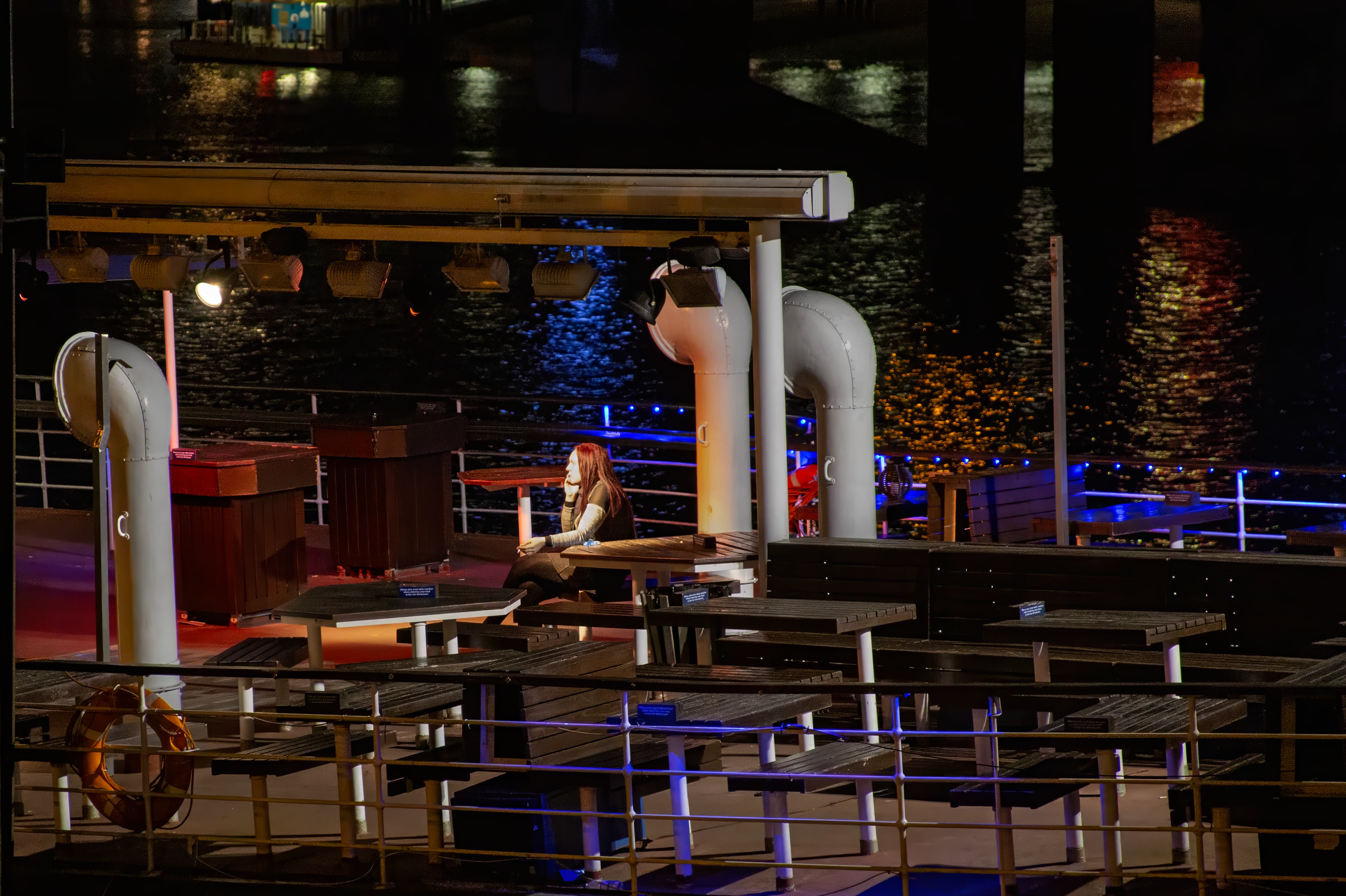
From across the river, one illuminated figure becomes the center of an otherwise empty gathering place.
The Company of Empty Chairs
FCS-PH-0061
Permanent Collection
Tattershall Castle, Victoria Embankment, Westminster, London SW1A 2HR, United Kingdom
Saturday, April 5, 2014 (London local time); camera recorded Friday, April 4, 2014
About the Work
A solitary woman sits aboard Tattershall Castle, a floating pub and entertainment venue moored on the River Thames opposite the London Eye. Quietly smoking while rows of empty tables and chairs surround her, she appears absorbed in her own thoughts. Warm light separates her from the darkness as blue deck lights and reflections move across the river behind her. Photographed from a considerable distance shortly after midnight, the scene preserves a private moment of contemplation within a space intended for conversation, companionship, and crowds.
The Artist
I began walking from my hotel in Hammersmith at approximately 4:34 in the afternoon, London time.
My intention was to walk toward the Tower of London while following the Thames as closely as the available route allowed. Along the way, I stopped repeatedly to photograph whatever caught my attention and occasionally moved away from the river when the streets required it.
Nearly eight hours later, shortly after midnight, I had reached the area near the London Eye.
That was when I noticed a woman sitting alone aboard a boat on the Thames.
Around her were rows of empty tables and chairs—places intended for groups of people, conversation, laughter, food, and companionship.
Yet she was the only person there.
She appeared absorbed in her own thoughts, quietly smoking while the river and the lights of London continued around her.
The wider photograph reveals how far away I actually was. From my position, she was only a small illuminated figure within a much larger nighttime scene.
I could have tried to walk closer, but I might have lost the moment. By the time I reached the boat, she could have moved, someone might have joined her, or she might have become aware of the camera and changed her posture.
Without hesitation, I chose to photograph her from where I stood.
I extended the lens to its maximum focal length and made the image immediately.
The distance limited the photograph's technical clarity, but it preserved the solitude that had made me raise the camera in the first place.
I could wish for a sharper photograph.
I would not exchange the moment for one.
The Curator
Curatorially, The Company of Empty Chairs is strongest when read through the discipline of noticing what might otherwise pass without emphasis. The composition does not require a dramatic event to justify its place in the collection; its meaning develops through relationships inside the frame—distance, scale, structure, atmosphere, and the distribution of visual weight. That restraint is important. It allows the photograph to carry the theme of observation through form as well as through biography, giving the work an independent visual life while remaining connected to the artist’s experience.
Story Behind the Photograph
On April 4, 2014, Francisco Colón left the Holiday Inn Express in Hammersmith and began an extended photographic walk through London.
His camera recorded the starting time as approximately 11:34 AM. Because the camera remained set to New York time, the corresponding London time was approximately 4:34 PM.
Colón intended to walk toward the Tower of London while following the River Thames as closely as the available route allowed.
The journey carried him through riverside paths, streets, and neighborhoods that had not been planned in advance. When the route moved away from the water, he followed the surrounding roads before returning toward the Thames.
He stopped repeatedly to photograph whatever attracted his attention.
Approximately seven hours and fifty-seven minutes after beginning the walk, Colón reached the area near the London Eye.
His camera recorded the time as 7:31:14 PM on April 4. In London, it was approximately 12:31:14 AM on April 5.
By then, he had traveled an estimated eight miles.
Near the river, Colón noticed a boat containing rows of tables, chairs, and benches. The space appeared designed for crowds, meals, conversation, and entertainment, but at that hour nearly every seat was empty.
One woman sat alone on the deck.
She appeared to be smoking and lost in her own thoughts.
Colón was positioned far from the boat. The wider environmental photograph shows that the woman occupied only a small part of the larger riverside scene.
He considered the possibility of moving closer, but approaching would have required time. The woman might have moved, someone might have joined her, or awareness of the photographer might have changed the private quality of the moment.
He chose not to risk losing what he had seen.
Using a Canon EOS 5D Mark III, Colón extended his Canon EF 28–135mm lens to its maximum focal length of 135mm. The camera operated at ISO 12,800 in the extremely low nighttime light. No flash was used.
The resulting photograph could not possess the clarity of an image created nearby under controlled conditions.
It preserved something more important.
One person remained illuminated among an entire gathering place of empty chairs.
Together, the wide and telephoto frames document not only the scene but also the photographer's decision: preserve the solitude immediately rather than risk destroying it in pursuit of technical perfection.
Reflection
I had been walking for nearly eight hours when I noticed her.
The journey had begun in Hammersmith during the afternoon. By the time I reached the area near the London Eye, daylight had disappeared and the date was changing from April 4 to April 5.
From where I stood, the woman was far away.
She occupied only a small part of the larger river scene, but something about her presence among all those empty tables made me stop.
I could have walked closer.
Perhaps I would have produced a sharper photograph.
But she might not have remained there.
Solitude can disappear the moment another person enters. A private posture can change when someone realizes they are being observed. A scene that appears permanent from a distance may last only a few seconds.
I chose the photograph I could make over the photograph I might never reach.
The distance remains visible in the finished image. So does the low light. Those limitations are part of the record.
They show how far away I was when I noticed her.
She was alone, but not entirely without company.
The empty chairs surrounded her.
Across the river, so did my attention.
The Museum
Preserved as the sixty-first accessioned photograph in the Francisco Colón Studio Photography Wing, The Company of Empty Chairs joins the People collection as a study of solitude, observation, distance, and photographic decision-making.
The photograph was created shortly after midnight on April 5, 2014, London local time, near the London Eye.
Colón had begun walking from his hotel in Hammersmith at approximately 4:34 PM the previous afternoon. By the time this photograph was created, he had been walking, exploring, and photographing for approximately seven hours and fifty-seven minutes across an estimated distance of eight miles.
The camera recorded April 4 at 7:31:14 PM because its clock remained set to New York time. London was approximately five hours ahead, placing the local capture time at approximately 12:31:14 AM on April 5.
The subject was photographed aboard a boat on the River Thames from a considerable distance. A wider environmental frame documents the photographer's original position and establishes how small the woman appeared within the larger riverside scene.
For the closer composition, Colón used the maximum 135mm focal length of his Canon EF 28–135mm lens. The available light required ISO 12,800, and no flash was used.
These conditions account for the photograph's limited fine detail and slight softness.
Rather than diminish the work, the technical limitations document the circumstances under which it was created. Colón chose not to approach the woman because doing so might have caused him to miss or disturb the solitary moment.
The photograph was revisited and restored in 2026. The restoration sought to improve tonal separation and visibility while respecting the limitations of the original capture.
Within the Studio archive, the work demonstrates that photographic value does not depend exclusively upon technical perfection. Its significance rests in recognition, timing, restraint, and the decision to preserve a fleeting human moment from the position in which it was first observed.
Technical Information
- Camera
- Canon EOS 5D Mark III
- Lens
- Canon EF 28–135mm f/3.5–5.6 IS USM
- Focal Length
- 135 mm
- Capture Date
- Saturday, April 5, 2014 (London local time); camera recorded Friday, April 4, 2014
- Capture Time
- Approximately 12:31:14 AM London local time; camera recorded 7:31:14 PM New York time
- Location
- Tattershall Castle, Victoria Embankment, Westminster, London SW1A 2HR, United Kingdom
- Route
- Approximately eight-mile photographic walk from the Holiday Inn Express London–Hammersmith toward central London and the Tower of London
- Flash
- Did not fire (compulsory mode)
- White Balance
- Auto
- Metadata Status
- Original EXIF metadata confirms the Canon EOS 5D Mark III, Canon EF 28–135mm f/3.5–5.6 IS USM lens at its maximum 135mm focal length, ISO 12,800, evaluative metering, automatic white balance, and that the flash did not fire. The camera remained set to New York time. The walk began at approximately 11:34 AM camera time, or 4:34 PM London time. This photograph was recorded at 7:31:14 PM camera time, or approximately 12:31:14 AM London time, seven hours and fifty-seven minutes after the walk began.
- Supporting Documentation
- Original wide environmental photograph identifying the vessel as Tattershall Castle, original 135mm telephoto image, surviving EXIF metadata, 2026 restored master, reconstructed walking route, camera-time chronology, and artist provenance narrative preserved in the Studio archive.
Collection Record
- Accession Number
- FCS-PH-0061
- Exhibit Number
- 61
- Exhibition
- People
- Status
- Permanent Collection
- Original Capture
- April 5, 2014
- Studio Acquisition
- Francisco Colón Studio Photography Wing
- Artist
- Francisco Colón
- Copyright
- © Francisco Colón. All Rights Reserved.