FCS-PH-0111
Photography Wing · Exhibit No. 111
The Crossing
The distance mattered less than who traveled beside me
The Crossing
FCS-PH-0111
Permanent Collection
Fort Washington Park, Manhattan, New York City, United States
September 6, 2015
Available as a Fine Art Print
Acquire a Print ↗About the Work
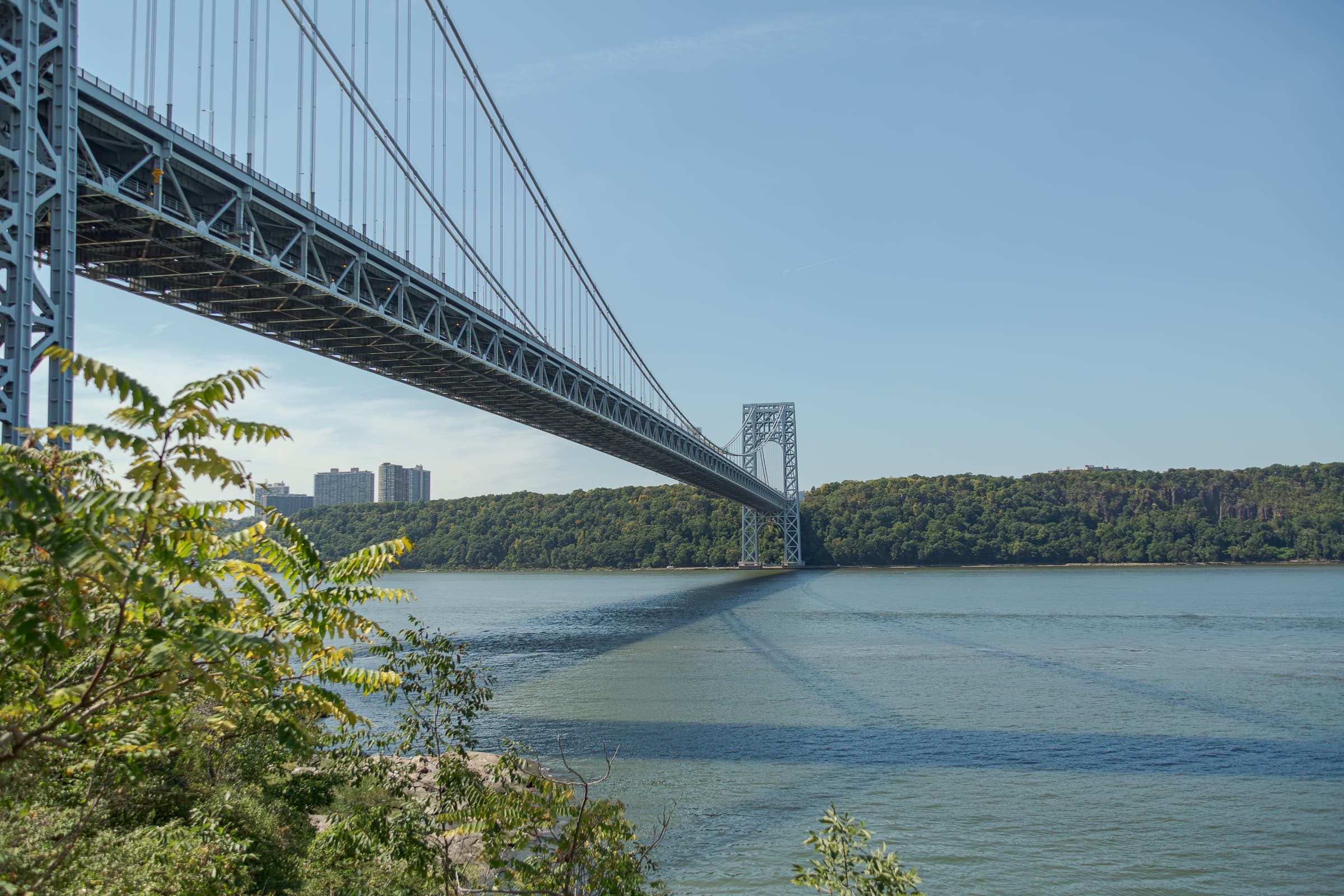
The George Washington Bridge reaches across the Hudson River beneath a clear afternoon sky, connecting New York and New Jersey through an immense span of steel, water, and light. Photographed from a wooded path below the bridge, the structure’s sweeping diagonal draws the eye toward its distant tower while its shadow continues the crossing across the surface of the water. The surrounding foliage and Palisades soften the scale of the architecture, presenting the landmark not only as a feat of engineering, but as part of a journey shared by a father and daughter.
The Artist
When I made this photograph, I was visiting my daughter in New York. She wanted us to have a day that belonged to the two of us, so she took me to a place where we could rent bicycles. We began in New York and rode across the George Washington Bridge into Fort Lee, New Jersey. I had crossed that bridge many times in a vehicle, but traveling across it on a bicycle allowed me to experience its size, its height, and the landscape around it differently.
This photograph was taken while we were making our way back. At one point, we found a path that required us to lift the bicycles onto our shoulders and carry them down a flight of steps. It was not the easiest part of the ride, but it brought us to the lower path where I could see the bridge stretching above the Hudson. From there, the bridge no longer appeared as something we had simply crossed. It became part of the landscape we had entered together.
I remember stopping to make photographs while my daughter and I continued exploring the area. The bridge was immense, but the day itself is what remained with me. We were riding, talking, discovering the path, carrying our bicycles, and spending time together without needing the day to be anything more than that.
Years later, we still talk about that bicycle ride. When I look at this photograph now, I do not only see the George Washington Bridge. I remember the weight of the bicycle on my shoulder, the path beneath us, the Hudson beside us, and my daughter sharing the experience with me. The photograph became evidence of something I could not have known at the time: an ordinary day together was becoming one of our lasting memories.
The Curator
The George Washington Bridge enters the photograph from beyond the upper-left boundary, immediately exceeding the limits of the frame. Its massive underside forms a strong diagonal that narrows toward the distant tower, pulling the viewer across the Hudson River and into the depth of the image. The composition does not present the bridge as an isolated monument. Instead, it places the viewer beneath and alongside it, within the physical environment through which the photographer and his daughter traveled.
A second crossing appears on the surface of the water. The bridge’s shadow extends from the foreground toward the tower, echoing the direction of the steel structure above it. These two lines—the bridge and its shadow—create parallel routes through the photograph. One is solid and engineered; the other is temporary, shaped by the position of the afternoon sun. Together, they reinforce the image’s central idea of movement between places.
The dense foliage in the foreground is essential to the composition. It gives the viewer a sense of standing on the wooded path rather than observing the bridge from a polished scenic overlook. The leaves partially interrupt the architectural lines, balancing the scale and rigidity of the steel with the irregular growth of the natural landscape. Across the river, the tree-covered Palisades continue that relationship between construction and nature.
Once the personal circumstances are known, the visual structure acquires another meaning. The converging lines do more than lead toward the opposite shore; they recall a journey made by a father and daughter. The bridge becomes the visible subject, but companionship becomes the emotional subject. The photograph succeeds because it allows both readings to exist simultaneously: it is a study of monumental architecture and an intimate record of a shared day.
Story Behind the Photograph
On September 6, 2015, Francisco Colón was visiting his daughter in New York when she planned a day for them to spend together. She took him to a location where they could rent two bicycles, and they began a ride that would carry them out of New York, across the George Washington Bridge, and into Fort Lee, New Jersey.
Crossing by bicycle transformed a familiar piece of infrastructure into a physical experience. They were not passing over the Hudson inside a vehicle, separated from the height and distance around them. They were moving through the open structure of the bridge, exposed to its scale and to the landscape extending on either side of the river.
The photograph was made during the return portion of their journey. While navigating the paths near the bridge, they reached a section where they could not simply continue riding. They had to dismount, lift the bicycles onto their shoulders, and carry them down a flight of steps. The effort brought them to a lower path near the Hudson River, where Francisco found this view beneath the bridge.
From that position, the George Washington Bridge appeared to begin above him and stretch toward its distant tower. Its long afternoon shadow crossed the water beneath it. Francisco stopped along the path and photographed the scene with his Canon EOS 5D Mark III at a wide focal length of 28 millimeters, preserving both the immensity of the bridge and the wooded surroundings through which they had traveled.
Nothing extraordinary had been scheduled beyond spending the day together. There was no ceremony or major occasion attached to the ride. Its importance emerged gradually, through memory. What began as a bicycle trip became one of those family experiences that continues to be revisited in conversation. Francisco and his daughter still talk about the bridge, the paths, carrying the bicycles down the steps, and the day they crossed the Hudson together.
Reflection
We often imagine that our most enduring memories will announce themselves while they are happening. We expect them to arrive through milestones, celebrations, or events important enough to be recognized immediately. But many of the moments that remain with us begin without ceremony. They begin when someone says, “Let us spend the day together.”
A bridge is built to overcome distance. It connects two places that the river would otherwise keep apart. Yet the more meaningful crossing in this photograph is not only the passage from New York to New Jersey. It is the distance traveled between two people while riding beside one another, solving small difficulties together, and sharing an experience that neither needed to explain.
The bicycles do not appear in the photograph. Neither does Francisco’s daughter. The steps they descended are outside the frame. Still, all of them are present in the meaning of the image. Photography often works this way: it records what stood before the camera while memory preserves everything surrounding it.
Years later, the bridge remains where it was, continuing to carry strangers between two shores. The day itself cannot be repeated. What remains is the photograph, the story, and the knowledge that father and daughter once made that crossing together. Sometimes the destination matters less than the person who traveled beside us.
The Museum
The Crossing forms part of the Francisco Colón Studio Photography Wing’s continuing examination of travel, family memory, and the emotional significance of ordinary movement. Although the George Washington Bridge is the dominant visual subject, the work is preserved within the collection because of the personal journey connected to its making.
The photograph demonstrates a recurring characteristic of Colón’s practice: the full meaning of an image often exists beyond what is visible inside the frame. No people appear in the composition, and nothing within the photograph independently reveals that it was made during a bicycle ride with his daughter. That information transforms the work without changing its visual contents. The bridge shifts from a celebrated feat of engineering into a structure through which a personal memory passes.
Within the Studio archive, the work also documents an important relationship between place and recollection. The Hudson River, the wooded path, the distant Palisades, and the bridge are not presented merely as geographic subjects. They function as anchors through which a particular day can be revisited. The image preserves the physical setting, while the accompanying narrative restores the human experience that the camera could not record directly.
The Crossing also serves as the documentary counterpart to The Crossing Before the Storm, a later interpretive version created with a digitally replaced sky and a more cinematic atmosphere. The two works are maintained as distinct expressions. One preserves the environmental conditions encountered during the original bicycle journey; the other uses the same underlying photograph as the foundation for an imagined dramatic scene.
Together, they illustrate two different functions of photographic art within the Studio: photography as witness and photography as interpretation. The documentary image remains the historical and emotional center because it belongs to the actual day Francisco shared with his daughter—a day they continue to remember long after completing the ride.
Technical Information
- Camera
- Canon EOS 5D Mark III
- Lens
- Canon EF 28–135mm f/3.5–5.6 IS USM
- Focal Length
- 28 mm
- Capture Date
- September 6, 2015
- Capture Time
- 1:21:56 PM
- Location
- Fort Washington Park, Manhattan, New York City, United States
- Flash
- Did not fire
- Metadata Status
- Verified from embedded EXIF metadata
- Supporting Documentation
- Original Canon RAW capture and embedded camera metadata
Collection Record
- Accession Number
- FCS-PH-0111
- Exhibit Number
- 111
- Exhibition
- Francisco Colón Studio Photography Wing
- Status
- Permanent Collection
- Original Capture
- September 6, 2015
- Studio Acquisition
- 2026
- Artist
- Francisco Colón
- Copyright
- © Francisco Colón. All Rights Reserved.