FCS-PH-0059
Photography Wing · Exhibit No. 59
The Gentleman I Wasn’t Looking For
An unexpected character waits on an ordinary Parisian wall.
The Gentleman I Wasn’t Looking For
FCS-PH-0059
Permanent Collection
Musée de Cluny area, Paris, France
Sunday, February 24, 2013
About the Work
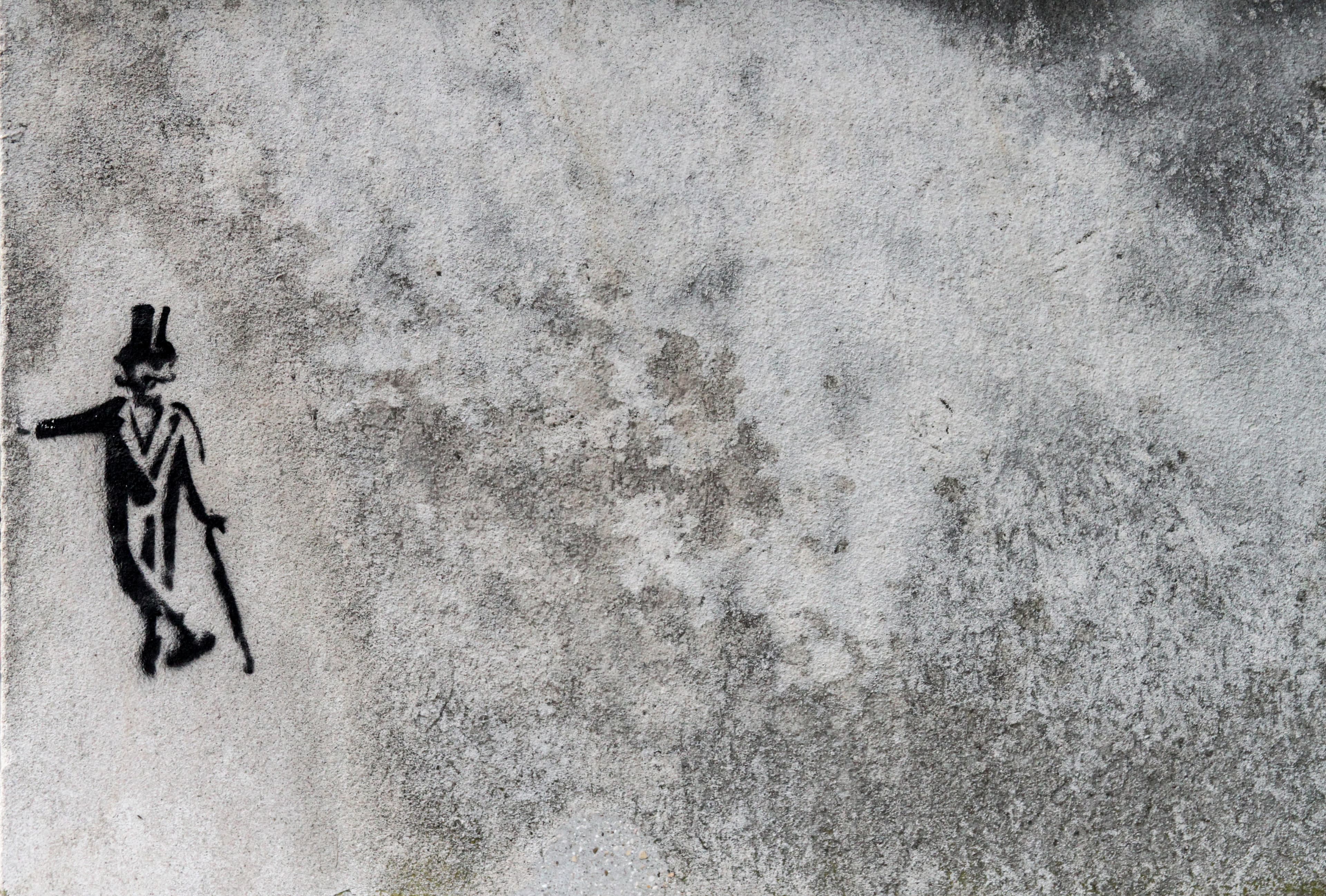
A small stenciled gentleman in a top hat steadies himself between a walking cane and an expansive weathered wall in Paris. Surrounded by stains, scratches, and negative space, the anonymous figure appears unexpectedly human despite his simple painted form. Discovered casually while walking through the city, he transforms an ordinary wall into a quiet meditation on age, endurance, and vulnerability.
The Artist
I encountered this character unexpectedly while walking through Paris.
The city offered no shortage of monuments, architecture, sculpture, and historical figures, but this small gentleman appeared on an ordinary weathered wall.
I had not been searching for street art, and there was nothing around him to explain why he was there.
He wore a top hat and carried a cane. His other hand appeared to be pressed against the wall, as though he were using both the cane and the surface beside him to remain steady.
For a moment, he seemed less like a painted figure and more like someone I had casually encountered along the way.
That was enough to make me stop.
I traveled to Paris intending to photograph its history and major landmarks. Yet, as with many of the photographs I made during that journey, the unexpected discovery became as important as the planned destination.
I was not looking for this gentleman.
Somehow, he appeared to be waiting for me.
The Curator
The Gentleman I Wasn’t Looking For uses scale and negative space to transform a fragment of Parisian street art into a quiet theatrical encounter.
The stenciled figure occupies only a small portion of the frame. Around him, the weathered wall expands into a field of stains, scratches, tonal variations, and accumulated age.
His formal appearance creates the photograph's humor.
The top hat and coat suggest ceremony, while the cane and arm pressed against the wall suggest that he is steadying himself. There is no audience, stage, or visible destination—only a solitary figure maintaining his balance against an expanse of weathered surface.
The surrounding surface becomes an imagined environment. A broad diagonal stain appears almost like a path, shadow, or landscape extending behind him.
The composition depends on restraint. By refusing to crop closely around the figure, Colón allows the emptiness to become part of the subject.
The gentleman is not merely painted on the wall.
He appears to inhabit it.
Story Behind the Photograph
Francisco Colón encountered the figure while walking through Paris during his 2013 European journey.
He had traveled to the city to experience and photograph its internationally recognized historical sites. The Eiffel Tower, Notre-Dame, the Seine, the architecture, and the streets provided more subjects than he could fully document during the visit.
This photograph emerged outside that planned itinerary.
On an ordinary wall, Colón noticed a small black figure wearing a top hat and carrying a cane. One arm extended toward the wall as though the gentleman were pressing against it for support.
The wall was otherwise dominated by weathering, stains, scratches, and empty space.
Colón stopped and photographed the scene without attempting to isolate the character from its surroundings. The scale of the wall was part of what made the encounter memorable.
The figure appeared unexpectedly small within the larger city, yet distinctive enough to interrupt the photographer's walk.
Later, Colón encountered another wall containing three related figures arranged diagonally across its surface. That second discovery suggested that the gentleman may have belonged to a recurring series of Parisian stencil characters rather than being an isolated mark.
The first encounter, however, retained its original mystery.
One gentleman stood alone, extending his arm to steady himself as he waited for the photographer to appear.
Reflection
Not every encounter requires an explanation.
I was walking through a city built around history when this small gentleman caught my attention.
He had no name.
I did not know who created him, why he had been placed on that wall, or what his gesture was intended to mean.
But he had presence.
His top hat and cane gave him formality. His extended arm made it appear as though he waited for me to notice him.
There was nothing else except him.
Perhaps that was the invitation.
Paris had given me monuments that millions of people traveled to see. This anonymous character offered something different: a private discovery waiting inside an ordinary surface.
I stopped because he was unexpected.
Years later, that remains enough.
The Museum
Preserved as the fifty-ninth accessioned photograph in the Francisco Colón Studio Photography Wing, The Gentleman I Wasn’t Looking For joins the Reflections collection as a study of discovery, scale, and imaginative observation.
Created in Paris during Colón's 2013 European journey, the photograph turns away from the city's monumental identity and concentrates on a small piece of anonymous street art.
The figure's placement within an expansive weathered wall is essential to the work. The surrounding negative space establishes solitude, while the wall's natural markings create an environment that exists somewhere between urban surface and abstract landscape.
The photograph also demonstrates a recurring characteristic of Colón's practice: planned destinations initiate the journey, but unplanned encounters frequently determine where the camera stops.
A later photograph showing three related figures provides evidence that the character may have belonged to a broader stencil series. Nevertheless, this first image preserves the experience as Colón originally encountered it—a solitary gentleman appearing without introduction on a Parisian wall.
Within the Studio archive, the work affirms that observation does not require spectacle.
Sometimes a figure only a few inches tall can interrupt an entire city.
Technical Information
- Camera
- Canon EOS Rebel T1i
- Lens
- Canon EF 28–135mm f/3.5–5.6 IS USM
- Focal Length
- 28 mm
- Capture Date
- Sunday, February 24, 2013
- Capture Time
- Approximately 5:13:16 PM Paris local time; camera recorded 11:13:16 AM New York time
- Location
- Musée de Cluny area, Paris, France
- Flash
- Did not fire (compulsory mode)
- White Balance
- Auto
- Metadata Status
- Original EXIF metadata confirms the camera, lens, focal length, camera-recorded date and time, flash status, and white balance. The February 24 date places the photograph in Paris, and neighboring archive images identify the surrounding area as the Musée de Cluny. The camera remained set to New York time; Paris was approximately six hours ahead.
- Supporting Documentation
- Original image file, related photograph showing three repeated figures, 2026 restored master, and artist provenance narrative preserved in the Studio archive.
Collection Record
- Accession Number
- FCS-PH-0059
- Exhibit Number
- 59
- Exhibition
- Reflections
- Status
- Permanent Collection
- Original Capture
- February 24, 2013
- Studio Acquisition
- Francisco Colón Studio Photography Wing
- Artist
- Francisco Colón
- Copyright
- © Francisco Colón. All Rights Reserved.