FCS-PH-0058
Photography Wing · Exhibit No. 58
The Home I Drew at Eighteen
A temporary place awakens the memory of an imagined home.
The Home I Drew at Eighteen
FCS-PH-0058
Permanent Collection
Cartagena, Colombia
Sunday, November 8, 2015
About the Work
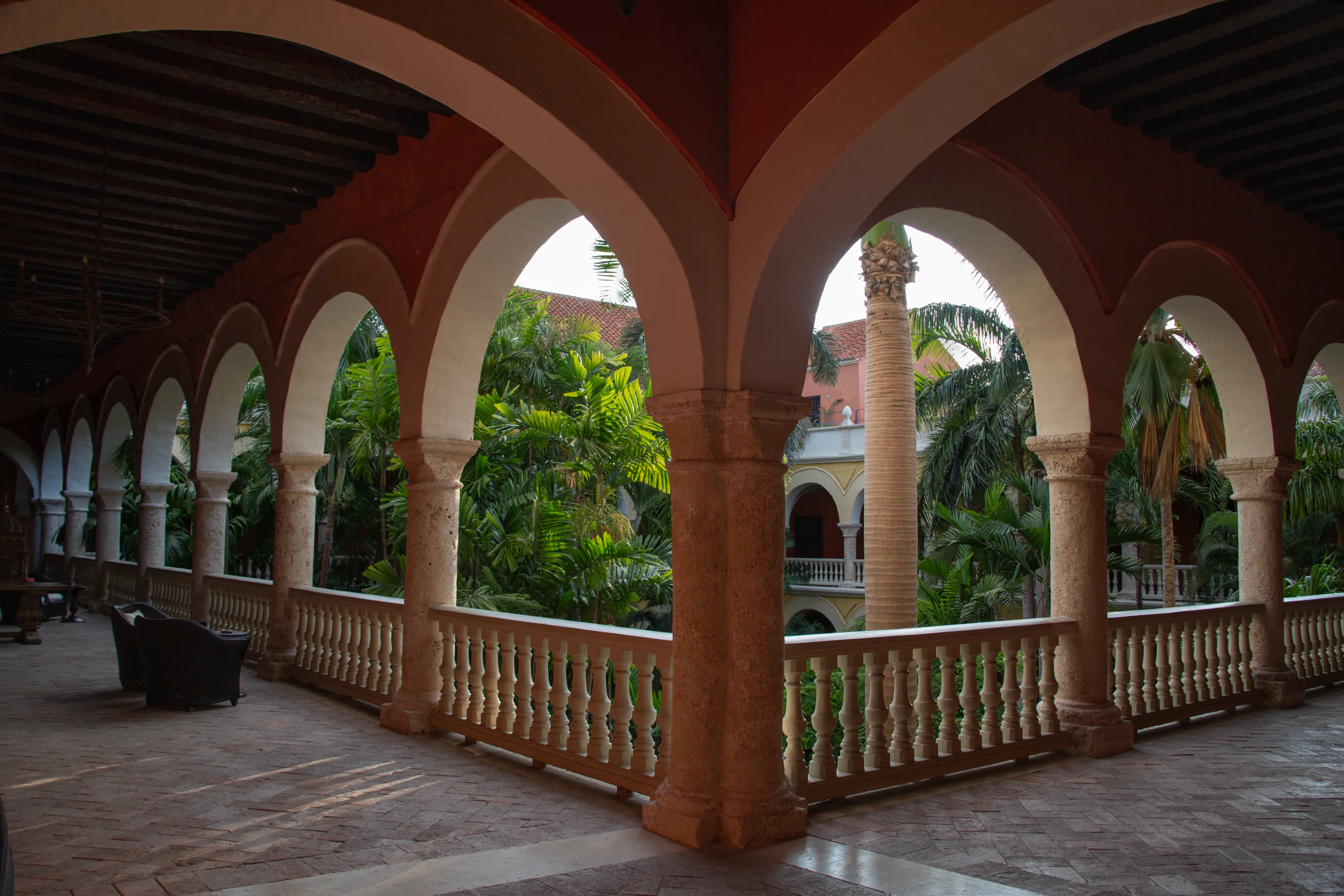
Repeating arches frame a tropical courtyard inside a hotel in Cartagena, Colombia, where warm architecture, palms, and quiet walkways create a place of shelter and reflection. Photographed during a business trip, the scene recalled a home imagined and drawn by the artist at eighteen—a home that also contained arches. What began as temporary accommodation became an encounter with an architectural memory carried across decades.
The Artist
I created this photograph during a business trip to Cartagena, Colombia.
This was the hotel where we were staying, but the space affected me as something more than temporary accommodation.
The arches first caught my attention. They repeated throughout the architecture, opening onto tropical greenery, palms, and the warm atmosphere of Colombia's Caribbean coast.
Something about the space felt familiar.
When I was eighteen, I had an opportunity to draw the kind of home I imagined for myself. I remember including arches in that design.
I did not know then where I would live or how far my life would take me.
Years later, standing inside this hotel in Cartagena, I encountered part of that imagined home.
I could see myself living in a place like this—somewhere life could become simple enough to eat, sleep, enjoy the scenery, and remain tranquil with my thoughts.
I was traveling for business, and the hotel was only temporary.
The feeling was not.
The Curator
The Home I Drew at Eighteen transforms an architectural study into an encounter between imagination and lived experience.
The photograph is organized through repetition. Arches extend in both directions from a dominant central column, forming a sheltered corridor around an open tropical courtyard.
The architecture establishes order, while the palms and dense greenery introduce movement and life.
A dark chair rests beneath the covered walkway on the left. Its presence quietly changes the scale and emotional character of the scene. The space is not merely designed to be admired; it appears capable of being inhabited slowly.
The photograph's deeper significance comes from the artist's recognition of the arches.
At eighteen, Francisco Colón drew an imagined home that included similar architectural forms. Years later, while traveling internationally for business, he encountered those forms inside a Cartagena hotel.
The image therefore documents more than a place.
It preserves the moment when something imagined early in life unexpectedly appeared within the life that followed.
Story Behind the Photograph
Francisco Colón traveled to Cartagena, Colombia, as part of his work in the telecommunications and software industries.
The trip was professional, and the hotel served a practical purpose: it was the place where he and his colleagues stayed while conducting business.
Yet the architecture created an experience beyond that purpose.
Throughout the hotel, repeating arches opened onto tropical courtyards filled with palms and dense greenery. Covered walkways offered shade from the Caribbean light, while chairs positioned beneath the arches suggested places where movement could stop.
Colón was drawn to one particular viewpoint.
A central column divided the composition while two large arches opened toward the courtyard. Smaller arches continued into the distance on both sides, producing a rhythm that felt simultaneously grand and intimate.
The structure awakened an older memory.
When Colón was eighteen, he had drawn the kind of home he imagined for himself. Although many details had faded with time, he remembered that the design included arches.
He had not traveled to Cartagena looking for that imagined home.
Nevertheless, part of it appeared before him.
He photographed the space because it represented something he could envision inhabiting: a place where daily life could become quiet enough to eat, sleep, appreciate the scenery, and remain alone with his thoughts.
Reflection
At eighteen, we imagine futures without knowing the roads that will lead toward them.
I once drew a home with arches.
At the time, it was simply an idea—an image of the kind of place in which I thought I might want to live.
Years later, my work carried me to Cartagena.
I entered a hotel built around arches, open corridors, tropical greenery, and quiet spaces where someone could sit without needing to go anywhere.
I had not built the home I drew.
I had not even gone searching for it.
Yet for the duration of that trip, I found myself living inside something that resembled the vision I had carried from eighteen.
Perhaps our early dreams do not always arrive in the form we expect.
Sometimes they appear temporarily.
They give us enough time to recognize them, inhabit them, and understand what we had been longing for.
Then life asks us to continue.
The Museum
Preserved as the fifty-eighth accessioned photograph in the Francisco Colón Studio Photography Wing, The Home I Drew at Eighteen joins the Reflections collection as a study of architectural memory.
Created during a business trip to Cartagena, Colombia, the work documents the interior courtyard of the hotel where Colón was staying.
The photograph's architectural structure is defined by repeated arches, a central supporting column, shaded walkways, tropical vegetation, and the contrasting relationship between interior darkness and Caribbean light.
Its importance within the Studio archive is personal rather than purely architectural.
The arches recalled a home Colón had imagined and drawn at eighteen. Their reappearance during an international business trip connected an early private vision with the unexpected geography of his adult life.
Within the Reflections collection, the photograph considers how memory can attach itself to physical form. A building encountered temporarily can feel familiar because it resembles something imagined long before the encounter occurred.
The hotel was not the artist's permanent home.
For one interval in Cartagena, however, it allowed him to inhabit part of the home he had once drawn.
Technical Information
- Camera
- Canon EOS 5D Mark III
- Lens
- Canon EF 28–135mm f/3.5–5.6 IS USM
- Focal Length
- 28 mm
- Capture Date
- Sunday, November 8, 2015
- Capture Time
- 5:34:12 PM
- Location
- Cartagena, Colombia
- Flash
- Did not fire (compulsory mode)
- White Balance
- Auto
- Metadata Status
- Original EXIF metadata confirms the Canon EOS 5D Mark III, Canon EF 28–135mm f/3.5–5.6 IS USM lens, capture date and time, 28 mm focal length, ISO 100, f/6.3 aperture, 1/50-second shutter speed, evaluative metering, automatic white balance, and that the flash did not fire.
- Supporting Documentation
- Original image file, surviving capture metadata, 2026 restored master, and artist provenance narrative preserved in the Studio archive.
Collection Record
- Accession Number
- FCS-PH-0058
- Exhibit Number
- 58
- Exhibition
- Reflections
- Status
- Permanent Collection
- Original Capture
- November 8, 2015
- Studio Acquisition
- Francisco Colón Studio Photography Wing
- Artist
- Francisco Colón
- Copyright
- © Francisco Colón. All Rights Reserved.