FCS-PH-0016
Photography Wing · Exhibit No. 16
The Last Touch
Respect expressed without a single word.
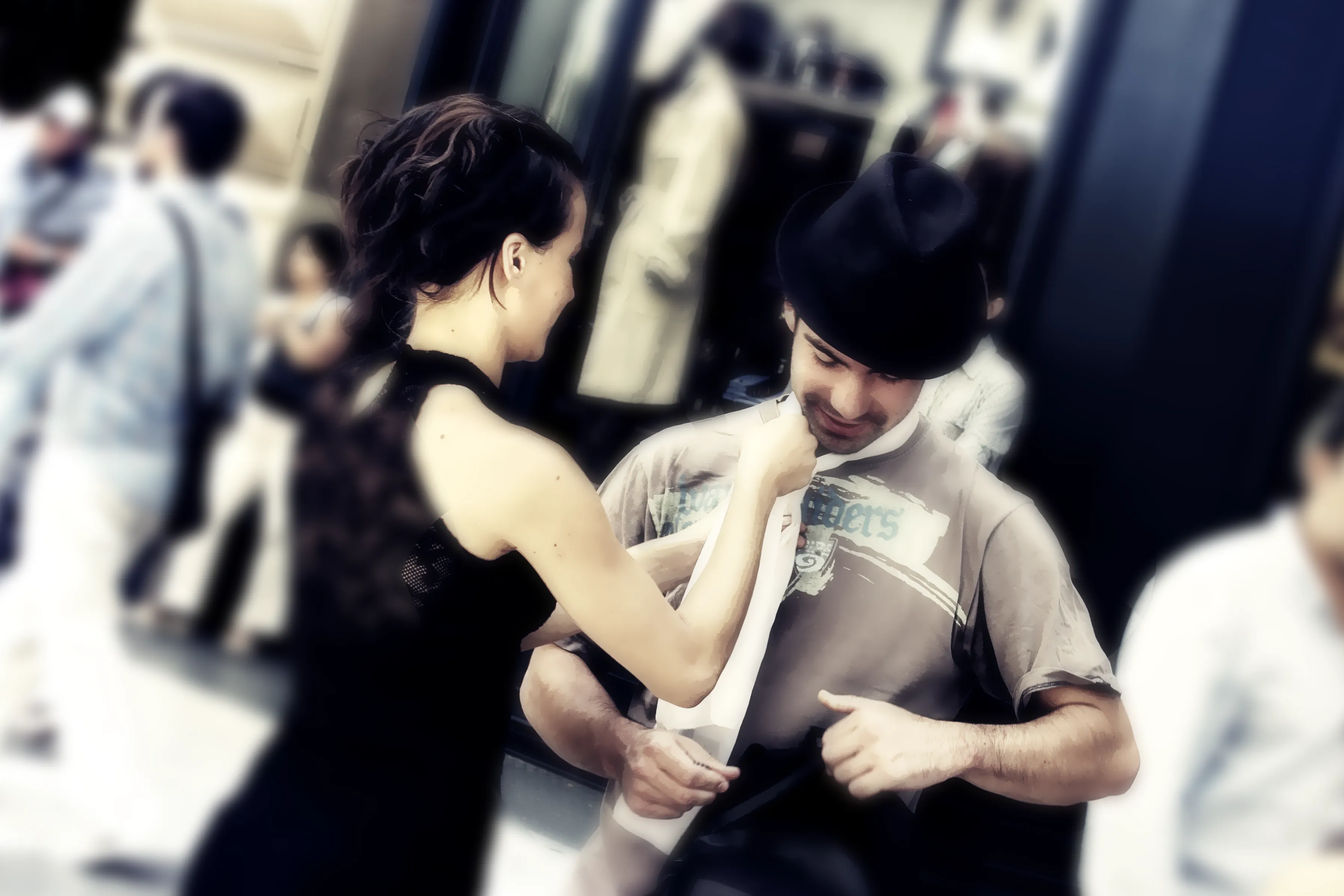
The Last Touch
FCS-PH-0016
Permanent Collection
Calle Florida, Buenos Aires, Argentina
About the Work
A tango performer carefully adjusts her partner's scarf before another street performance. The brief gesture becomes a meditation on trust, professionalism, and the quiet acts of care that precede public artistry.
The Artist
Every time I return to Buenos Aires, one of the rituals I repeat is walking the length of Calle Florida.
For me, it is more than a commercial street.
It is filled with memories—bookstores, familiar shops, passing faces, and moments that have remained with me for decades.
As always, I carried my camera.
Along the street, tango performers were preparing for another public presentation. Their stage was the sidewalk, and their reward would be whatever tips the passing audience chose to leave.
Before the music began, I noticed the woman quietly adjusting the man's scarf.
I never learned whether they were a couple or simply dance partners.
It did not matter.
What mattered was the care she gave to that small gesture, making sure everything was right before they stepped into their roles.
Looking back, I realize I was not photographing the scarf.
I was photographing respect—for the performance, for the audience, and for one another.
The Curator
Audiences remember performances.
They rarely witness the quiet moments immediately beforehand.
The Last Touch preserves one of those unseen acts. A simple adjustment of a scarf becomes a gesture of trust, professionalism, and mutual respect.
Before every performance comes preparation.
Before every public success, someone quietly helps another become ready.
Curatorially, The Last Touch is strongest when read through relationships created by proximity, gesture, and shared space. The composition does not require a dramatic event to justify its place in the collection; its meaning develops through relationships inside the frame—distance, scale, structure, atmosphere, and the distribution of visual weight. That restraint is important. It allows the photograph to carry the theme of connection through form as well as through biography, giving the work an independent visual life while remaining connected to the artist’s experience.
Story Behind the Photograph
This photograph was created on Calle Florida, one of Buenos Aires' busiest pedestrian streets.
Every visit to the city includes a walk along its length because the street continually reconnects the artist with memories gathered over many years.
Street performers have long been part of its character, transforming the sidewalks into an open-air stage for workers, shoppers, residents, and tourists.
On this particular day, two tango performers were preparing for another presentation.
Before the music began, the woman reached up and carefully adjusted the man's scarf.
The gesture lasted only a few seconds.
The artist never discovered whether they were spouses, friends, or simply dance partners.
The gesture itself told the story.
The photograph’s significance did not end when the shutter closed. What was encountered in Calle Florida later became part of a larger personal record, and the surviving frame now connects the circumstances of the exposure with the perspective gained afterward. That distinction matters: the image documents what was physically present, while the story records what the moment came to mean. Keeping those two forms of evidence together—without confusing one for the other—is central to the way this work is preserved.
Reflection
Great performances are remembered for what happens before an audience.
Yet the character of the performers is often revealed before anyone is watching.
A quiet adjustment.
A careful touch.
A final moment of reassurance.
Sometimes love looks like this.
Sometimes friendship looks like this.
And sometimes respect is expressed without saying a single word.
The photograph ultimately raises a question about the quiet visual evidence of people or places being linked. A camera can hold the appearance of a moment, but it cannot hold the entire experience surrounding it. That limitation gives The Last Touch much of its power. What is absent is not a flaw to be repaired; it is the space in which memory continues to work. The image remains fixed while the person returning to it does not.
The Museum
Preserved as the sixteenth accessioned photograph in the Francisco Colón Studio Photography Wing, The Last Touch documents the quiet preparation that makes public performance possible.
The work reflects the Photography Wing's continuing attention to human gestures that might otherwise pass unnoticed within crowded public spaces.
Within the Francisco Colón Studio Photography Wing, The Last Touch is retained as part of the archive as a record of relationships rather than isolated subjects. Its importance is therefore not measured only by subject matter or visual appeal. The work helps establish a recurring Studio principle: personal history can be preserved with emotional depth while the archive remains disciplined about the difference between what the photograph shows, what the artist remembers, and what later interpretation can responsibly infer.
Technical Information
- Location
- Calle Florida, Buenos Aires, Argentina
- Metadata Status
- Location and artist provenance preserved. Exact capture date, camera, and lens information require verification from the original file.
- Supporting Documentation
- Original source photograph and artist provenance narrative preserved in the Francisco Colón Studio archive.
Collection Record
- Accession Number
- FCS-PH-0016
- Exhibit Number
- 16
- Exhibition
- People
- Status
- Permanent Collection
- Studio Acquisition
- Francisco Colón Studio Photography Wing
- Artist
- Francisco Colón
- Copyright
- © Francisco Colón. All Rights Reserved.