FCS-PH-0100
Photography Wing · Exhibit No. 100
The Mountain They Built
At Teotihuacán, human hands raised a monument in conversation with the mountain behind it.
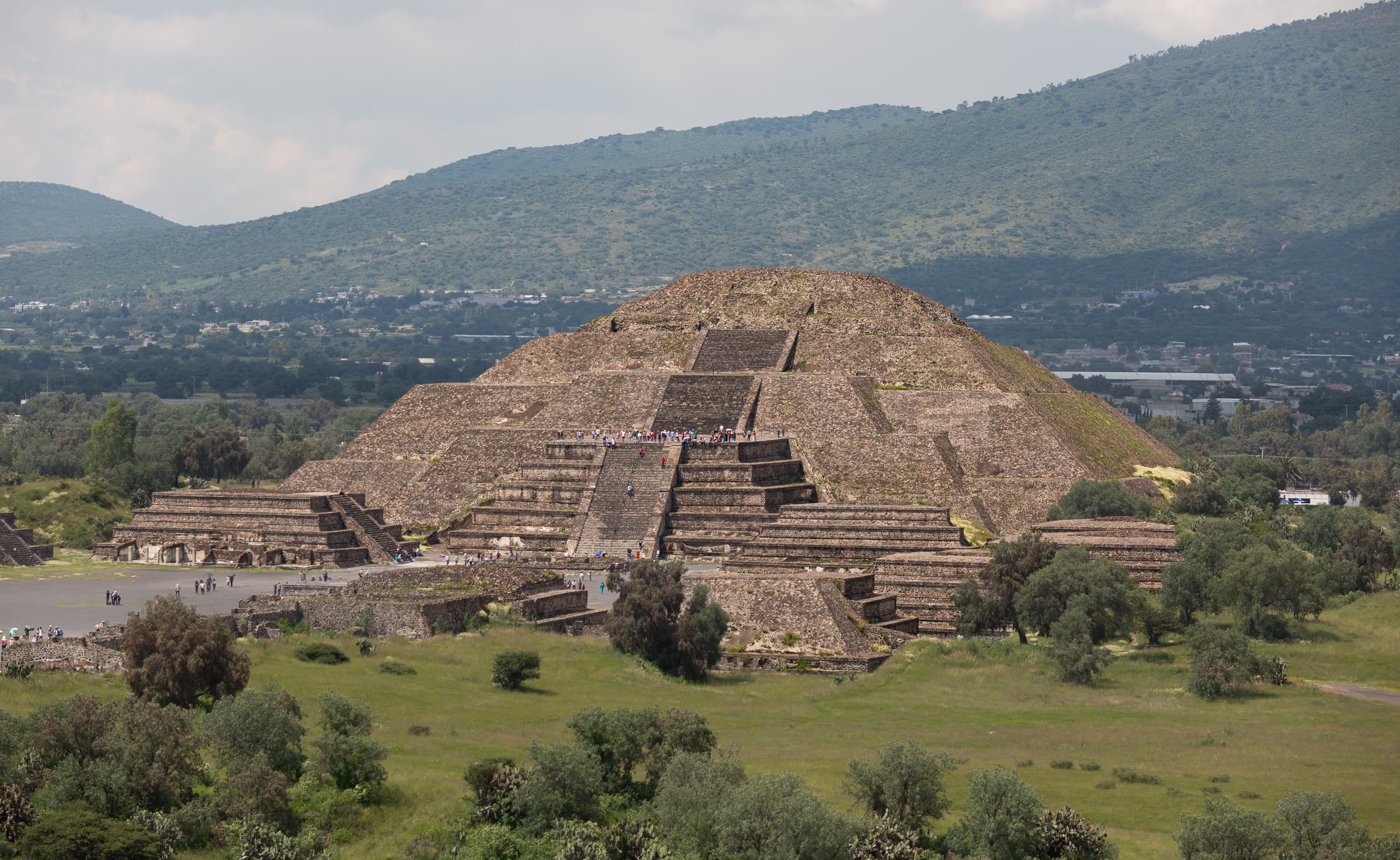
The Mountain They Built
FCS-PH-0100
Permanent Collection
Pyramid of the Moon, Teotihuacán Archaeological Zone, State of Mexico, Mexico
Saturday, September 8, 2018
Available as a Fine Art Print
Acquire a Print ↗About the Work
The Pyramid of the Moon rises from the ancient city of Teotihuacán with Cerro Gordo extending across the horizon behind it. The pyramid was positioned to echo the mountain’s profile, allowing human construction and the surrounding landscape to appear as a single ascending form. Visitors gathered along its terraces provide a measure of scale, while the mountain reminds us that the builders were not attempting to separate their city from nature—they were placing it in conversation with the land.
The Artist
I came to Teotihuacán with some very good friends. I had seen pictures of the pyramids before, but photographs did not prepare me for their size. Standing there, I was struck by the magnitude of what people had built and by the fact that these structures had survived for so long.
I also found myself thinking about distance. The pyramids of Mexico stand far from those in Africa and Asia, yet people in different parts of the world created monumental forms that seem to reach toward something beyond ordinary life. I wondered how civilizations separated by oceans and enormous distances could arrive at structures that feel related.
I do not pretend that the photograph answers that question. What stayed with me was the feeling that human beings have always been connected by certain needs: to build, to remember, to understand the world, and to leave something behind. Places like this should be taught in schools and made available for people to explore. Seeing the pyramid in person gave me an understanding that no textbook image could provide.
The Curator
The Pyramid of the Moon occupies the center of the composition, with its frontal staircase establishing a strong vertical axis. Its terraces widen toward the base and repeat the horizontal layers of the surrounding landscape. Small groups of visitors interrupt the stone surfaces and provide an immediate measure of the structure’s scale.
Cerro Gordo rises directly behind the pyramid. Its long profile visually continues the monument’s ascending form, making the constructed pyramid appear connected to the natural mountain. The open foreground preserves sufficient distance for the viewer to understand the pyramid as part of a larger ceremonial landscape rather than as an isolated building.
Colón’s elevated viewpoint compresses the pyramid and mountain without collapsing their distinction. One was built; the other emerged through geological time. Their alignment allows the photograph to hold human intention and natural form within the same visual structure.
Story Behind the Photograph
Francisco Colón made this photograph on September 8, 2018, while visiting the archaeological city of Teotihuacán with close friends. The experience gave him an opportunity to see directly the size of the structures he had previously encountered through photographs and historical references.
The image shows the Pyramid of the Moon with Cerro Gordo behind it. Mexico’s National Institute of Anthropology and History identifies the monument as a pyramid-temple and artificial sacred mountain. Its known development includes seven construction phases dating across much of Teotihuacán’s history. The pyramid was positioned so that, from important viewpoints within the city, its profile visually corresponds with the mountain behind it.
During the visit, Colón thought about pyramid-shaped monuments constructed by civilizations in widely separated regions of the world. Similar architectural forms do not by themselves establish direct contact between those societies. For Colón, however, their existence raised a broader question about the ideas, ambitions, and human needs that distant civilizations may have shared.
Reflection
A monument begins with people who know they will not live long enough to see everything that follows from their work. Stone must be lifted, placed, and aligned by hands belonging to individual lives. Yet the structure is conceived for a time beyond any one of them. To build at this scale is to imagine a future filled with people who have not yet been born.
Across the world, different civilizations raised monumental forms toward the sky. Their purposes, methods, and meanings were not identical, and resemblance alone cannot prove that their builders knew one another. Still, the repetition invites a different kind of connection. Human beings separated by continents looked at the land, faced the mystery of existence, and decided that ordinary proportions were not enough for what they wanted to express.
Perhaps our connection does not depend upon a forgotten meeting between distant peoples. It may lie in the recurring human desire to give physical form to what cannot easily be explained: reverence, power, mortality, memory, and our place within the universe. Different hands answered those questions in different languages of stone.
Standing before the Pyramid of the Moon, Colón encountered more than the remains of an ancient society. He encountered evidence that people long before him wanted their understanding of the world to endure. The monument has outlived its builders, its original ceremonies, and many of the explanations once attached to it. Yet it continues to make visitors stop, look upward, and ask questions. Its survival has become another part of what it means.
The Museum
The Mountain They Built enters the Cities collection as a record of the Pyramid of the Moon within the larger landscape of Teotihuacán. The photograph preserves the relationship between the monument, its visitors, and Cerro Gordo as it appeared during Colón’s 2018 visit.
Within the Photography Wing, the work contributes to the archive’s examination of architecture as evidence of human intention across time. Its importance extends beyond the identification of a historic structure. It records the artist’s response to physical scale, endurance, education, and the recurrence of monumental forms among distant civilizations.
The photograph also preserves the presence of contemporary visitors. Their small figures establish that Teotihuacán is not only an archaeological subject. It remains a place where people gather, learn, climb, compare their own scale with the past, and carry new questions away with them.
Technical Information
- Camera
- Canon EOS 5D Mark III
- Lens
- Canon EF 28–300mm f/3.5–5.6L IS USM
- Focal Length
- 110 mm
- Capture Date
- Saturday, September 8, 2018
- Capture Time
- Approximately 3:13:04 PM local time; camera recorded 4:13:04 PM New York time
- Location
- Pyramid of the Moon, Teotihuacán Archaeological Zone, State of Mexico, Mexico
- Flash
- Did not fire
- Metadata Status
- EXIF screenshot confirms the camera, lens, focal length, exposure, ISO, exposure mode, metering mode, original dimensions, edited dimensions, date, camera time, and flash status. The local time is converted from the camera’s established New York time setting.
- Supporting Documentation
- EXIF screenshot, artist’s account, and official archaeological information. Original dimensions: 5760 × 3840 pixels. Edited dimensions shown: 5760 × 3541 pixels.
Collection Record
- Accession Number
- FCS-PH-0100
- Exhibit Number
- 100
- Exhibition
- Cities
- Status
- Permanent Collection
- Original Capture
- September 8, 2018
- Studio Acquisition
- Francisco Colón Studio Photography Wing
- Artist
- Francisco Colón
- Copyright
- © Francisco Colón. All Rights Reserved.