FCS-PH-0137
Photography Wing · Exhibit No. 137
The Picture That Stayed
The first picture disappeared. The reason it mattered did not.
The Picture That Stayed
FCS-PH-0137
Permanent Collection
September 6, 2015
Available as a Fine Art Print
Acquire a Print ↗About the Work
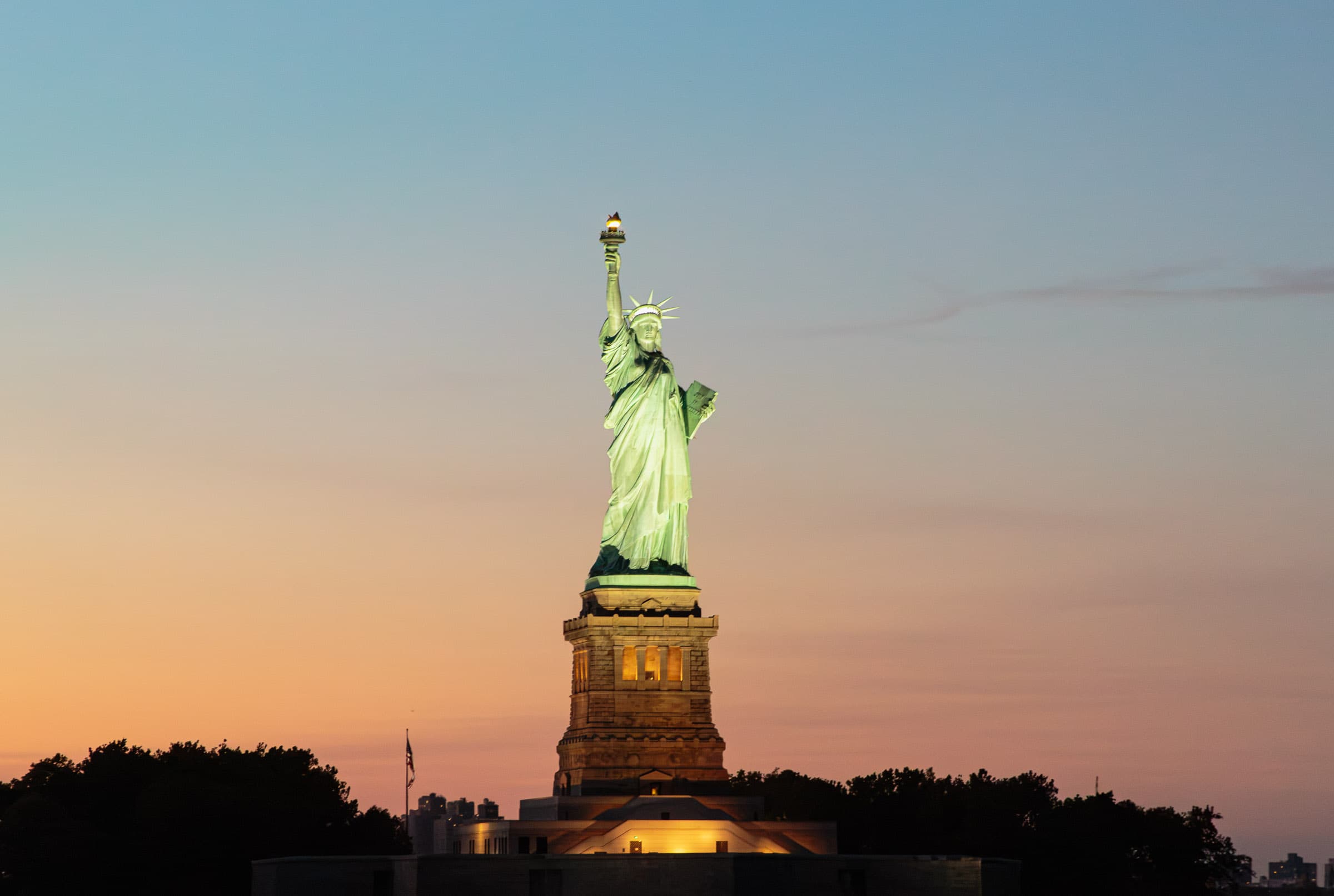
Photographed from New York Harbor in 2015, The Picture That Stayed records the Statue of Liberty against the fading colors of an evening sky. For Francisco Colón, however, the photograph reaches much farther back than the moment of exposure. His relationship with Liberty began in 1976, when a seventh-grade art teacher unexpectedly asked him to enlarge a small image of the statue into a drawing approximately the size of a door. Nearly four decades later, traveling through New York Harbor with his daughter, Colón finally encountered the figure he had studied so carefully as a boy and made a picture of her for himself.
The Artist
I wanted to see her for myself.
My relationship with the Statue of Liberty began long before I made this photograph.
It began in 1976.
I was in seventh grade, and I did not think of myself as anyone particularly important in my class. I liked to draw and would fiddle with drawings, but one day my art teacher unexpectedly called me to his desk.
There had been no contest and no announcement.
He simply called me over, showed me a small picture of the Statue of Liberty, and asked if I thought I could draw it much larger.
I said yes.
The reference was approximately the size of a small card. The paper I was going to work on was roughly the size of a door.
My teacher began showing me how to use scale and proportion to transfer what I saw in the small image onto that much larger surface.
I still remember that lesson.
But what I remember even more clearly is what being chosen gave me.
Purpose.
My purpose became my focus.
And my focus became to draw the Statue of Liberty as best I could.
I completed the drawing and painted her in different shades of gray. When it was finished, my teacher displayed it on the door of his art room for everyone to see.
At the end of the school year, he gave it to me and I took it home.
Nearly forty years later, I was in New York Harbor with my daughter and finally had the opportunity to see the Statue of Liberty at a distance that felt completely different from knowing her through pictures.
I wanted the details.
I wanted to get as close as the boat and the lens I had would allow.
I worked hard to keep her in focus.
I wasn't trying to make her small against the sky or deliberately avoid the familiar views of the Statue of Liberty. I was working within the limitations of where I was standing and the equipment I had.
I simply wanted to make the best photograph of her that I could.
In 1976, I had worked from someone else's picture.
In 2015, I was finally making my own.
The Curator
The Picture That Stayed places the Statue of Liberty against a broad evening sky transitioning from warm orange near the horizon into cooler blue above.
Liberty rises clearly above the dark tree line and surrounding structures. Her illuminated copper surface separates strongly from the subdued colors of the sky, while the pedestal provides a visual foundation within the lower portion of the composition.
A small American flag and flagpole appear to the lower left of the monument. Their comparatively small scale provides an additional visual reference for Liberty's physical presence without competing with the primary subject.
The generous amount of sky should not be interpreted solely as an intentional minimalist strategy. Colón was photographing from a moving harbor excursion with the equipment available to him and was attempting to obtain as much detail and sharpness in the statue as his position and lens permitted.
The resulting composition nevertheless creates a powerful hierarchy of scale: the surrounding elements remain comparatively small while Liberty rises independently into the changing evening light.
The photograph gains its deeper significance not from formal symbolism imposed at the moment of exposure, but from Colón's personal history with the image of the Statue of Liberty—a history that began thirty-nine years before this exposure was made.
Reflection
When I look at this photograph now, I don't return only to 2015.
I return to 1976.
I remember being a seventh-grade student and being called unexpectedly to my art teacher's desk.
I remember him showing me the small picture.
I remember him asking if I could do it.
And I remember saying yes.
That selection meant everything to me.
It didn't suddenly make me somebody in the classroom.
It gave me purpose.
My purpose became my focus, and my focus became drawing the Statue of Liberty as well as I possibly could.
The finished picture was placed on the door of my teacher's art room for everyone to see.
Eventually he gave it to me.
I took it home, but the picture did not survive.
Because of its size, I had to roll it. With time, the paint began cracking and breaking away from the paper. I was preparing to leave for Puerto Rico around that period, and I no longer remember exactly what ultimately happened to it.
Perhaps I left it behind.
Perhaps it was discarded because it was already crumbling.
I don't know.
I do know that I took it home.
For many years, that was simply a childhood memory.
Then in 2015 I found myself on the water in New York Harbor with my daughter, looking at the actual Statue of Liberty.
I had known her image for most of my life.
Now I could finally see her for myself.
There are details about Liberty that I would learn only later. Among them are the broken shackle and chains at her feet, elements that cannot be seen in this photograph and that I did not know about when I was a boy.
Even after looking at an image for decades, there can still be something left to discover.
And now it is 2026.
Fifty years have passed since my teacher called me to his desk.
The door-sized picture is gone.
The shades of gray are gone.
The paper and paint are gone.
But I can still remember the assignment.
I can still remember the lesson about scale.
I can still remember seeing my work displayed on that classroom door.
And I can still remember the sense of purpose that came from being asked to make it.
Perhaps that is why this photograph means so much more to me now than it could have when I pressed the shutter in 2015.
The boy who made that first picture could not have known that nearly forty years later he would stand on the water with his daughter and make another.
And neither of them could have known that in 2026 I would look at this photograph and realize that fifty years had passed since the story began.
The first picture did not survive.
The reason it mattered did.
The Museum
Preserved as the one hundred thirty-seventh accessioned photograph in the Francisco Colón Studio Photography Wing, The Picture That Stayed was made in New York Harbor on September 6, 2015.
The work records the Statue of Liberty during an evening harbor excursion Colón shared with his daughter.
Its place within the Reflections collection is rooted in a personal history extending back to 1976, when Colón's seventh-grade art teacher selected him to create a large-scale drawing and painting of the Statue of Liberty during the year of the United States Bicentennial.
The assignment introduced a practical lesson in scale and proportion while also giving the young artist an unexpected sense of purpose. The completed work was displayed on the door of the teacher's art room before eventually being returned to Colón.
The original artwork later deteriorated and was lost.
Thirty-nine years after making that first image, Colón photographed the actual Statue of Liberty for himself while accompanied by his daughter.
Revisited in 2026, fifty years after the classroom assignment, the photograph connects three distinct moments: the student learning to translate a small image into a large work of art, the father making his own photograph of the monument decades later, and the older photographer recognizing how completely the original experience survived the physical artwork.
The photograph therefore preserves more than an encounter with an American monument.
It preserves the continuation of an act of seeing that began half a century earlier.
Technical Information
- Camera
- Canon EOS 5D Mark III
- Lens
- Canon EF 28-135mm f/3.5-5.6 IS USM
- Focal Length
- 135 mm
- Capture Date
- September 6, 2015
- Flash
- Did not fire
Collection Record
- Accession Number
- FCS-PH-0137
- Exhibit Number
- 137
- Exhibition
- Reflections
- Status
- Permanent Collection
- Original Capture
- September 6, 2015
- Studio Acquisition
- Francisco Colón Studio Photography Wing
- Artist
- Francisco Colón
- Copyright
- © Francisco Colón. All Rights Reserved.