FCS-PH-0128
Photography Wing · Exhibit No. 128
The Reach of the Light
The Reach of the Light
FCS-PH-0128
Published
Granada, Andalusia, Spain
April 8, 2014
Available as a Fine Art Print
Acquire a Print ↗About the Work
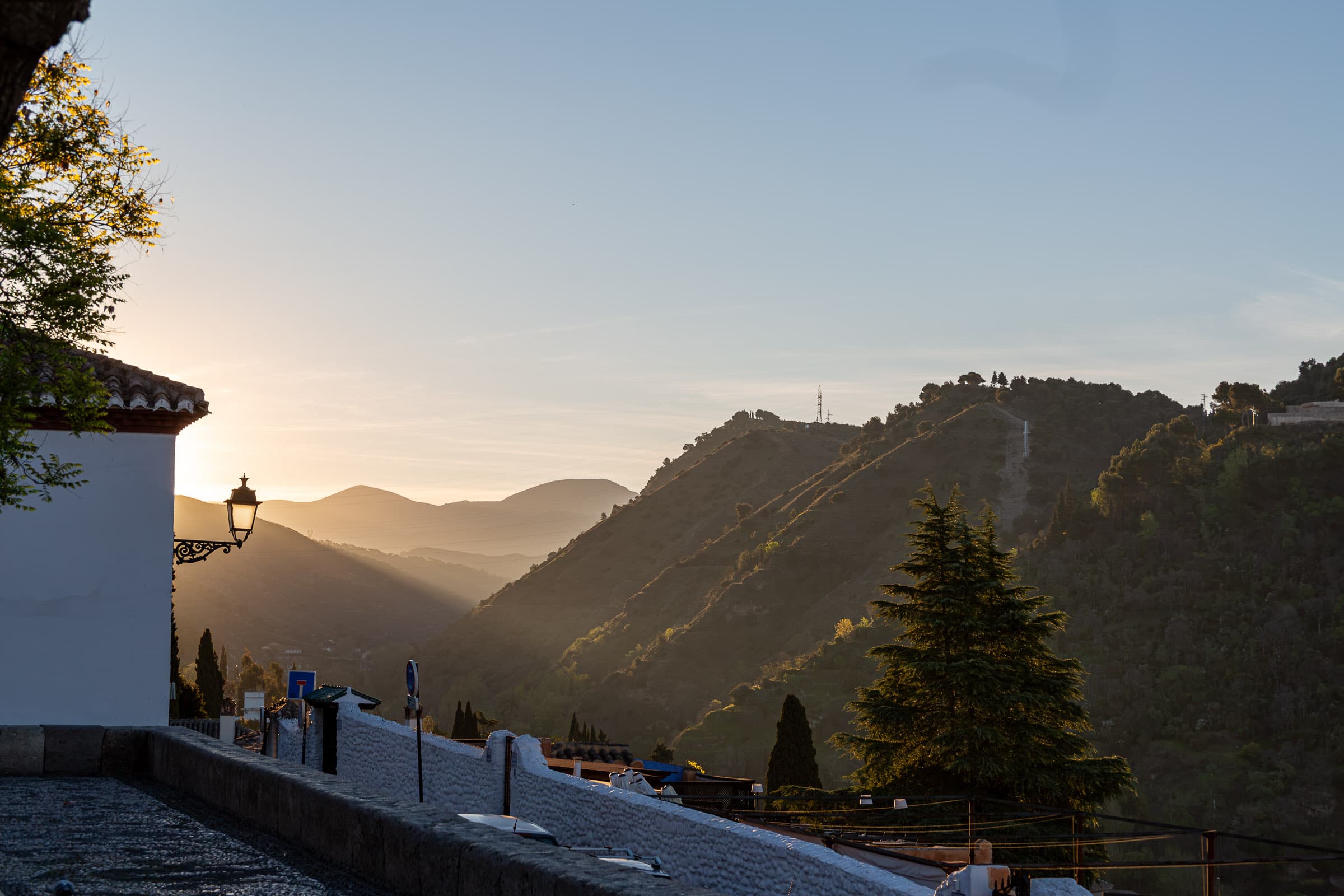
The Reach of the Light looks across the mountains surrounding Granada, Spain, as the rising sun begins its passage through the valley. From the shadowed foreground, whitewashed walls descend toward the landscape while a solitary streetlamp stands silhouetted near the emerging light. Beyond it, the mountains unfold in layers. Sunlight crosses the first ridge, reaches through the valley, and catches the slopes beyond, tracing portions of the landscape while neighboring areas remain in shadow. The contrast reveals the shape of the terrain not all at once, but gradually, according to where the morning light has reached. The photograph exists in that brief interval when darkness has not completely surrendered and daylight has not yet claimed the entire landscape. Trees, streets, and portions of the mountains remain in shadow while bands of warm illumination travel across the distance. The Reach of the Light is less about sunrise itself than about its movement—the extraordinary distance light can travel, and the way even a small portion of it can begin to transform everything it touches.
The Artist
I have always been drawn to the moment when light begins to change a space. It is not necessarily the brightness that interests me most, but the transition—the period when darkness is still present and light has begun to move through it.
Standing above this valley in Granada, what caught my attention was not simply the rising sun. It was what the sunlight was doing to the landscape. The rays seemed to travel from one mountain, through the valley, and onto another. Some slopes had already been reached while others remained in shadow. The landscape was revealing itself unevenly, according to the path of the light.
That distinction matters to me. Morning does not arrive everywhere at once. Light finds the high places first, crosses open spaces, disappears behind ridges, and then appears again somewhere farther away. For a brief period, darkness and illumination occupy the same landscape.
Years later, I understand that my fascination with moments like this may reach farther back than photography. In 1975, while living with my father in New Jersey, there was a period when our apartment had no electricity. At night, I sometimes remained in darkness rather than use up the candle we depended upon. Morning brought relief. Through the uncovered windows, daylight slowly entered the apartment and returned the room to view.
I was not consciously thinking about those mornings when I made this photograph in Granada nearly four decades later. But photographs sometimes reveal connections only after enough time has passed for us to recognize them.
Looking at this image now, I see the same transition on a much larger scale. Instead of light entering a room, it is entering a valley. Instead of revealing walls and objects, it reveals mountains, trees, ridges, and distance.
Perhaps what continues to hold my attention is not simply light or darkness, but the place where the two meet—and how far the light can reach.
The Curator
The Reach of the Light is organized around the movement of illumination across a layered mountain landscape. Rather than allowing sunrise itself to dominate the composition, the photograph uses the sun primarily as a source whose effects become visible across the terrain.
The darker foreground establishes the viewer's position within shadow. A whitewashed architectural edge and silhouetted streetlamp at left provide human scale and connect the natural landscape to the city from which it is being observed. From there, the composition opens outward into successive ridges and valleys.
The central visual event is the uneven distribution of sunlight. Warm illumination crosses portions of the nearer slopes, disappears into areas of shadow, and reappears along the larger ridge. This alternation between illuminated and unilluminated terrain reveals the topography and creates a natural progression across the frame.
Atmospheric perspective becomes increasingly important with distance. The farther mountains lose contrast and definition, producing successive tonal layers that deepen the landscape without competing with the strongly defined foreground. The prominent evergreen provides a dark vertical anchor against the predominantly horizontal and diagonal movement of the mountains.
The resulting photograph is not simply a depiction of a mountainous landscape at sunrise. Its structure depends upon the visible reach of light itself. Illumination becomes an active compositional element, connecting geographically separated portions of the landscape and allowing the viewer to follow its movement across the valley.
Reflection
When I first made this photograph, I responded to the landscape in front of me—the mountains, the valley, the morning atmosphere, and the extraordinary way sunlight seemed to move from one ridge to another.
With time, I have come to see something else in it.
Light does not eliminate the darkness in this photograph. Much of the landscape remains in shadow. The foreground is dark. Portions of the mountains have not yet received the sun. Yet the presence of darkness does not diminish the light. In many ways, it allows us to see its reach more clearly.
That realization connects this photograph to memories that existed long before I owned a camera. As a boy, I knew what it was like to wait through darkness for daylight to enter a room. Decades later, standing in Granada, I photographed essentially the same transformation occurring across an entire landscape without consciously recognizing the connection.
This is one of the things photography continues to teach me. We do not always understand why we stop. We do not always know why one arrangement of light, place, and time holds our attention while another does not. Sometimes the meaning arrives much later.
The photograph has remained unchanged since April 2014. What has changed is my understanding of why I noticed it.
The Museum
Created in Granada, Spain, on the morning of April 8, 2014, The Reach of the Light examines the interaction between early sunlight, mountainous terrain, and the built environment at the edge of the landscape. The photograph combines elements of travel, landscape, and observational photography while emphasizing the transitional character of morning illumination.
The composition moves from a dark architectural foreground into a broad sequence of valleys and ridges. A whitewashed building and traditional streetlamp establish the immediate urban context, while the landscape beyond expands through overlapping mountain forms. The prominent evergreen near the foreground provides scale and a vertical counterpoint to the diagonal contours of the terrain.
Of particular importance is the distribution of sunlight across the mountains. Illumination appears in separated passages rather than as uniform brightness, allowing the geography itself to determine where light and shadow meet. This produces a visual record not simply of the landscape but of a temporary atmospheric condition that would change continuously as the sun rose.
Within the Francisco Colón Studio collection, The Reach of the Light belongs to a recurring examination of transitional light and moments discovered while moving through unfamiliar places. It shares both geographic and thematic proximity with FCS-PH-0127, Where the Street Finds the Light, photographed in Granada the same morning. While the earlier work uses architecture to frame the transition from darkness toward illumination, The Reach of the Light expands that observation across the surrounding landscape.
Viewed together, the two photographs demonstrate how a single morning can produce different expressions of the same visual phenomenon: light gradually reclaiming spaces still occupied by shadow.
Technical Information
- Camera
- Canon EOS 5D Mark III
- Lens
- EF 28-135mm f/3.5-5.6 IS USM
- Focal Length
- 70mm
- Capture Date
- April 8, 2014
- Capture Time
- 8:12 AM local time
- Location
- Granada, Andalusia, Spain
- Flash
- Did not fire
- Metadata Status
- Original camera clock remained set to New York time. EXIF records 2:12:44 AM; corrected to approximately 8:12 AM local time in Granada.
- Supporting Documentation
- Original EXIF metadata retained. Local capture time corrected from camera time using the six-hour difference between New York and Granada on April 8, 2014.
Collection Record
- Accession Number
- FCS-PH-0128
- Exhibit Number
- 128
- Exhibition
- Nature
- Status
- Published
- Original Capture
- April 8, 2014
- Artist
- Francisco Colón
- Copyright
- © Francisco Colón. All rights reserved.