FCS-PH-0088
Photography Wing · Exhibit No. 88
The Space He Occupied
John Haydn Colley (1967–2019) — Granada, Spain
The Space He Occupied
FCS-PH-0088
Permanent Collection
Granada, Spain
April 8, 2014
About the Work
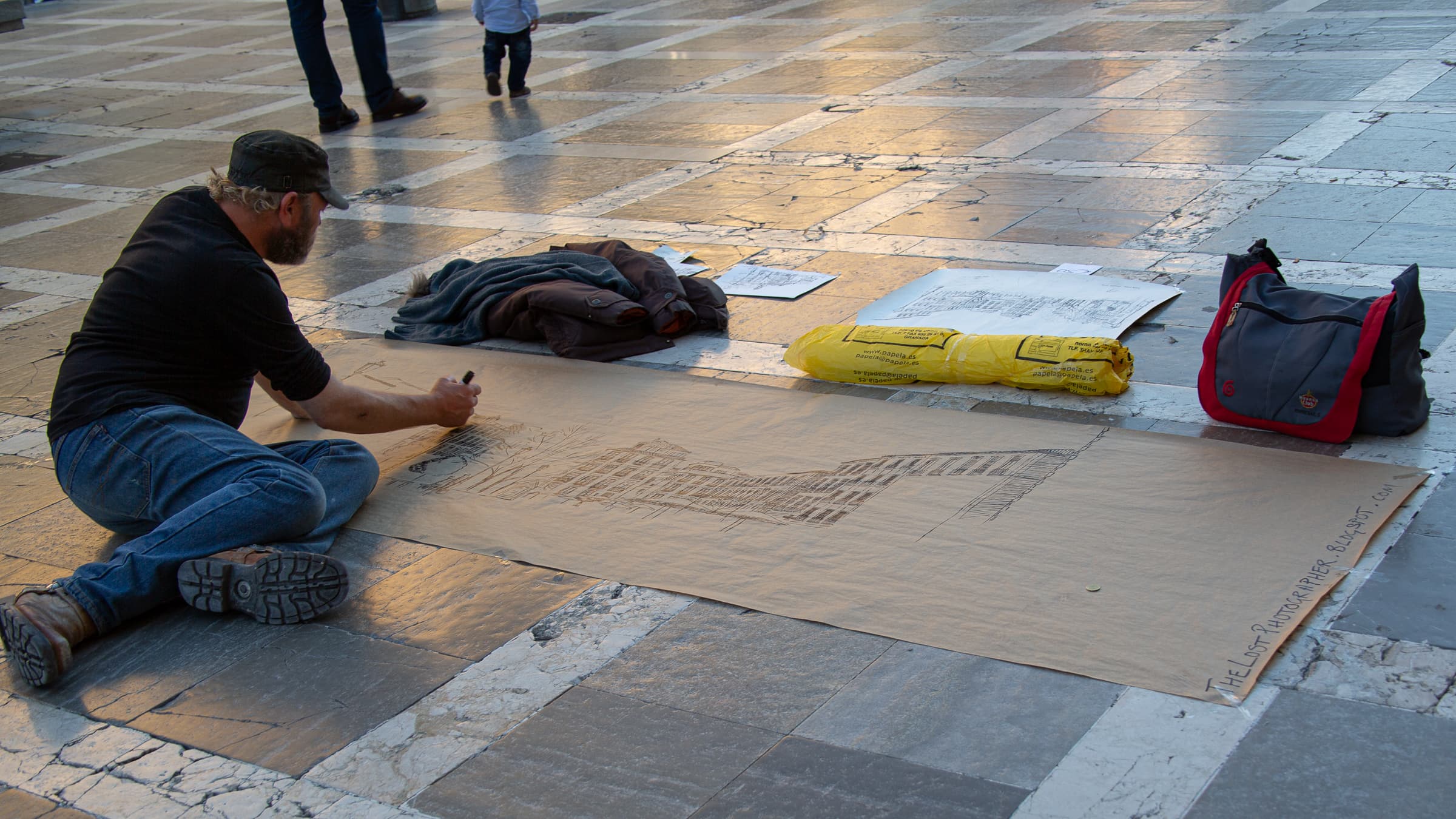
The Space He Occupied documents British artist John Haydn Colley (1967–2019) at work in Granada, Spain, on April 8, 2014, seated on the pavement as he creates a large architectural drawing on cardboard. More than twelve years later, while revisiting the original RAW photograph, Francisco Colón discovered Colley’s web address written along the edge of the drawing and traced it to The Lost Photographer, where Colley had documented his experience in Granada at the time. Colón subsequently discovered a public notice reporting that Colley died on May 11, 2019, at IPO Hospital in Lisbon, Portugal. The Studio has not independently verified the circumstances of his death. What began as a photograph of an unidentified street artist has become a record of a named artist, his work, and an encounter whose significance was not understood when the photograph was made.
The Artist
I was touring Granada when I saw this man sitting on the pavement drawing. What caught my attention was the scale of what he was doing. He wasn't working in a sketchbook. He had spread a large piece of cardboard across the ground and was building an architectural drawing directly on it.
I photographed him from behind and continued on. I never spoke with him, and I knew nothing about him. After that trip, the photograph remained among my RAW files from 2014 and I didn't return to it for more than twelve years.
When I finally looked at it again, I noticed something I had completely missed when I made the photograph: writing along the edge of the cardboard. Among it was a reference to The Lost Photographer.
I followed it.
The artist was John Haydn Colley. His site was still there, and because I knew exactly when I had made the photograph — April 8, 2014 — I went into his archive looking for that period. There I found his writing from Granada. On April 7, the day before my photograph, he wrote about leaving the city after being fined €150 for what he described as "occupation of a public space" while working as an artist.
That discovery changed the photograph for me.
Then I discovered something I was not prepared for. John had died several years after I photographed him.
I had never spoken to this man. He never knew that I made this photograph, and until now I didn't even know his name. Yet suddenly I wasn't simply looking at an unknown street artist from one of my travels. I knew who he was. I had read his words. I had seen his work. And I knew that he was no longer here.
I understand his frustration in Granada differently now. As an artist myself, I understand wanting the freedom simply to make something and share it with the people around you.
I want his own work to remain part of this record. That is why the Studio maintains a link to The Lost Photographer. It is my small gesture of solidarity from one artist to another.
The photograph didn't change. What I was able to see in it did.
The Curator
The composition places John Haydn Colley low within the public plaza, his seated body anchoring the left side of the frame while the long sheet of cardboard extends horizontally across the pavement. His posture, arm and hand direct the eye immediately toward the drawing, creating a visual connection between artist and work.
Around him are the ordinary materials of a working artist: bags, clothing, loose drawings and the improvised surface on which he works. Pedestrians continue through the upper portion of the frame, establishing a quiet contrast between movement and concentration. Colley has stopped; the city continues around him.
The broad horizontal format reinforces the physical territory occupied by the drawing. Yet even with the cardboard, belongings and artist spread across the pavement, they consume only a modest portion of the surrounding public space. That spatial relationship takes on additional meaning when considered alongside Colley's contemporaneous account of being fined for the "occupation of a public space."
The title therefore operates both literally and retrospectively. The space Colley occupied was physical, temporary and relatively small. What survived from his presence there — the drawing, his writing and this photograph — extends far beyond it.
Story Behind the Photograph
Francisco Colón made this photograph in Granada, Spain, on April 8, 2014, while touring the city. He encountered an artist working directly on the pavement and photographed him from behind as he produced a large architectural drawing on cardboard.
There was no conversation between photographer and subject. Colón did not know the man's identity or circumstances, and the photograph subsequently remained among his Camera RAW files for more than twelve years.
During a review of the archive in 2026, Colón noticed writing preserved along the edge of the cardboard. Following that information led to The Lost Photographer, the online archive of artist John Haydn Colley.
The known capture date made it possible to search Colley's contemporaneous writings. An entry dated April 7, 2014 — one day before this photograph — documents Colley's dissatisfaction with his experience in Granada. In his own account, Colley stated that he had received a €150 fine for "occupation of a public space" while working as an artist and expressed his intention to leave Granada.
The Studio distinguishes between what the photograph documents and what was subsequently learned from Colley's account. The photograph establishes Colley's presence and work in Granada on April 8, 2014. His description of the fine and his dispute with local authorities comes from his own contemporaneous writing; the Studio has not independently examined the citation or the city's account of the incident.
Further research led Colón to a public notice posted beneath a video about Colley stating that John Haydn Colley died on May 11, 2019, at IPO Hospital in Lisbon, Portugal. The Studio has not independently verified the circumstances of his death and therefore preserves that information with its source qualification.
What began in 2014 as a photograph of an unidentified street artist became, twelve years later, a documented encounter between two artists whose connection was unknown to either of them at the time.
Reflection
A photograph can contain information its maker does not yet understand.
At the moment of exposure, the photographer sees only what circumstances allow him to see: a man, a drawing, a public square, an act of concentration. But photographs preserve relationships, inscriptions and evidence that can remain dormant until someone returns and looks again.
Here, a small piece of writing along the edge of a sheet of cardboard survived inside the frame for more than twelve years. It became a path from image to identity, from identity to another artist's words, and ultimately from an anonymous encounter to the recognition of a life.
There is also a question of what it means for an artist to occupy public space. Cities are experienced not only through their monuments and architecture but through the people who temporarily transform their streets — musicians, painters, performers, photographers and those who stop to watch them.
Colley's physical occupation of this particular space was temporary. The evidence of his presence was not.
His drawings survived. His words survived. His online archive survived. And without either man knowing it at the time, a photograph survived.
The space an artist occupies may be physically small. What remains from having occupied it can be considerably larger.
The Museum
The Space He Occupied is preserved within the Francisco Colón Studio Photography Wing as both a documentary street photograph and an example of retrospective photographic discovery.
The original RAW file establishes the photograph in Granada on April 8, 2014. More than twelve years later, details retained within that file allowed Francisco Colón to identify the previously unknown artist as John Haydn Colley (1967–2019) and connect the photograph with Colley's contemporaneous writings at The Lost Photographer.
During that research, Colón discovered a public notice reporting that John Haydn Colley died on May 11, 2019, at IPO Hospital in Lisbon, Portugal. Because the Studio has not located an independent death record or obituary confirming those particulars, the date and place of death are preserved here with that qualification.
Colley's blog, The Lost Photographer, remains online. Francisco Colón Studio preserves a direct link to that archive in recognition of the artist depicted here and in solidarity from one artist to another.
Colley speaks for himself there. His drawings, photographs, travels, frustrations and observations remain in his own words.
In Granada on April 8, 2014, their paths crossed without introduction. John Haydn Colley was making a drawing. Francisco Colón made a photograph. Neither man knew that more than twelve years later the photograph would lead one artist back to the identity, words and surviving archive of the other.
Artist Archive — John Haydn Colley (1967–2019) The Lost Photographer https://thelostphotographer.blogspot.com/
This external archive is maintained independently of Francisco Colón Studio.
Technical Information
- Camera
- Canon EOS 5D Mark III
- Lens
- Canon EF28-135mm f/3.5-5.6 IS USM
- Focal Length
- 41 mm
- Capture Date
- April 8, 2014
- Capture Time
- 2:02:27 PM
- Location
- Granada, Spain
- Flash
- Did not fire
- White Balance
- As Shot
- Metadata Status
- Original Camera RAW file (_25A8662.CR2). ISO 100; 41 mm; 1/60 sec at f/5.6; 0 EV exposure bias; Normal exposure program; Pattern metering; flash did not fire. Original dimensions 5760 × 3840 pixels. Final presentation dimensions 5183 × 2915 pixels following a 16:9 crop. Capture information verified from the original RAW metadata.
- Supporting Documentation
- John Haydn Colley's online archive, The Lost Photographer, including his April 7, 2014 entry concerning his experience working as an artist in Granada. Additional later-life information derives from a public comment beneath a video about Colley and has not been independently verified by the Studio.
Collection Record
- Accession Number
- FCS-PH-0088
- Exhibit Number
- 88
- Exhibition
- Photography Wing
- Status
- Permanent Collection
- Studio Acquisition
- Francisco Colón Studio Photography Wing
- Artist
- Francisco Colón
- Copyright
- © Francisco Colón. All Rights Reserved.