FCS-PH-0067
Photography Wing · Exhibit No. 67
The View I Almost Missed
Moving through Cartagena in search of photographs, the photographer's attention stops at a wall filled with objects and memory.
The View I Almost Missed
FCS-PH-0067
Permanent Collection
Historic Old City, Cartagena, Colombia
Sunday, November 8, 2015
About the Work
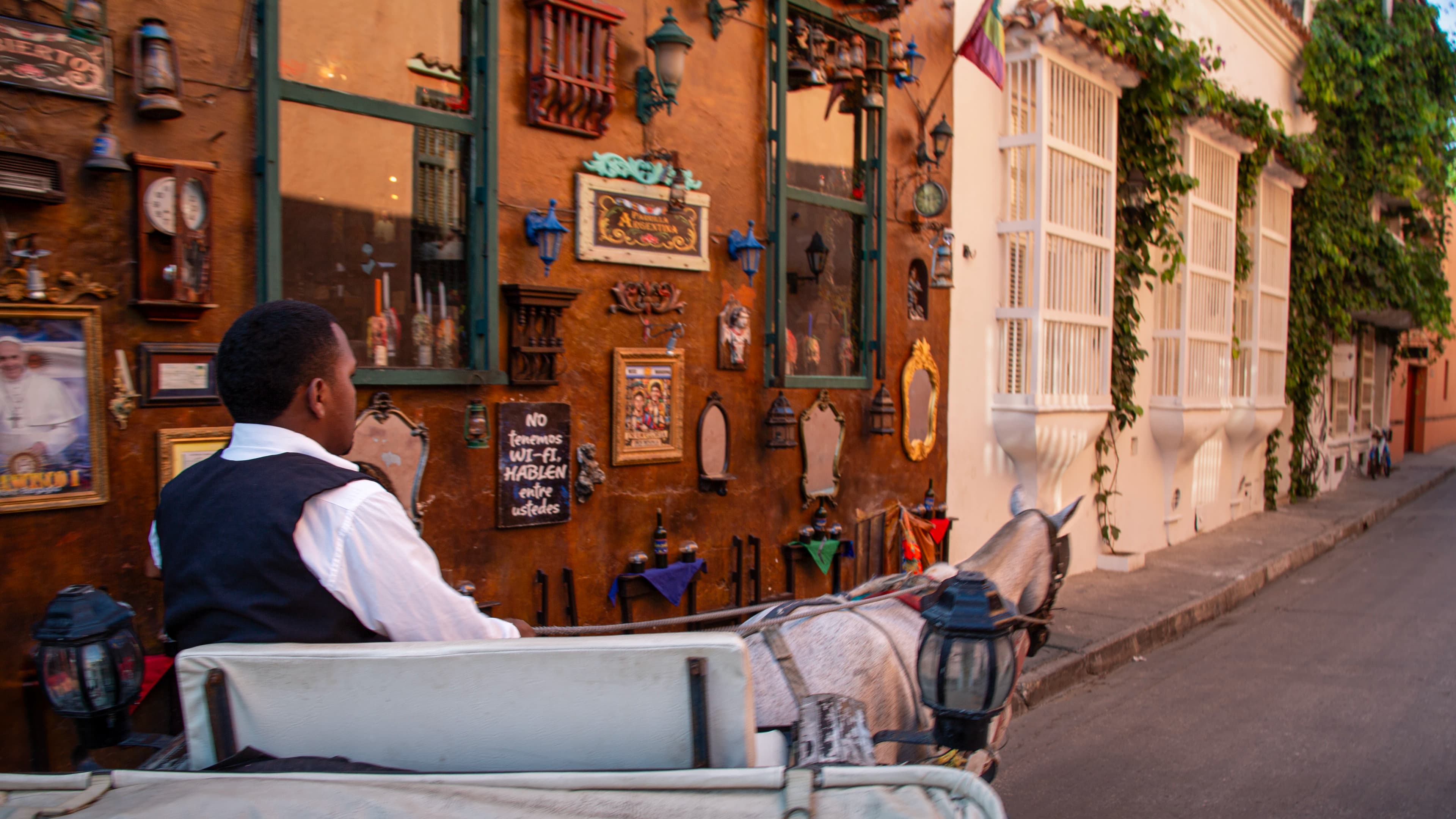
Photographed from a horse-drawn carriage moving through Cartagena's old city, this layered street scene reveals the photographer's attention turning away from the road and toward an extraordinary decorated wall. Mirrors, lanterns, clocks, religious imagery, nameplates, tables, and a handwritten sign reading “No tenemos Wi-Fi. Hablen entre ustedes” compete for attention as the driver and horse continue forward. The image reflects the difference between passing through a place, photographing it, and fully experiencing it.
The Artist
I hired a horse and carriage to take me through the streets of Cartagena while I photographed everything that attracted my attention.
I believed the elevated position would give me a clearer view and allow me to capture more of the old city.
I was both correct and mistaken.
The carriage carried me through beautiful streets and past places I might not otherwise have reached. From that higher position, I photographed continuously.
But I was so focused on what I could capture that I did not always appreciate what I was seeing.
My eyes were constantly searching for the next composition.
In this photograph, the driver and horse are returning to the street, but my attention has already moved away from the road ahead.
I am looking at the wall beside us.
The wall seemed to contain an entire collection of individual stories.
I saw a framed portrait of a pope, although I cannot confidently identify whether it was John Paul II or Benedict XVI. I saw a clock, lanterns, a nameplate, mirrors, small tables, lights, religious images, and a handwritten sign telling visitors that there was no Wi-Fi and that they should speak with one another.
Each object competed for my attention.
Even the mirrors seemed to invite people to stop and look at themselves.
I loved the arrangement—not because it was orderly, but because every object appeared to have been placed there by someone who valued it.
The wall felt less like decoration and more like a collection of memories displayed in public.
Meanwhile, the driver and horse continued carrying me forward.
The photograph preserves that contradiction.
I was moving through Cartagena, but my attention had stopped at the wall.
The Curator
Curatorially, The View I Almost Missed is strongest when read through the discipline of noticing what might otherwise pass without emphasis. The composition does not require a dramatic event to justify its place in the collection; its meaning develops through relationships inside the frame—distance, scale, structure, atmosphere, and the distribution of visual weight. That restraint is important. It allows the photograph to carry the theme of observation through form as well as through biography, giving the work an independent visual life while remaining connected to the artist’s experience.
Story Behind the Photograph
During a business trip to Cartagena, Colombia, in November 2015, Francisco Colón hired a horse-drawn carriage to carry him through the streets of the historic old city.
He believed the carriage would provide two advantages.
It would allow him to visit more locations, and its elevated seating position would give him a clearer photographic view of the streets.
The decision was both successful and limiting.
The carriage transported Colón through much of the old city and provided access to a continuous sequence of architecture, people, storefronts, and street details.
At the same time, the movement required him to evaluate each passing scene quickly.
Instead of fully experiencing Cartagena, his attention became concentrated upon what could be captured before it disappeared from view.
In this photograph, the carriage driver and horse occupy the foreground as they proceed into the street.
The visible portion of the carriage establishes Colón's position as a passenger and places the viewer within the same moving perspective.
The road continues into the distance on the right, but the photographer's attention has turned toward the richly decorated wall on the left.
The storefront contains mirrors, lanterns, clocks, framed pictures, religious imagery, nameplates, small pieces of furniture, and other decorative objects.
Among them is a handwritten sign reading, “No tenemos Wi-Fi. Hablen entre ustedes”—“We don't have Wi-Fi. Talk among yourselves.”
A framed portrait of a pope is also visible, although the surviving image does not provide sufficient detail to identify him confidently.
The driver and horse continue moving forward while the wall temporarily arrests the photographer's attention.
The image therefore documents both the city and the process through which Colón attempted to photograph it.
He saw a great deal of Cartagena from the carriage and created many photographs during the journey.
Only a small number eventually entered the Studio.
The remaining images stayed within the archive, waiting to be reconsidered.
The View I Almost Missed is one of those recovered observations: a photograph about seeing more of a city while questioning how much of it was fully experienced.
Reflection
The carriage allowed me to see more of Cartagena.
It also made me aware that seeing more does not necessarily mean experiencing more.
I had hired it because I wanted access, movement, and an elevated position from which to photograph the old city.
The plan worked.
I traveled through beautiful streets and made many images.
But my attention was always moving ahead of me.
I was searching for the next subject, the next arrangement of objects, the next photograph that might disappear if I did not respond quickly enough.
This wall brought that habit into view.
The horse and driver were continuing into the street, but my eyes had stopped among the clocks, mirrors, lanterns, pictures, signs, and small pieces of furniture.
I could not see beyond what entered the frame.
The destination ahead disappeared because the wall beside me had become the entire world of the photograph.
There is an irony in the handwritten sign.
It tells people that there is no Wi-Fi and asks them to speak with one another.
I was physically present in Cartagena, surrounded by the city and traveling with another person, yet my attention remained concentrated through the camera.
Photography helped me preserve the experience.
It may also have prevented me from fully inhabiting parts of it.
The image reminds me that looking, photographing, and appreciating are related acts, but they are not always the same.
The Museum
Preserved as the sixty-seventh accessioned photograph in the Francisco Colón Studio Photography Wing, The View I Almost Missed joins the Cities collection as a study of observation, movement, memory, and the limits of photographic attention.
The photograph was created from a horse-drawn carriage traveling through the historic old city of Cartagena, Colombia, during a business trip in November 2015.
Colón hired the carriage to reach more of the city and photograph from an elevated position.
The foreground retains a visible portion of the carriage, its driver, and the horse. These elements establish the photographer's physical location and place the viewer within the moving vehicle.
The composition divides attention between two directions.
The driver, horse, and receding street indicate continued forward movement, while the decorated storefront draws the photographer's attention laterally toward the wall.
The wall contains numerous objects, including clocks, lanterns, mirrors, framed imagery, nameplates, furniture, religious material, and a handwritten sign reading, “No tenemos Wi-Fi. Hablen entre ustedes.”
The English translation is: “We don't have Wi-Fi. Talk among yourselves.”
A framed portrait of a pope is visible at the far left. Because the portrait cannot be identified reliably from the available detail, the Studio record does not attribute it to a specific pontiff.
The image contains slight motion softness consistent with photographing from a carriage in transit.
That softness has been retained as evidence of the circumstances of the capture rather than replaced through excessive sharpening.
The photograph was revisited and restored in 2026. The restoration controlled highlights, opened selected shadows, preserved the warm Cartagena atmosphere, and reduced the visual dominance of the pale carriage covering through a panoramic crop.
Within the Studio archive, The View I Almost Missed functions as both a city photograph and an indirect self-portrait.
Colón does not appear within the frame, but the visible carriage documents his position, method, and way of looking.
The work considers a central contradiction of travel photography: the camera may help preserve a place while simultaneously concentrating the photographer's attention so narrowly that parts of the lived experience pass unnoticed.
Technical Information
- Camera
- Canon EOS 5D Mark III
- Lens
- Canon EF 28–135mm f/3.5–5.6 IS USM
- Focal Length
- 28 mm
- Capture Date
- Sunday, November 8, 2015
- Capture Time
- 5:03:27 PM (camera-recorded time)
- Location
- Historic Old City, Cartagena, Colombia
- Route
- Photographed from a hired horse-drawn carriage traveling through Cartagena's historic streets
- Flash
- Did not fire (compulsory mode)
- White Balance
- Auto
- Metadata Status
- Original EXIF metadata confirms the Canon EOS 5D Mark III, Canon EF 28–135mm f/3.5–5.6 IS USM lens at 28mm, ISO 100, evaluative metering, automatic exposure mode, automatic white balance, a maximum aperture value of f/3.7, and that the flash did not fire. The camera recorded the photograph on November 8, 2015, at 5:03:27 PM. The image was created two minutes and forty-seven seconds before The Wall Keeps Watch, supporting the documented sequence of photographs made while traveling through Cartagena.
- Supporting Documentation
- Original Canon RAW file, surviving EXIF metadata, surrounding Cartagena carriage sequence, 2026 restored master, and artist provenance narrative preserved in the Francisco Colón Studio archive.
Collection Record
- Accession Number
- FCS-PH-0067
- Exhibit Number
- 67
- Exhibition
- Cities
- Status
- Permanent Collection
- Original Capture
- November 8,2015
- Studio Acquisition
- Francisco Colón Studio Photography Wing
- Artist
- Francisco Colón
- Copyright
- © Francisco Colón. All Rights Reserved.