FCS-PH-0081
Photography Wing · Exhibit No. 81
The View I Asked For
Rio taught me its language and left me with its rhythm.
The View I Asked For
FCS-PH-0081
Permanent Collection — Photographic Composite
Sheraton Hotel, Rio de Janeiro, Brazil
Not available in accessible EXIF metadata
About the Work
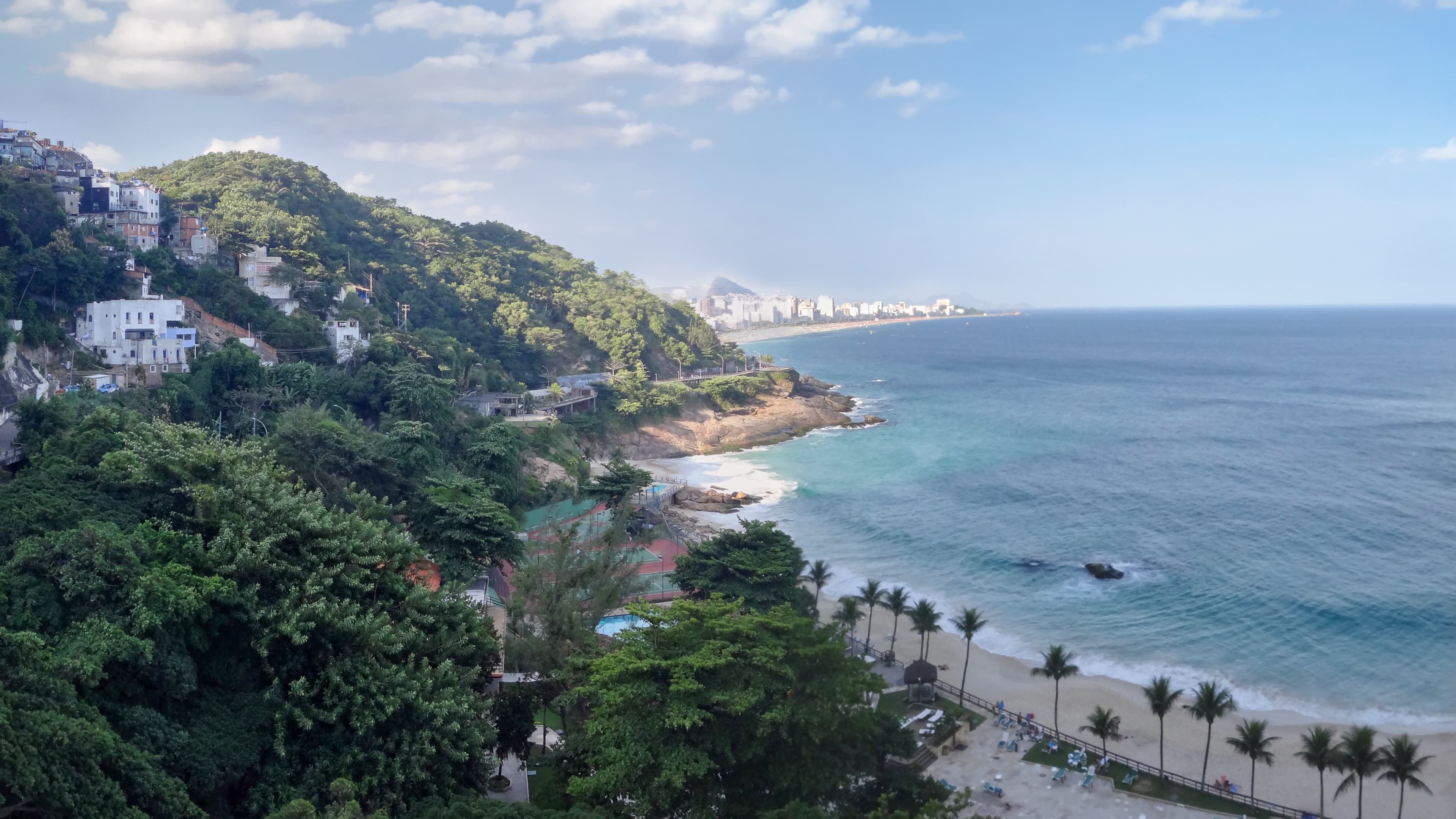
From a high corner room at the Sheraton, Rio de Janeiro unfolds between a forested hillside and the Atlantic Ocean, with the coastline leading toward Leblon and Copacabana. It was a view repeatedly requested during many visits to the city. The photograph preserves more than familiar scenery—it recalls the place where Portuguese was learned through conversations with local people and where the rhythms of samba began finding their way into compositions written with Spanish lyrics.
The Artist
I traveled to Rio de Janeiro extensively, and during many of those visits I stayed at the Sheraton. Whenever possible, I requested a room in the upper corner of the hotel—not because of the room itself, but because of this view.
From there, I could see the hillside descending toward the Atlantic Ocean, with the coastline extending toward Leblon and Copacabana. The city and the ocean appeared together, each giving scale and meaning to the other.
The view became familiar, but I never considered it ordinary. Each time I returned, it reminded me that I was once again in a city that had changed how I spoke, how I listened, and eventually how I composed music.
The Curator
The View I Asked For is organized around the sweeping diagonal of Rio de Janeiro's coastline. The densely forested hillside anchors the foreground, while the shoreline directs the eye toward the distant city. The Atlantic occupies the open right side of the composition, creating a visual balance between enclosure and possibility.
The elevated perspective might initially suggest distance from the city below. The accompanying history reveals the opposite. This was not a view observed in isolation, but the starting point for repeated walks into Rio, conversations with local residents, and a gradual immersion in Brazilian language and culture.
The photograph therefore functions as both landscape and personal map. It identifies the place from which the artist repeatedly entered the city and the perspective to which he returned.
Story Behind the Photograph
I traveled to Rio de Janeiro many times, and during those visits I frequently stayed at the Sheraton. Whenever possible, I requested a room in the upper corner of the hotel. I did not request it for luxury. I requested it because I wanted this view.
From the window, I could see the green hillside descending toward the Atlantic and the coastline continuing toward Leblon and Copacabana. I often left the hotel on foot and followed that coastline into the city. It was an enjoyable walk—long enough to observe the neighborhoods, meet people, and experience Rio beyond the boundaries of the hotel.
Rio was also where I had to stop depending on Spanish and force myself to learn Portuguese. Speaking with local people taught me what lessons alone could not. The language gradually became part of how I experienced the city, and over time I became comfortable enough to call myself, affectionately, a Carioca.
Music became part of that connection. Samba was everywhere—not simply as entertainment, but as part of Rio's movement and personality. Its rhythm remained with me after I left. Eventually, traces of that samba sound began appearing in my own compositions, carrying a Brazilian pulse beneath Spanish lyrics.
This photograph preserves the view I repeatedly requested: the city and the ocean held within the same frame. It represents more than a destination I enjoyed visiting. It remembers a city that changed how I spoke, how I listened, and how I approached music.
Reflection
Some places become important not because we visited them once, but because we returned often enough for them to begin changing us.
A familiar hotel room can become an entry point into another language. A walk along the coast can become an education in how a city moves. A rhythm heard in the streets can cross borders and reappear years later beneath words written in another language.
Travel does not always transform us through a single dramatic moment. Sometimes transformation happens gradually—one conversation, one walk, one returning view at a time.
Eventually, we stop feeling like visitors. A part of the place begins traveling with us.
The Museum
Preserved within the Journeys collection of the Francisco Colón Studio Photography Wing. The work documents the relationship between repeated travel, cultural immersion, language, and musical development.
The photograph also establishes a connection between the Studio's Photography and Music Wings. The rhythms encountered in Rio de Janeiro later influenced compositions combining elements of samba with Spanish-language lyrics.
The original capture contained unrecoverable highlight clipping in a portion of the sky. The sky was reconstructed during post-processing while the coastline, hillside, ocean, buildings, and principal geographic features of the original photograph were preserved. The completed work is therefore cataloged as a photographic composite.
Technical Information
- Camera
- Sony Cyber-shot DSC-TX10
- Lens
- Sony 4.43–17.7mm f/3.5–4.6
- Focal Length
- 4.4 mm
- Capture Date
- Not available in accessible EXIF metadata
- Location
- Sheraton Hotel, Rio de Janeiro, Brazil
- Flash
- Did not fire, compulsory mode
- White Balance
- Auto
- Metadata Status
- Partial original EXIF metadata preserved; capture date unavailable
- Supporting Documentation
- Automatic exposure, ISO 125, f/3.5, pattern metering, and brightness value 9.22. Sky reconstructed during post-processing to address unrecoverable highlight clipping.
Collection Record
- Accession Number
- FCS-PH-0081
- Exhibit Number
- 81
- Exhibition
- Journeys
- Status
- Permanent Collection — Photographic Composite
- Original Capture
- Capture date unavailable in accessible EXIF metadata
- Studio Acquisition
- Francisco Colón Studio Photography Wing
- Artist
- Francisco Colón
- Copyright
- © Francisco Colón. All Rights Reserved.