FCS-PH-0066
Photography Wing · Exhibit No. 66
The Wall Keeps Watch
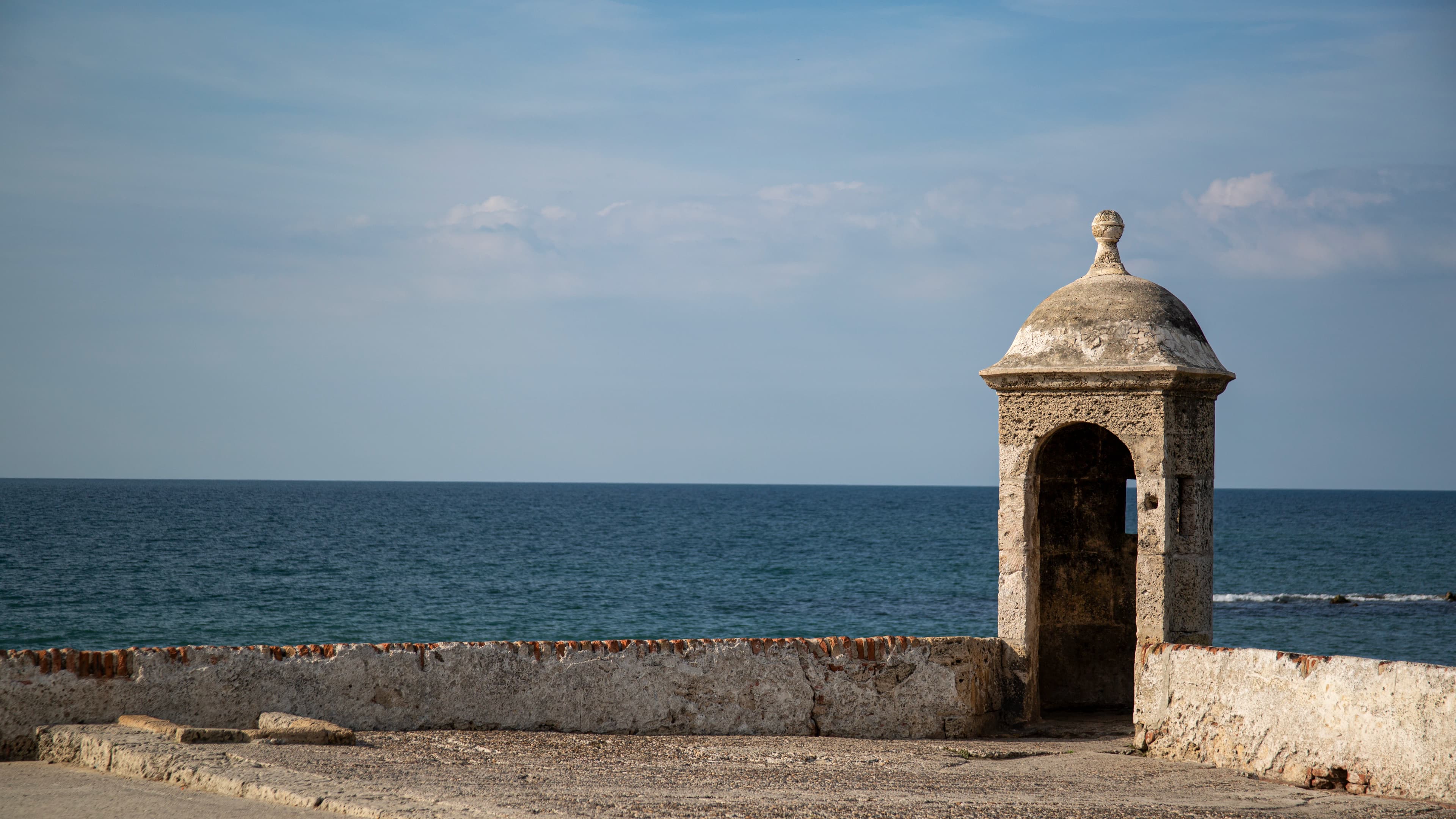
The soldiers and empire have departed, but the old sentry post continues facing the Caribbean horizon.
The Wall Keeps Watch
FCS-PH-0066
Permanent Collection
Historic fortified wall, Cartagena, Colombia; precise section unconfirmed
Sunday, November 8, 2015
About the Work
A solitary stone sentry post stands along Cartagena's historic fortified wall, facing the Caribbean Sea. Originally created as part of a defensive system intended to protect the Spanish colonial port, the weathered structure now watches over a quiet horizon. Broad layers of stone, water, and sky emphasize its enduring presence, while a small bird crossing the distance suggests the passage of time beyond the wall.
The Artist
I made this photograph while walking through Cartagena during a business trip in November 2015.
Whenever I had time away from work, I carried my camera and photographed whatever drew my attention.
This small defensive structure immediately felt familiar.
It reminded me of the garitas found along the historic fortifications of Puerto Rico.
Although Cartagena and Puerto Rico are separated geographically, their coastal defenses share a Spanish colonial history.
Structures like this allowed sentries to observe the water and formed part of larger systems built to protect strategically important ports, maritime trade, and Spain's territorial interests in the Caribbean.
Standing alone against the sea, the guardhouse no longer appeared threatening.
Its military purpose belonged to another time, yet its position remained unchanged.
The doorway still faced outward.
The structure still seemed to observe the horizon.
The soldiers are gone.
The empire that built it is gone.
The wall keeps watch.
The Curator
Curatorially, The Wall Keeps Watch is strongest when read through the distance between an event and its later remembrance. The composition does not require a dramatic event to justify its place in the collection; its meaning develops through relationships inside the frame—distance, scale, structure, atmosphere, and the distribution of visual weight. That restraint is important. It allows the photograph to carry the theme of memory through form as well as through biography, giving the work an independent visual life while remaining connected to the artist’s experience.
Story Behind the Photograph
On November 8, 2015, Francisco Colón was walking through Cartagena, Colombia, during a business trip.
Away from his professional responsibilities, he carried his camera through the city and photographed the places and details that attracted his attention.
Along Cartagena's historic fortified wall, Colón encountered a small stone sentry post facing the Caribbean Sea.
The structure immediately reminded him of similar garitas preserved within the Spanish colonial fortifications of Puerto Rico.
Cartagena and Puerto Rico occupied important positions within Spain's colonial network in the Americas.
Their fortified ports were developed over time to protect harbors, maritime commerce, military interests, and territories from competing European powers, privateers, and other threats.
Sentry posts provided protected positions from which guards could observe the coastline and approaches to the fortified city.
Although the structure in Cartagena belonged to a different place, its design carried a visual language familiar to Colón through Puerto Rico's surviving coastal defenses.
He photographed the guardhouse from a distance using a Canon EOS 5D Mark III with a Canon EF 28–135mm lens extended to its maximum focal length of 135mm.
The long focal length isolated the structure against the sea and compressed the horizontal layers of foreground wall, water, and sky.
The guardhouse was positioned away from the center of the composition, leaving the open Caribbean horizon to occupy most of the frame.
A small bird appeared in the upper-left sky, providing a subtle living counterpoint to the stationary architecture.
The image was recorded at ISO 100 in the late afternoon without flash.
The resulting photograph presents a structure created for vigilance after the conditions that required its vigilance have passed.
Its original sentries, military authority, and colonial empire are absent.
The architectural gesture remains.
The wall continues facing the water.
Reflection
The structure reminded me of Puerto Rico before I knew anything more about it.
I recognized the shape of the garita, its small doorway, its protected interior, and the way it faced outward toward the sea.
The resemblance connected two places in my life through a history that began long before me.
Cartagena and Puerto Rico both carry the architectural evidence of Spanish colonial power.
These walls were not decorative.
They were constructed to observe, defend, control, and protect territories considered strategically valuable.
The sentry who once occupied this post would have watched the horizon for danger.
When I photographed it, the sea was quiet.
There were no approaching ships and no visible soldiers.
Only the structure remained in position.
That contrast is what gives the photograph its meaning for me.
A defensive building can outlive the conflict, authority, and empire that gave it purpose.
Over time, something designed for military surveillance becomes part of the landscape, a historic monument, and a place encountered by someone walking with a camera.
Its purpose has changed.
Its posture has not.
The wall keeps watch, even when there is nothing left for it to defend.
The Museum
Preserved as the sixty-sixth accessioned photograph in the Francisco Colón Studio Photography Wing, The Wall Keeps Watch joins the Cities collection as a study of colonial architecture, memory, observation, and the transformation of defensive space across time.
The photograph was created in Cartagena, Colombia, on November 8, 2015.
Colón encountered the stone sentry post while walking through the city during a business trip.
The structure formed part of Cartagena's historic coastal defensive environment and visually recalled the garitas found within the Spanish colonial fortifications of Puerto Rico.
The Studio record identifies the setting conservatively as Cartagena's historic fortified wall. A more precise section of the fortifications has not been independently confirmed from the surviving archive.
Spanish colonial authorities developed extensive defensive systems around strategically important Caribbean ports. Walls, bastions, forts, and sentry posts supported observation and protection against military rivals, privateers, and threats to maritime commerce and territorial control.
The architectural resemblance between Cartagena and Puerto Rico reflects their participation in this broader Spanish colonial defensive tradition.
The original EXIF metadata records the photograph at 5:06:14 PM using a Canon EOS 5D Mark III and a Canon EF 28–135mm f/3.5–5.6 IS USM lens at its maximum focal length of 135mm.
The camera operated at ISO 100 using evaluative metering, automatic exposure, and automatic white balance. The flash did not fire.
The 135mm focal length visually isolated the sentry post and compressed the composition into horizontal layers of wall, sea, and sky.
The panoramic crop created during the 2026 restoration reduced excess foreground while preserving the open horizon, the placement of the guardhouse, and the small bird visible in the sky.
Within the Studio archive, The Wall Keeps Watch connects Cartagena with Colón's visual memory of Puerto Rico while acknowledging the shared colonial history embodied by their surviving defensive architecture.
The photograph presents vigilance after empire: a sentry post that retains its outward-facing position even after its original military purpose has ended.
Technical Information
- Camera
- Canon EOS 5D Mark III
- Lens
- Canon EF 28–135mm f/3.5–5.6 IS USM
- Focal Length
- 135 mm
- Capture Date
- Sunday, November 8, 2015
- Capture Time
- 5:06:14 PM (camera-recorded time)
- Location
- Historic fortified wall, Cartagena, Colombia; precise section unconfirmed
- Route
- Photographed while walking through Cartagena during a November 2015 business trip
- Flash
- Did not fire (compulsory mode)
- White Balance
- Auto
- Metadata Status
- Original EXIF metadata confirms the Canon EOS 5D Mark III, Canon EF 28–135mm f/3.5–5.6 IS USM lens at its maximum 135mm focal length, ISO 100, evaluative metering, automatic exposure mode, automatic white balance, a maximum aperture value of f/5.7, and that the flash did not fire. The camera recorded the photograph on November 8, 2015, at 5:06:14 PM.
- Supporting Documentation
- Original Canon RAW file, surviving EXIF metadata, surrounding Cartagena image sequence, 2026 restored master, artist provenance narrative, and comparative visual reference to Spanish colonial sentry posts preserved in the Francisco Colón Studio archive.
Collection Record
- Accession Number
- FCS-PH-0066
- Exhibit Number
- 66
- Exhibition
- Cities
- Status
- Permanent Collection
- Original Capture
- November 8, 2015
- Studio Acquisition
- Francisco Colón Studio Photography Wing
- Artist
- Francisco Colón
- Copyright
- © Francisco Colón. All Rights Reserved.