FCS-PH-0054
Photography Wing · Exhibit No. 54
The Weight of Promises
Private declarations become part of the city.
The Weight of Promises
FCS-PH-0054
Permanent Collection
Pont de l’Archevêché, Paris, France
Monday, February 25, 2013
About the Work
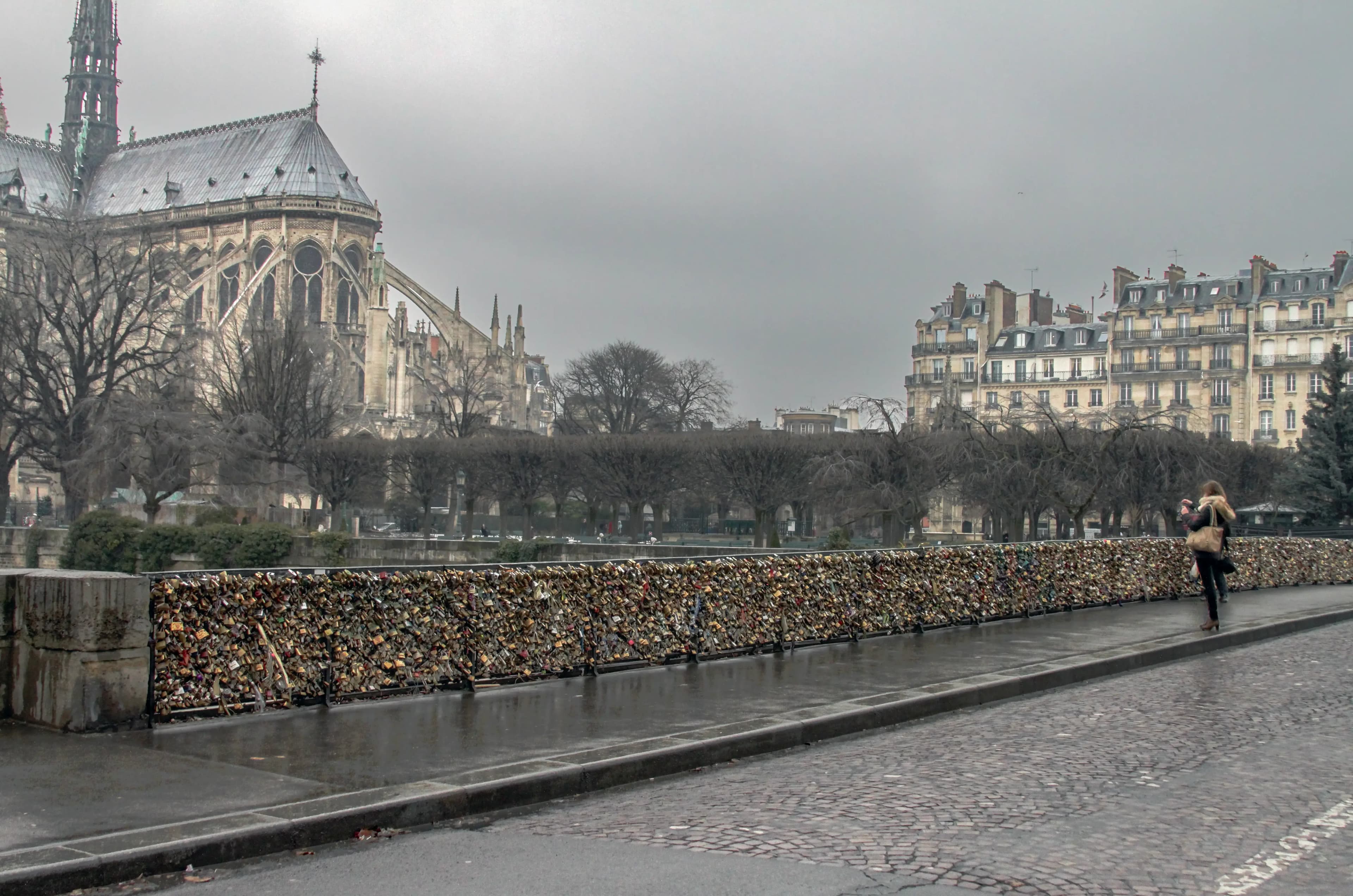
Thousands of love locks cover the Pont de l’Archevêché beside Notre-Dame on a rainy February day in Paris. As a solitary visitor pauses to photograph the bridge, the accumulated padlocks transform private declarations of devotion into a public monument. Created on February 25, 2013, the image preserves a temporary chapter of Parisian history before the locks were removed because of their structural weight and environmental impact.
The Artist
I created this photograph on February 25, 2013, while walking through Paris.
What attracted me was the accumulation of locks covering the bridge. Each one had been placed there by someone who wanted to leave behind a declaration of love, commitment, or hope.
Individually, the locks were small.
Together, they had transformed the bridge.
Notre-Dame stood beyond them as part of the historic landscape of Paris, while a woman paused near the railing to make a photograph of her own.
The weather was gray, the pavement was wet, and the city appeared subdued. Against that muted background, the locks created a long band of texture and restrained color.
At the time, I was recording something I encountered while moving through the city.
Years later, the photograph became more meaningful because the scene no longer exists in this form. What appeared permanent was eventually removed.
The promises remained only in memory, in the photographs people carried home, and perhaps in the lives of those who placed them there.
The Curator
The Weight of Promises examines the point at which a private gesture becomes part of a public landscape.
A single padlock attached to a bridge might represent one relationship. Thousands of locks gathered together produce something different: an unplanned monument created by strangers who may never meet.
The composition establishes several layers of time.
Notre-Dame represents centuries of Parisian history. The locks document a comparatively recent ritual. The solitary visitor on the right records the scene as it existed for one passing moment.
The visual weight of the locks extends almost continuously across the frame. Their density contrasts with the open gray sky, while the wet pavement reinforces the atmosphere of a cold February day.
The title carries both emotional and physical meaning. The locks represented promises intended to endure, but their combined weight eventually threatened the structures supporting them.
The photograph therefore preserves both the romance of the gesture and the consequences of its accumulation.
Story Behind the Photograph
The practice of attaching locks to bridges predates its arrival in Paris.
Its earliest widely repeated origin comes from Vrnjačka Banja, Serbia, during the First World War. According to local legend, a schoolteacher named Nada fell in love with a Serbian officer named Relja. After he left for war and fell in love with another woman, local women began attaching named padlocks to the bridge where the couple had once met. They hoped the gesture would protect their own relationships from the same fate.
The modern international spread of the ritual was later influenced by Italian author Federico Moccia. In his novel I Want You, and its subsequent film adaptation, a couple attaches a padlock to Rome’s Ponte Milvio and throws the key into the Tiber River. Readers and viewers began imitating the gesture, helping the practice spread across Europe.
Couples would write their names or initials on padlocks, attach them to bridge railings, and frequently throw the keys into the river below. The locked padlock represented a relationship that could no longer be opened or separated.
In Paris, love locks began appearing prominently around 2008. The Pont des Arts became their best-known location, but the practice soon spread to other bridges throughout the city.
One of those locations was the Pont de l’Archevêché, immediately beside Notre-Dame Cathedral.
By February 2013, when Francisco Colón created this photograph, its railings had become densely covered. Locks of different shapes, colors, ages, and sizes overlapped one another until the original structure was nearly hidden.
A woman stands near the right side of the frame, photographing the scene. Her presence provides both scale and context. Like Colón, she had stopped to preserve what she encountered.
The locks appeared to form a permanent part of Paris.
They were not permanent.
As their numbers increased, their collective weight damaged bridge railings and created public-safety concerns. Keys thrown into the Seine also raised environmental objections. Paris eventually removed large quantities of locks and altered bridge railings to discourage the practice.
The photograph now records a temporary landscape—one created by thousands of personal declarations and later changed by the physical burden those declarations produced.
Reflection
We often imagine a promise as something without physical weight.
A promise is spoken, remembered, or carried privately between people.
On this bridge, promises became objects.
They accumulated one beside another until the railing itself nearly disappeared beneath them. Each lock may have represented hope, devotion, or a desire to make one moment permanent.
But permanence is complicated.
The locks remained attached even as the people who placed them continued with their lives. Some relationships may have endured. Others may have ended. The bridge carried every declaration without knowing the difference.
Eventually, their combined weight became too much.
The locks were removed, but the meaning of the gesture did not disappear completely. It survived in memory and in photographs made by those who witnessed the bridge during that period.
Perhaps that is what photographs also attempt to do.
They cannot make a moment permanent.
They can only carry some evidence that it once existed.
The Museum
Preserved as the fifty-fourth accessioned photograph in the Francisco Colón Studio Photography Wing, The Weight of Promises documents a temporary transformation of the Parisian landscape.
Created at the Pont de l’Archevêché beside Notre-Dame on February 25, 2013, the work records the love-lock phenomenon during a period of extraordinary accumulation.
The image brings together three forms of preservation.
Notre-Dame represents architectural and institutional history. The locks represent individual attempts to preserve emotional commitments. The photograph preserves the temporary relationship between them.
The work also contains an observational exchange. A woman standing beside the bridge raises her own camera toward the locks while Colón photographs the larger scene. The observer therefore becomes part of what is observed.
Within the Studio collection, the photograph expands the examination of Paris beyond streets, cafés, and destinations. It considers how people leave marks upon a city and how those marks can acquire meanings and consequences beyond their original intentions.
The bridge eventually changed, but the photograph retains evidence of the period when thousands of private promises collectively became part of its public identity.
Technical Information
- Camera
- Canon EOS Rebel T1i
- Lens
- Canon EF 28–135mm f/3.5–5.6 IS USM
- Focal Length
- 28 mm
- Capture Date
- Monday, February 25, 2013
- Capture Time
- Approximately 12:01:32 PM Paris local time; camera recorded 6:01:32 AM New York time
- Location
- Pont de l’Archevêché, Paris, France
- Flash
- Did not fire (compulsory mode)
- White Balance
- Auto
- Metadata Status
- Original EXIF metadata confirms the camera, lens, focal length, camera-recorded date and time, flash status, and white balance. The camera remained set to New York time while the photographer traveled; Paris was approximately six hours ahead.
- Supporting Documentation
- Original image file, surviving metadata, 2026 restored master, artist recollection, and historical documentation concerning the love-lock installations on Paris bridges preserved in the Studio archive.
Collection Record
- Accession Number
- FCS-PH-0054
- Exhibit Number
- 54
- Exhibition
- Cities
- Status
- Permanent Collection
- Original Capture
- February 25, 2013
- Studio Acquisition
- Francisco Colón Studio Photography Wing
- Artist
- Francisco Colón
- Copyright
- © Francisco Colón. All Rights Reserved.