FCS-PH-0104
Photography Wing · Exhibit No. 104
What the Photograph Remembered
The image preserved what memory could not.
What the Photograph Remembered
FCS-PH-0104
Permanent Collection
Puerta de los Tristes, Paseo de los Tristes, Granada, Spain
Tuesday, April 8, 2014
About the Work
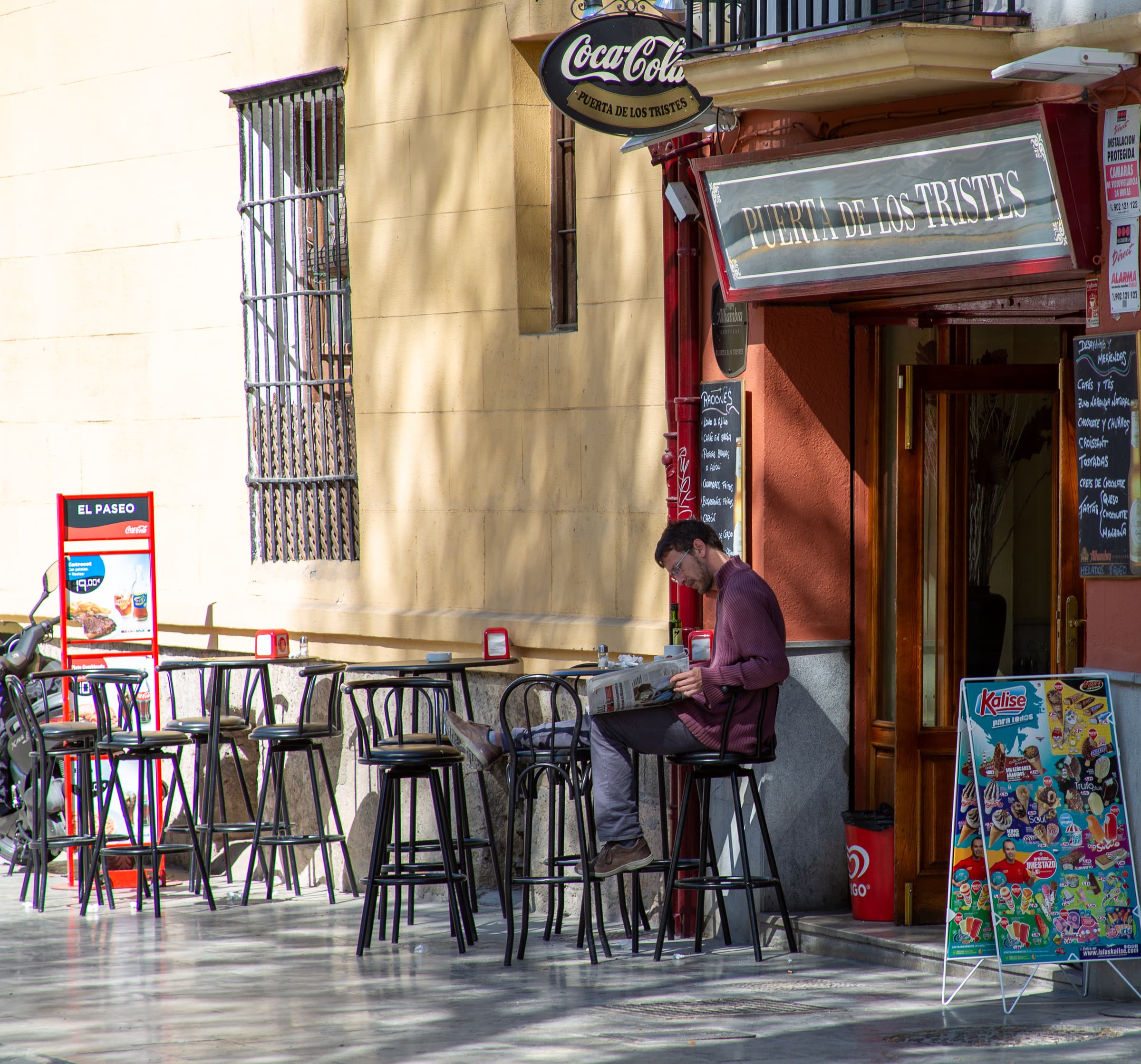
A solitary man reads a Spanish-language newspaper outside Puerta de los Tristes, a restaurant along Granada's historic Paseo de los Tristes. Around him, the café tables remain empty as the late morning quietly unfolds. I do not remember the precise moment when I made this photograph, but the image helped reconstruct what memory could not. The newspaper, empty chairs, storefront signage, and geography of the street returned the moment piece by piece. Sometimes the photograph makes the story. In this case, the story made the photograph.
The Artist
I do not remember the exact moment when I made this photograph. What remains is the evidence inside the frame and my knowledge of the route I was walking that morning.
I was staying at El Ladrón de Agua on the Carrera del Darro. Based on the location, the direction of the photograph, and the path I had discovered the day before, I was most likely walking toward Sacromonte. Puerta de los Tristes would have appeared on my left. I believe I had already passed it when something made me turn around.
That something was the man sitting alone.
He was not looking at a phone or a tablet. He was reading a printed newspaper while the tables around him remained empty. I cannot say whether he was a local or a visitor, although the Spanish-language newspaper made me wonder. Nor can I identify with certainty what was inside the bottle on the table. Those details interest me precisely because they resist a complete explanation.
I may not remember pressing the shutter, but I recognize why I would have stopped. In the middle of a city I was still discovering, one person had created a quiet world of his own.
The Curator
What the Photograph Remembered is constructed through a deliberate tension between place and withdrawal. The restaurant entrance, commercial signs, and warm red façade establish an active public setting on the right, while a row of unoccupied tables and chairs extends into the quieter left side of the frame. The seated reader occupies the threshold between those two visual territories.
His body turns away from the doorway and toward the empty terrace. That direction initially appears to disconnect him from the establishment, but it ultimately gives the composition its meaning. His downward gaze and folded posture slow the eye, while the newspaper forms a small private space within the larger public environment. Above him, the words Puerta de los Tristes introduce a poetic association that the photograph does not force but cannot entirely escape.
The frame's visual movement travels from the signage to the reader and then across the empty chairs. Architecture identifies the location, but human solitude supplies the emotional center.
Story Behind the Photograph
This photograph was made in Granada, Spain, on Tuesday, April 8, 2014. Francisco was staying at El Ladrón de Agua, a historic lodging at Carrera del Darro 13. Puerta de los Tristes stands farther east along the same riverside corridor, at the point where the Carrera del Darro opens toward the Paseo de los Tristes and the route continues in the direction of Sacromonte.
Francisco does not retain a direct memory of taking the photograph. The likely sequence has instead been reconstructed from the image, its metadata, the known location of his hotel, his remembered walks through Granada, and the direction from which the scene was photographed. He was probably walking from the hotel toward Sacromonte when he passed the restaurant, noticed the solitary reader, and turned back to make the frame.
The establishment visible in the photograph is Puerta de los Tristes, a restaurant and terrace bar on Granada's Paseo de los Tristes. The neighboring El Paseo name visible among the signs was associated with the same establishment. The paseo's popular name—literally, the Walk of the Sad—developed from its historic use as part of the route taken by funeral processions traveling toward the cemetery.
Within that historically suggestive setting, the photograph records a much smaller event: one man, a newspaper, a bottle on the table, and a terrace not yet filled for the day. Whether he was a Granada resident or a visitor cannot be determined from the image. What can be known is that his solitary presence caused the photographer to look back.
Reflection
Memory does not always return as a complete scene. Sometimes it survives as fragments: the name of a hotel, the direction of a street, the route discovered the previous day, or the knowledge that something once made us turn around.
A photograph can hold more than we consciously remember placing inside it. Years later, its details become witnesses. A sign identifies the location. Morning light suggests the hour. A newspaper describes an older rhythm of attention. Empty chairs reveal that the day had not yet gathered around the solitary figure.
There is humility in allowing an image to tell us what it can while admitting what it cannot. We do not know the man's name, whether he belonged to Granada, what he was reading, or what occupied his thoughts. The photograph does not return those answers. Instead, it returns the reason for looking: amid an unfamiliar city, one quiet human presence was enough to interrupt a journey.
Sometimes the photograph makes the story. In this case, the story made the photograph.
The Museum
Preserved in the Francisco Colón Studio Photography Wing as a study of observation, incomplete memory, and responsible reconstruction. The work demonstrates how a photograph may function as both an artwork and a piece of evidence, allowing geography, metadata, signage, and personal recollection to recover the circumstances surrounding an otherwise forgotten exposure.
Within the collection, What the Photograph Remembered extends the Studio's examination of solitude in public places and supports the archival principles underlying Because I Looked. Its significance rests not on claiming certainty, but on preserving the distinctions between what the image confirms, what the artist remembers, and what the surviving evidence makes probable.
Technical Information
- Camera
- Canon EOS 5D Mark III
- Lens
- Canon EF 28–135mm f/3.5–5.6 IS USM
- Focal Length
- 132 mm
- Capture Date
- Tuesday, April 8, 2014
- Capture Time
- Approximately 11:48:26 AM Granada local time; camera recorded 5:48:26 AM New York time
- Location
- Puerta de los Tristes, Paseo de los Tristes, Granada, Spain
- Flash
- Did not fire
- Metadata Status
- EXIF screenshot confirms the camera, lens, focal length, exposure, aperture, ISO, exposure program, metering mode, original and edited dimensions, date, camera time, and flash status. Granada local time is converted from the camera's established New York time setting.
- Supporting Documentation
- EXIF screenshot, artist's account, and location reconstruction. Exposure: 1/160 second at f/6.3, ISO 100, Normal exposure program, Pattern metering, and 0 EV exposure compensation. Original dimensions: 5760 × 3840 pixels. Edited dimensions: 4165 × 3823 pixels.
Collection Record
- Accession Number
- FCS-PH-0104
- Exhibit Number
- 104
- Exhibition
- People
- Status
- Permanent Collection
- Original Capture
- April 8, 2014
- Studio Acquisition
- Francisco Colón Studio Photography Wing
- Artist
- Francisco Colón
- Copyright
- © Francisco Colón. All Rights Reserved.