FCS-PH-0068
Photography Wing · Exhibit No. 68
What the Walls Remember
The words survived long enough for the question to return.
What the Walls Remember
FCS-PH-0068
Permanent Collection
Alhambra, Granada, Spain
Sunday, April 6, 2014
About the Work
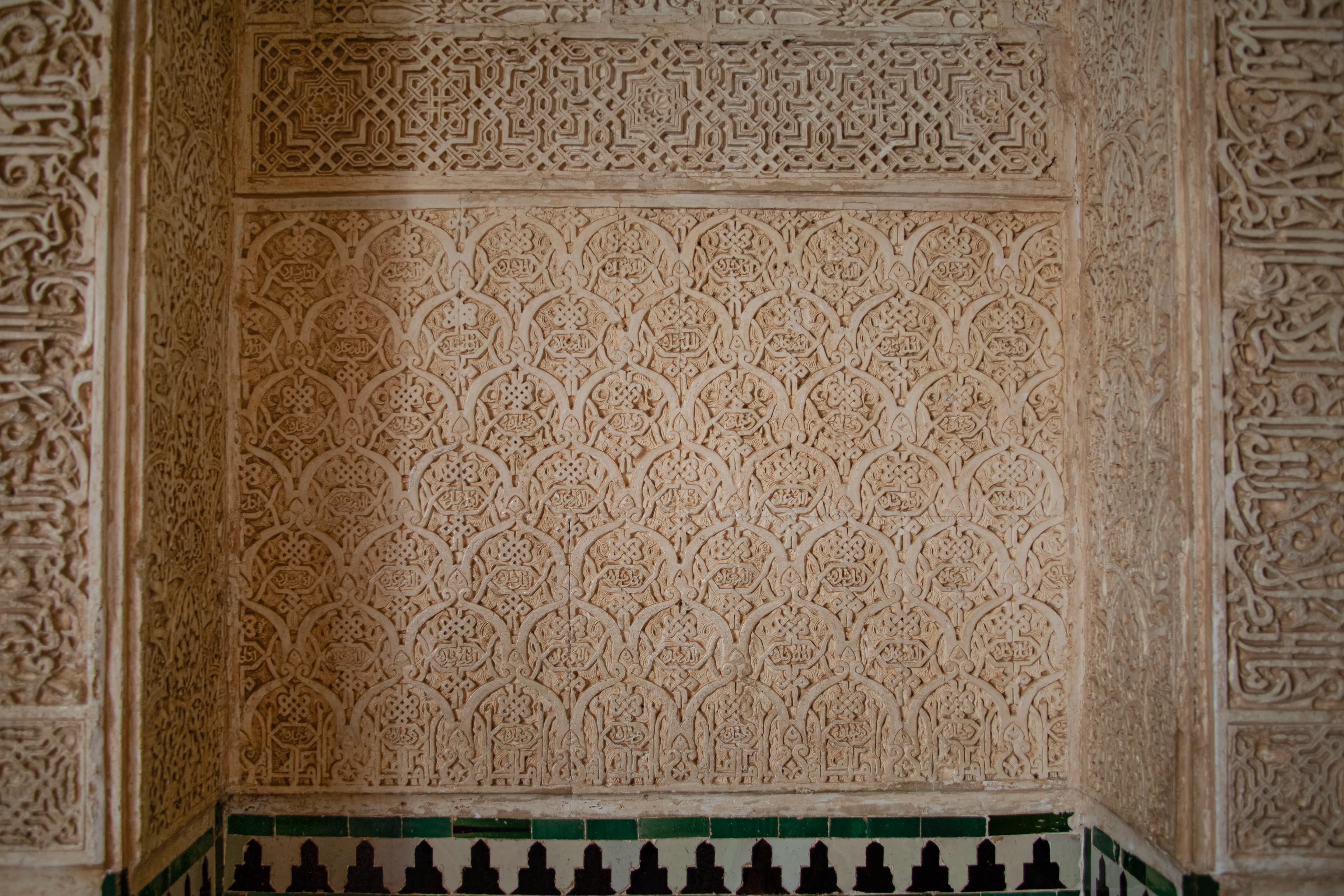
Inside the Alhambra, centuries-old plasterwork transforms architecture into a surface of geometry, ornament, and written language. Repeating patterns, carved borders, Arabic calligraphy, and traces of age fill the composition. What first attracted the photographer as visual design gradually became something more compelling: the realization that the forms were carrying meaning he could see but could not yet understand.
The Artist
I made this photograph while spending the day inside the Alhambra in Granada in 2014.
At first, I was drawn to the shapes.
The walls seemed almost impossible to take in all at once. Everywhere I looked there were repeating patterns, curves, straight lines, carved borders, colors, and details layered upon details.
But the closer I looked, the more I realized that some of what I was seeing was not simply decoration.
It was writing.
I could see the Arabic calligraphy woven into the plasterwork, but I could not read it.
That changed the way I looked at the wall.
Someone had chosen those words.
Someone had carved them.
They had been repeated across a palace centuries before I stood there with a camera.
I began wondering what they said, why those particular words had been placed there, and how many generations had stood before the same wall while understanding something that I could only observe.
I photographed the larger architectural space.
Then I moved closer.
And closer again.
What interested me was no longer simply the beauty of the pattern.
I wanted to understand its history.
I wanted to know what the walls were saying.
More than a decade later, returning to this photograph brought me back to exactly the same question.
The wall had not changed.
My curiosity had simply been waiting for me to return.
The Curator
What the Walls Remember examines architecture not merely as structure, but as a carrier of language, belief, craftsmanship, and cultural memory.
The photograph concentrates on a recessed section of decorated plasterwork within the Alhambra. Repeating geometric and vegetal forms surround areas of Arabic epigraphy, while narrow carved borders and the surviving tilework beneath the plaster establish the larger architectural context.
The photographer's interest moves progressively from appearance toward meaning.
What begins as an encounter with pattern becomes an encounter with language.
That distinction is central to the work.
The Arabic inscriptions are visibly present, yet their precise reading is intentionally not assigned within this record until the specific panel can be identified and its epigraphy verified.
The resulting uncertainty is not a weakness in the photograph.
It is part of its subject.
The viewer is placed in the same position as the photographer in 2014: able to recognize that the wall is communicating while remaining separated from the full meaning of what it says.
Story Behind the Photograph
This photograph was created during a full day spent exploring the Alhambra in Granada in 2014.
Throughout the visit, the photographer documented the palace at several scales.
Some photographs recorded complete rooms and courtyards.
Others examined individual architectural recesses, tilework, carved surfaces, and increasingly small details.
This image emerged from that process of moving closer.
The larger photographic sequence preserved the room surrounding the wall, the recessed architectural feature within it, and finally the detailed plasterwork seen here.
What initially attracted Colón was the extraordinary organization of shapes.
Geometric forms repeat alongside flowing vegetal ornament. Carved bands divide one area from another. Arabic writing becomes part of the architecture rather than something applied separately to it.
The longer he studied the surface, the more his attention shifted toward the calligraphy.
He understood that the marks were not arbitrary decoration.
They were words.
Yet because he could not read Arabic, their meaning remained inaccessible.
The photograph therefore became an unfinished conversation between the observer and the architecture.
Colón left Granada with the image but without the answer.
When he returned to the photograph in 2026 while reconstructing his photographic archive, the same curiosity immediately returned.
What did these words mean?
Why were they repeated?
What ideas had been considered important enough to become part of the walls themselves?
The photograph had quietly preserved those questions for twelve years.
Reflection
We often think walls preserve buildings.
Sometimes they preserve much more.
A wall can carry the decisions of a ruler.
The hands of a craftsman.
The language of a civilization.
A prayer.
A poem.
A declaration.
A belief repeated so many times that architecture itself becomes a form of memory.
Centuries later, we may stand before those same walls unable to understand every word.
Yet we recognize that something is being said.
Perhaps that is one of the reasons places like the Alhambra continue to hold our attention.
We are not simply looking at what survived.
We are standing before messages sent forward through time.
Some we understand immediately.
Others require us to keep asking questions.
And occasionally a photograph preserves the question long enough for us to return and ask it again.
The Museum
Preserved as the sixty-eighth accessioned photograph in the Francisco Colón Studio Photography Wing, What the Walls Remember joins the Cities collection as a study of architecture, observation, language, cultural memory, and the persistence of human expression across time.
The photograph was created inside the Alhambra in Granada, Spain, during the artist's 2014 visit.
The composition records a recessed architectural surface containing repeating Nasrid decorative elements, including geometric organization, vegetal ornament, carved plasterwork, Arabic epigraphy, and surviving tilework.
The photograph belongs to a larger sequence created during the same visit in which Colón progressively moved from broader architectural views toward increasingly detailed studies of the palace surfaces.
That sequence provides important archival context for the work.
The Studio record intentionally does not assign a word-for-word translation to the visible Arabic inscription. Arabic epigraphy throughout the Alhambra includes multiple forms of text, and the exact architectural panel represented here has not yet been positively identified within the available epigraphic record.
Likewise, the precise interior room remains unassigned until supporting evidence allows the location to be established with confidence.
The photograph was revisited and restored in 2026.
The restoration preserved the warm character of the aged plaster, surface cracks, discoloration, worn edges, and natural variation in illumination. A localized adjustment opened detail within the shadowed left side without eliminating the original falloff of light.
No missing plasterwork, decorative forms, or Arabic characters were reconstructed within the archival master.
This distinction is significant to the work's preservation.
Because the photograph concerns the historical meaning of the surviving ornament and language, the authenticity of the recorded architectural surface remains fundamental to the Studio record.
Technical Information
- Camera
- Canon EOS 5D Mark III
- Lens
- Canon EF 28–135mm f/3.5–5.6 IS USM
- Focal Length
- 33 mm
- Capture Date
- Sunday, April 6, 2014
- Capture Time
- 6:08:08 AM (camera-recorded time)
- Location
- Alhambra, Granada, Spain
- Flash
- Did not fire (compulsory mode)
- White Balance
- Auto
- Metadata Status
- Original EXIF metadata confirms the Canon EOS 5D Mark III, Canon EF 28–135mm f/3.5–5.6 IS USM lens at 33mm, ISO 125, evaluative metering, automatic exposure mode, automatic white balance, standard scene capture type, normal processing, a maximum aperture value of f/3.7, and that the flash did not fire. The camera recorded the photograph on April 6, 2014, at 6:08:08 AM. The precise interior room within the Alhambra remains under archival review.
- Supporting Documentation
- Original image file, surviving EXIF metadata, wider architectural photographs from the same Alhambra sequence, 2026 restored master, and artist provenance narrative preserved in the Francisco Colón Studio archive.
Collection Record
- Accession Number
- FCS-PH-0068
- Exhibit Number
- 68
- Exhibition
- Cities
- Status
- Permanent Collection
- Original Capture
- April 6, 2014
- Studio Acquisition
- Francisco Colón Studio Photography Wing
- Artist
- Francisco Colón
- Copyright
- © Francisco Colón. All Rights Reserved.