FCS-PH-0057
Photography Wing · Exhibit No. 57
When the Observer Appears
The photographer enters the scene through reflection.
When the Observer Appears
FCS-PH-0057
Permanent Collection
Paris, France
Monday, February 25, 2013
About the Work
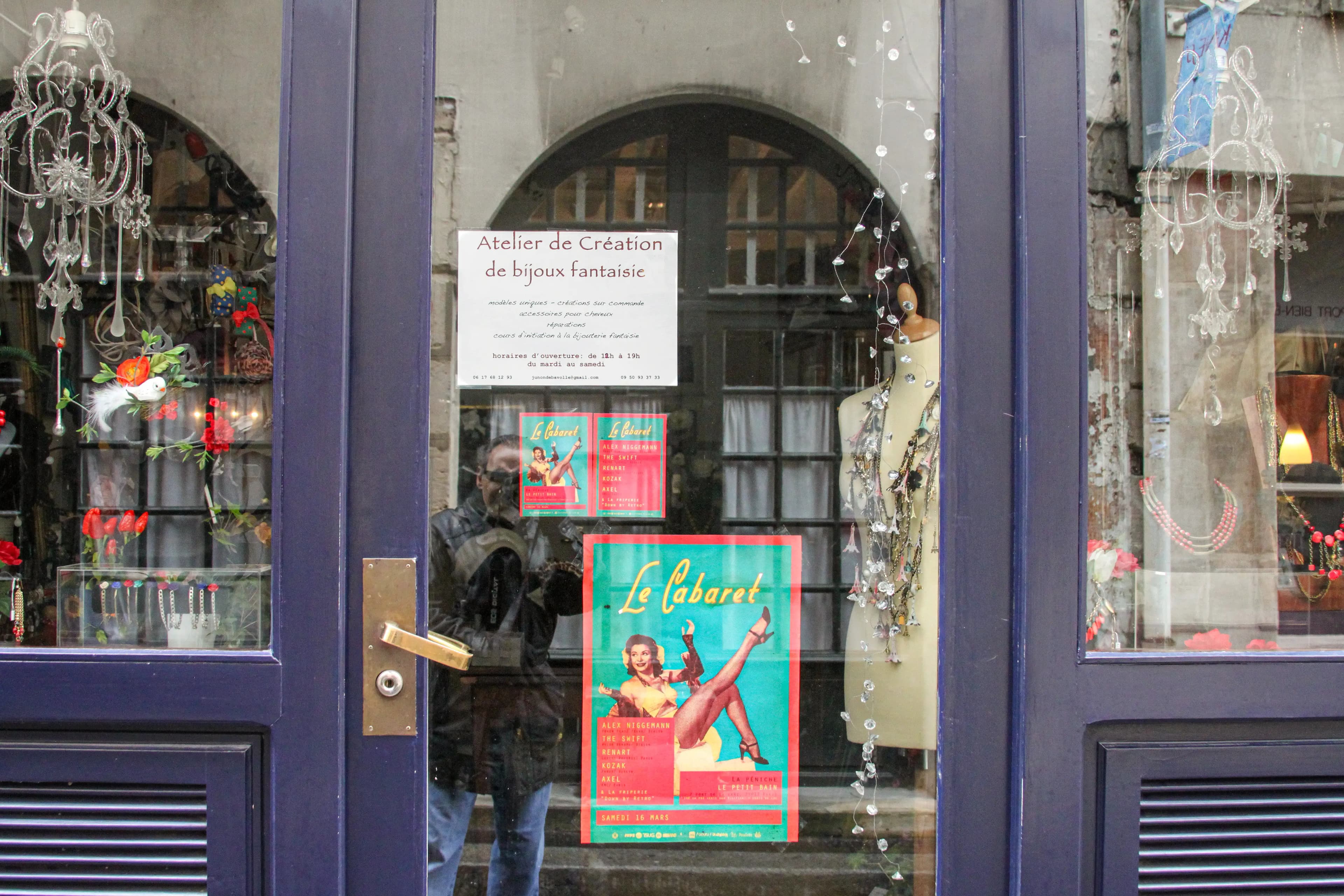
A Paris jewelry workshop becomes a layered study of performance, display, and observation. A colorful Le Cabaret poster occupies the central window, surrounded by costume jewelry, crystal ornaments, and a mannequin adorned for presentation. Reflected within the glass, the photographer intentionally enters the scene, transforming an ordinary storefront photograph into a deliberate self-portrait.
The Artist
I created this photograph while walking through Paris and photographing whatever caught my attention.
The storefront drew me in because of the objects arranged behind the glass. There was costume jewelry, hanging crystal ornaments, a mannequin covered with necklaces, and a colorful poster advertising Le Cabaret.
The French sign described the business as an atelier de création de bijoux fantaisie—a workshop creating costume jewelry.
As I composed the photograph, I intentionally positioned myself so that my reflection would appear in the central door.
I did not want to remain completely outside the scene.
The window contained several forms of presentation: jewelry arranged for customers, a mannequin dressed for display, and a cabaret performer represented through a poster. By including my reflection, I placed the photographer among the things being observed.
Throughout my travels, I photographed people whose lives and destinations remained unknown. In this image, I deliberately became one of the people within the collection.
I remained the observer, but I also entered the observation.
The Curator
Curatorially, When the Observer Appears is strongest when read through the discipline of noticing what might otherwise pass without emphasis. The composition does not require a dramatic event to justify its place in the collection; its meaning develops through relationships inside the frame—distance, scale, structure, atmosphere, and the distribution of visual weight. That restraint is important. It allows the photograph to carry the theme of observation through form as well as through biography, giving the work an independent visual life while remaining connected to the artist’s experience.
Story Behind the Photograph
While walking through Paris in 2013, Francisco Colón encountered a jewelry workshop whose storefront combined commerce, ornament, and theatrical imagery.
The French sign identified the shop as an atelier de création de bijoux fantaisie—a workshop devoted to creating costume jewelry.
Inside the windows, necklaces, crystals, decorative objects, and a mannequin formed an elaborate display. At the center, a brightly colored Le Cabaret poster introduced another kind of presentation: a performer posed before an imagined audience.
Colón stopped to photograph the storefront and intentionally positioned himself so that his reflection would appear in the central door.
His reflection appeared with the camera raised, surrounded by the jewelry, mannequin, French lettering, and central poster he had intended to photograph.
By entering the composition deliberately, the photographer became both observer and subject.
Colón had spent much of the journey observing people and situations encountered while walking. Some subjects were separated by geography, circumstance, class, and personal history, yet the French language created an unexpected connection connection between photographs made in Paris and Haiti.
In this photograph, French appears directly in the storefront lettering and cabaret advertisement. More significantly, the photographer who created those other observations becomes one of the people visible within the collection.
The observer had entered the frame.
Reflection
A photographer often believes he stands outside the moment.
He watches, frames, and records.
believes himself unseen.
Glass has its own way of changing that arrangement.
His.
I stopped because of the jewelry, the mannequin, and the cabaret poster. I believed I was photographing a display created for other people to see.
The window was also displaying me.
My reflection became part of the scene by intention. I was no longer only the person looking through the camera. I had become another figure within the photograph.
There is something appropriate about that discovery.
I have photographed strangers whose stories I did not know. I have wondered where they were going, what circumstances brought them together, and what existed beyond the fraction of a second I preserved.
In this image, I intentionally placed myself where a future viewer could ask a similar question about me.
Who is the man reflected in the window?
Why did he choose to become part of the scene?
What was he trying to preserve?
For once, the observer does not remain entirely invisible.
He becomes the observed.
The Museum
Preserved as the fifty-seventh accessioned photograph in the Francisco Colón Studio Photography Wing, When the Observer Appears introduces a deliberate self-portrait into the People collection.
Created through a reflective Paris storefront, the work contains several layers of human representation. A mannequin presents jewelry. A cabaret performer appears within a poster. The photographer enters through reflection.
None occupies the scene in the same way.
The mannequin represents the body without identity. The poster presents a performer through a reproduced image. Colón's reflection records the physical presence of the person creating the photograph.
The work also extends an unexpected linguistic relationship within the People collection. The Passenger Above was created in Haiti, while The City Keeps Walking and The Everyday Runway were created in Paris. Although their circumstances differ dramatically, all emerge within places shaped by the French language.
When the Observer Appears makes that language visible through the storefront itself.
More importantly, it reveals the person responsible for bringing those observations together. The photographer, normally who had remained behind the camera, becomes part of the collection he was building.
Technical Information
- Camera
- Canon EOS Rebel T1i
- Lens
- Canon EF 28–135mm f/3.5–5.6 IS USM
- Focal Length
- 28 mm
- Capture Date
- Monday, February 25, 2013
- Capture Time
- Approximately 12:06:54 PM Paris local time; camera recorded 6:06:54 AM New York time
- Location
- Paris, France
- Flash
- Did not fire (compulsory mode)
- White Balance
- Auto
- Metadata Status
- Original EXIF metadata confirms the camera, lens, focal length, camera-recorded date and time, flash status, and white balance. The camera remained set to New York time while the photographer traveled; Paris was approximately six hours ahead.
- Supporting Documentation
- Original image file, surviving metadata, 2026 restored master, storefront details, and artist provenance narrative preserved in the Studio archive.
Collection Record
- Accession Number
- FCS-PH-0057
- Exhibit Number
- 57
- Exhibition
- People
- Status
- Permanent Collection
- Original Capture
- February 25, 2013
- Studio Acquisition
- Francisco Colón Studio Photography Wing
- Artist
- Francisco Colón
- Copyright
- © Francisco Colón. All Rights Reserved.