FCS-PH-0098
Photography Wing · Exhibit No. 98
Where Conversation Waits
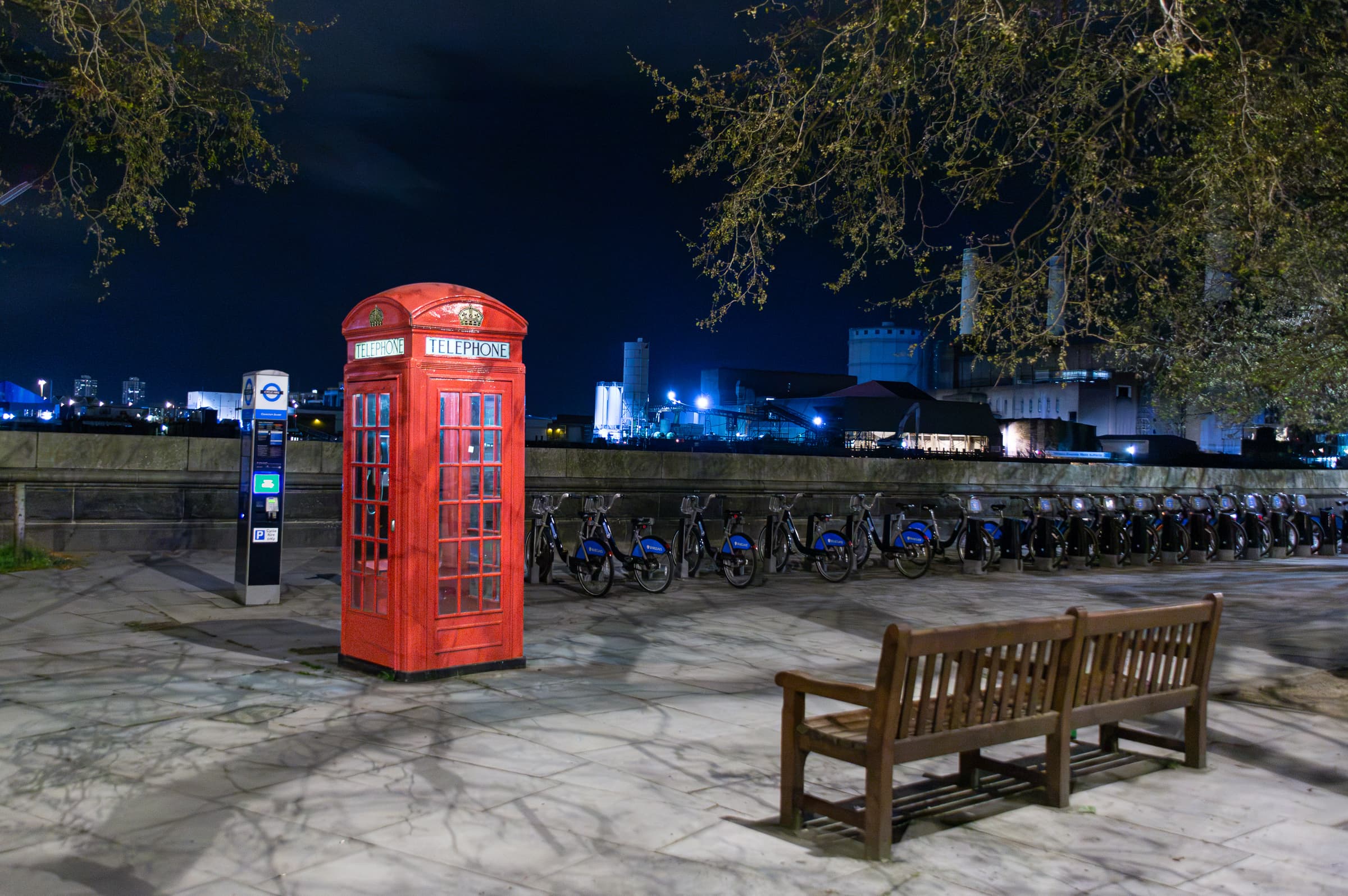
A telephone box and an empty bench beside the Thames at night.
Where Conversation Waits
FCS-PH-0098
Permanent Collection
Along the River Thames, London, England
Friday, April 4, 2014
Available as a Fine Art Print
Acquire a Print ↗About the Work
On a nighttime walk beside the River Thames, Francisco Colón photographed a red telephone box near an empty bench. A row of bicycles waits behind them. The telephone offers a way to speak across a distance; the bench offers a place to speak side by side. In their shared emptiness, the scene invites a question about how the places we use to connect with one another change over time.
The Artist
I was walking along the Thames at night when the red telephone box caught my attention. Then I noticed the empty bench in front of it. I began thinking about how both could be places for conversation. You could step into the booth to call someone, or sit on the bench beside someone and talk.
I wondered how often that telephone is used now that so many people carry cell phones. I imagined a time when people might have waited in line for their turn inside. I do not know whether that happened at this particular booth, but the thought stayed with me. I made the photograph because these two empty places seemed to be waiting for someone to come and speak.
The Curator
The red telephone box stands apart from the darker surroundings, making it the photograph's immediate point of attention. Across the foreground, the unoccupied bench creates a second place where a person might pause. The row of bicycles behind them introduces another kind of waiting: objects prepared for use, temporarily still.
The distance between bench and telephone box lets the viewer consider them together without making them identical. One accommodates a voice sent elsewhere; the other leaves room for someone to sit close. Night gathers around both, while the booth's color and the pale pavement keep their forms legible.
Story Behind the Photograph
On April 4, 2014, Francisco Colón was walking at night along the River Thames in London. He stopped to photograph a red telephone box, an empty bench, and a row of bicycles nearby.
The telephone box first drew his eye. Seeing the bench close to it led him to think about two ways people talk: through a telephone and while sitting together. He wondered how much use a public telephone receives in an era of cell phones and imagined the people who might once have waited to make a call. That imagined line belongs to his response to the scene; the photograph records the booth and bench standing empty that night.
Reflection
I stood there thinking about two places where a conversation might begin. The telephone box offers a way to reach someone who is far away. The bench offers a place for someone to be near. Both were empty that night, but each seemed to hold the possibility of a voice.
I imagined people once waiting outside the booth, perhaps rehearsing what they needed to say before their turn came. I have no way of knowing whether anyone ever lined up at this particular telephone. Still, I wonder how many conversations began there, how many ended, and how many people stepped back out feeling different from when they went in.
A cell phone has made it easier to call almost anyone from almost anywhere. Yet the empty bench reminds me that being able to reach someone and having someone beside you are different comforts. Sometimes a conversation needs only a voice. Sometimes it needs the time it takes for another person to sit down and stay. As I walked on, I found myself wondering which of these two places was waiting longer for someone.
The Museum
Where Conversation Waits enters the Cities collection as an observation of ordinary spaces shaped by human connection. The record preserves Colón's account of the nighttime walk and the association he made between the telephone box and the bench.
Within the Photography Wing, the work extends an interest in places that suggest people even when no one appears in the frame. Its questions about use, absence, and changing habits arise from the photographed scene and from the artist's response to it.
Technical Information
- Camera
- Canon EOS 5D Mark III
- Lens
- Canon EF 28–135mm f/3.5–5.6 IS USM
- Focal Length
- 28 mm
- Capture Date
- Friday, April 4, 2014
- Capture Time
- 11:13:44 PM London local time; camera recorded 6:13:44 PM New York time
- Location
- Along the River Thames, London, England
- Flash
- Did not fire
- Metadata Status
- EXIF screenshot confirms camera, lens, focal length, exposure, ISO, date, time, flash status, and file dimensions. The London time is converted from the camera's New York time setting.
- Supporting Documentation
- EXIF screenshot and artist's account. Exposure: 1/40 sec at f/3.5; ISO 8000; exposure bias −1 EV. Original dimensions: 5760 × 3840 pixels; edited dimensions shown: 4979 × 3308 pixels.
Collection Record
- Accession Number
- FCS-PH-0098
- Exhibit Number
- 98
- Exhibition
- Cities
- Status
- Permanent Collection
- Original Capture
- April 4, 2014
- Studio Acquisition
- Francisco Colón Studio Photography Wing
- Artist
- Francisco Colón
- Copyright
- © Francisco Colón. All Rights Reserved.