FCS-PH-0125
Photography Wing · Exhibit No. 125
Where Darkness Becomes Light
The boundary between night and day is never as simple as it appears.
Where Darkness Becomes Light
FCS-PH-0125
Permanent Collection
Cherie Down Park, Cape Canaveral, Florida, United States
October 4, 2026
Available as a Fine Art Print
Acquire a Print ↗About the Work
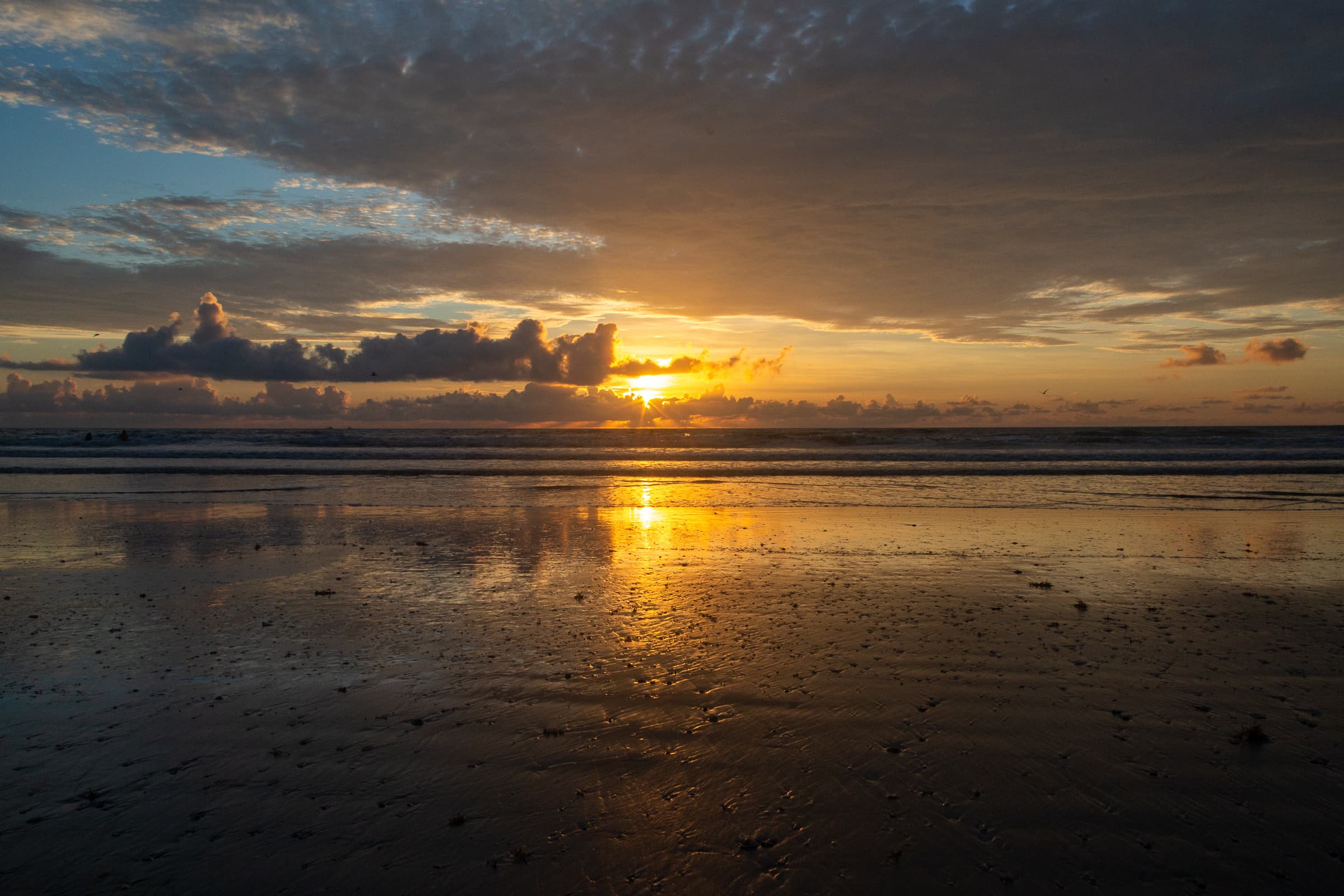
Where Darkness Becomes Light explores the gradual passage between night and day along the ocean's edge. From the nearly black foreground, detail slowly emerges across the wet sand before reaching the reflected sunlight, ocean, and illuminated horizon, while a massive cloud layer still carries the darkness above. Inspired by Francisco Colón's lifelong fascination with the boundary between the illuminated and unilluminated Earth, the photograph reflects on a distinction that appears simple from a distance but becomes far more complicated when experienced: darkness does not simply end where light begins.
The Artist
I remember being a boy in school and seeing diagrams of the Earth illuminated by the sun. One side was in light and the other in darkness, and between them there always seemed to be a simple line.
That image stayed with me.
Perhaps that is one of the reasons I have always been drawn to photographing sunrise. No two are ever the same, but I think I have also been looking for that boundary I first saw as a child.
Standing here that morning, the distinction was anything but simple.
Parts of the beach were still nearly black. Other areas were beginning to reveal the texture of the sand. The ocean had its own degree of light, the horizon another, and above the rising sun a massive cloud still carried the darkness.
There was no line.
I grew up thinking there was a line between darkness and light. The older I became, the more I understood that almost everything happens in between.
The Curator
Where Darkness Becomes Light is constructed through layers of illumination rather than through a single dominant subject. The dark wet sand occupies much of the foreground, gradually revealing texture as it approaches the water. A narrow vertical reflection then leads the eye toward the rising sun near the horizon.
Horizontal bands of shoreline and ocean stabilize the composition while an expansive cloud mass occupies much of the upper frame. Rather than allowing the sunrise to become purely luminous or celebratory, the dark cloud introduces visual weight above the brightest area of the photograph.
The resulting composition does not divide naturally into darkness and light. Instead, multiple intermediate tonal states occupy most of the frame, making transition itself the photograph's principal visual structure.
Story Behind the Photograph
Francisco Colón made this photograph at Cherie Down Park in Cape Canaveral, Florida, on the morning of October 4, 2026.
The scene initially appeared almost empty: wet sand, ocean, clouds, sky, and the rising sun. Only on closer inspection did a tiny bird become visible near the horizon, a nearly imperceptible sign of life within the expansive landscape.
Colón has photographed sunrises repeatedly, drawn in part to the knowledge that no sunrise can ever be photographed twice. The changing relationship among clouds, atmosphere, water, light, and time makes every occurrence temporary.
While developing this photograph, a childhood memory returned to him: diagrams showing sunlight striking one side of the Earth while the opposite side remained dark. The clean boundary depicted in those illustrations contrasted with what the photograph actually recorded—a landscape passing gradually and unevenly from darkness into light.
Reflection
From a distance, opposites appear simple.
Light and darkness. Night and day. Before and after.
We draw boundaries between them because boundaries make complicated things easier to understand.
But transitions rarely behave like lines.
Light arrives gradually. Darkness remains in some places after it has disappeared from others. What appears absolute from a distance becomes filled with degrees, interruptions, reflections, and uncertainty when experienced from within.
Perhaps much of life exists there—not entirely in darkness and not entirely in light, but in the difficult and beautiful territory between them.
The Museum
Where Darkness Becomes Light is preserved within the Francisco Colón Studio Photography Wing as part of the collection's continuing examination of time, transformation, observation, and the changing character of familiar places.
Although sunrise is a recurring photographic subject, this work is retained not simply as a record of atmospheric beauty. Its significance lies in the gradual tonal transition across the landscape and in the personal memory through which Colón came to interpret that transition.
The photograph connects an observation made on the Florida coast in 2026 with an image retained from childhood: the apparently simple division between the illuminated and unilluminated Earth. The finished work challenges that simplicity by preserving the many tonal states existing between darkness and full light.
The small bird near the horizon has been retained as photographed. Though nearly invisible at normal viewing distance, its presence provides an unplanned trace of life within an otherwise spare landscape.
Technical Information
- Camera
- Canon EOS 5D Mark III
- Lens
- Canon EF28-135mm f/3.5-5.6 IS USM
- Focal Length
- 28 mm
- Capture Date
- October 4, 2026
- Capture Time
- 7:25:16 AM (camera-recorded time)
- Location
- Cherie Down Park, Cape Canaveral, Florida, United States
- Flash
- Did not fire
- Metadata Status
- Original RAW metadata preserved. ISO 800; 28 mm; 1/200 sec at f/22; -0.33 EV exposure bias; Shutter Priority exposure program; Pattern metering; flash did not fire. Original dimensions 5760 × 3840 pixels; final dimensions 5118 × 3412 pixels. Developed in Adobe Lightroom Classic with restrained tonal adjustments intended to preserve the gradual transition from deep foreground shadow through reflected light to the illuminated horizon.
Collection Record
- Accession Number
- FCS-PH-0125
- Exhibit Number
- 125
- Exhibition
- Photography Wing
- Status
- Permanent Collection
- Studio Acquisition
- Francisco Colón Studio Photography Wing
- Artist
- Francisco Colón
- Copyright
- © Francisco Colón. All Rights Reserved.