FCS-PH-0123
Photography Wing · Exhibit No. 123
Where Our Histories Meet
Returning with my daughter to a place where family, memory, and history converge.
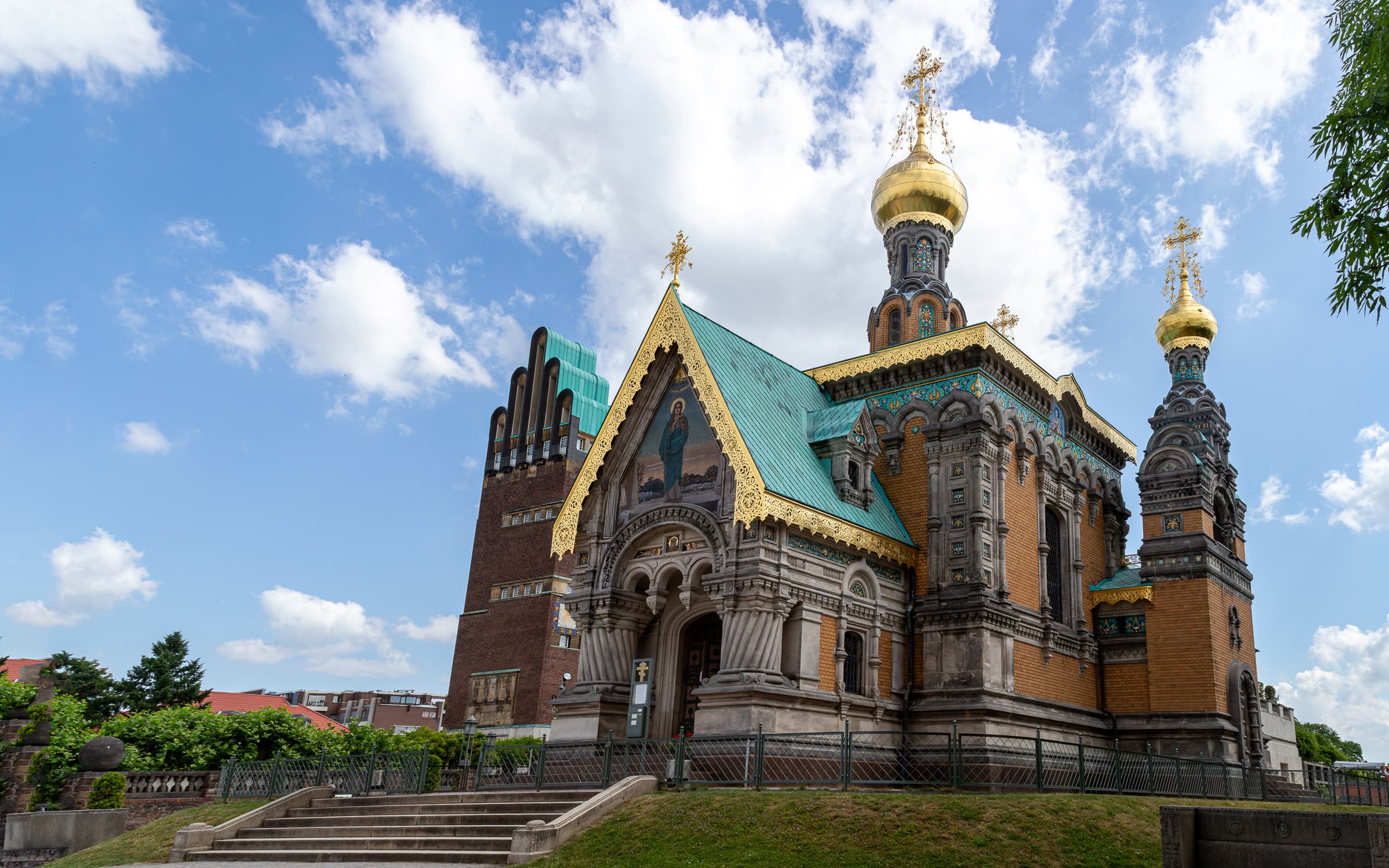
Where Our Histories Meet
FCS-PH-0123
Permanent Collection
Mathildenhöhe, Darmstadt, Germany
June 18, 2014
Available as a Fine Art Print
Acquire a Print ↗About the Work
Where Our Histories Meet portrays the Russian Chapel of St. Mary Magdalene on the Mathildenhöhe in Darmstadt, Germany, photographed during a 2014 return to a city deeply connected to Francisco Colón's family history. Colón first encountered the chapel while stationed in Darmstadt with the U.S. Army and later brought his wife there; decades afterward, he returned with their daughter, who was born in nearby Frankfurt. Built for Russian Emperor Nicholas II and his family during their visits to Darmstadt, the chapel brought together personal memory, family, history, and the quiet weight of return.
The Artist
I first came to this place when I was a young soldier stationed in Darmstadt.
During Head Start Week, a German guide brought us here and explained the history of the Russian Chapel. I remember being told that materials used in its construction had been brought from Russia. I never investigated the story. I simply carried it with me.
I had married in 1983, and about two weeks later I left for Germany. When my wife eventually joined me, this was one of the places I brought her. Our daughter would later be born in nearby Frankfurt.
In 2014, I returned to Darmstadt with that daughter.
I was bringing her to a place where I had once brought her mother.
But I could never look at this chapel only through my own memories. I knew of its connection to Nicholas II and his wife Alexandra, and I knew how the story of their family ended. Standing there again, I felt a sense of grief, particularly for their children.
Darmstadt has remained dear to me. Coming back, even as a tourist, did not feel like simply visiting a place I once knew. I was returning to a place where my own family's history and a much older history had somehow come to occupy the same ground.
The Curator
The photograph presents the Russian Chapel of St. Mary Magdalene within the broader architectural landscape of Darmstadt's Mathildenhöhe. Colón constructed the finished image from three separate exposures, creating a panoramic view capable of holding the chapel's elaborate architecture together with the surrounding sky and neighboring structures.
The upward perspective emphasizes the chapel's vertical forms, while the gold domes and ornamentation rise against an expansive field of blue and white. Turquoise roofing, patterned mosaics, brick, stone, and gilded details create a dense architectural surface, balanced by the openness of the sky.
Although the photograph functions as an architectural document, its significance within Colón's work comes from return. The building is not an unfamiliar monument encountered during travel, but a place revisited across different stages of the photographer's life.
Story Behind the Photograph
The Russian Chapel of St. Mary Magdalene on Darmstadt's Mathildenhöhe was constructed between 1897 and 1899 for Nicholas II, the last Emperor of Russia. His wife, Alexandra Feodorovna, was born Princess Alix of Hesse and by Rhine and was the sister of Grand Duke Ernst Ludwig of Hesse. The chapel allowed the Russian imperial family to attend Orthodox services during visits to Alexandra's family in Darmstadt.
Francisco Colón first encountered the chapel while serving with the United States Army in Darmstadt. During his Head Start orientation, a German guide introduced him to the site and told the group that materials used in the chapel's construction had been brought from Russia. Historical sources support a Russian material connection: period archival documentation records building components arriving from Russia, while other accounts document Russian soil being imported for the site.
After Colón's wife joined him in Germany following their 1983 marriage, he brought her to see the chapel. Their daughter was subsequently born in nearby Frankfurt.
More than three decades later, in 2014, Colón returned to Darmstadt with their daughter and brought her to the same place he had once shown her mother.
The photograph was constructed from three exposures made during that return.
Reflection
Places do not preserve only one history.
A building may belong to the history of a city, a nation, a religion, or an imperial family, while simultaneously becoming part of the private history of people who pass through it.
Returning changes the relationship.
The monument remains, but the person standing before it does not. A young soldier can return as a father. A place once shared with a wife can later be shared with their daughter. Knowledge acquired through history can also change what the eye sees and what the heart carries.
Sometimes histories separated by generations meet simply because someone returns.
The Museum
Where Our Histories Meet is preserved within the Francisco Colón Studio Photography Wing as both an architectural document and a work concerned with return, memory, and intergenerational connection.
The photograph records the Russian Chapel of St. Mary Magdalene at Mathildenhöhe, Darmstadt, during Colón's 2014 return to Germany with his daughter. The site is personally significant because Colón first encountered it while stationed in Darmstadt with the United States Army and later brought his wife there after she joined him in Germany.
Its historical significance extends beyond the photographer's biography. The chapel was constructed for Emperor Nicholas II and his family during their visits to Darmstadt and remains one of the distinctive architectural elements of the Mathildenhöhe.
The finished photograph is a panorama assembled from three individual exposures. Its inclusion in the collection preserves not merely the appearance of the building in 2014, but the convergence of documented history and personal memory that made Colón return to it.
Technical Information
- Camera
- Canon EOS 5D Mark III
- Lens
- Canon EF28-135mm f/3.5-5.6 IS USM
- Focal Length
- 28 mm
- Capture Date
- June 18, 2014
- Capture Time
- 5:08:58 AM (camera-recorded time)
- Location
- Mathildenhöhe, Darmstadt, Germany
- Flash
- Did not fire
- Metadata Status
- Three-frame panoramic stitch. Source metadata preserved. ISO 1000; 28 mm; 1/500 sec at f/14; -0.33 EV exposure bias; Normal exposure program; Pattern metering; flash did not fire. Final stitched dimensions 6078 × 6946 pixels. Developed in Adobe Lightroom Classic with restrained tonal recovery intended to preserve architectural detail, gilded ornamentation, roof color, and natural sky luminosity.
Collection Record
- Accession Number
- FCS-PH-0123
- Exhibit Number
- 123
- Exhibition
- Photography Wing
- Status
- Permanent Collection
- Studio Acquisition
- Francisco Colón Studio Photography Wing
- Artist
- Francisco Colón
- Copyright
- © Francisco Colón. All Rights Reserved.