FCS-PH-0122
Photography Wing · Exhibit No. 122
Where Stone Meets the Sierra
The Alhambra rises against the Sierra Nevada as evening light settles over Granada.
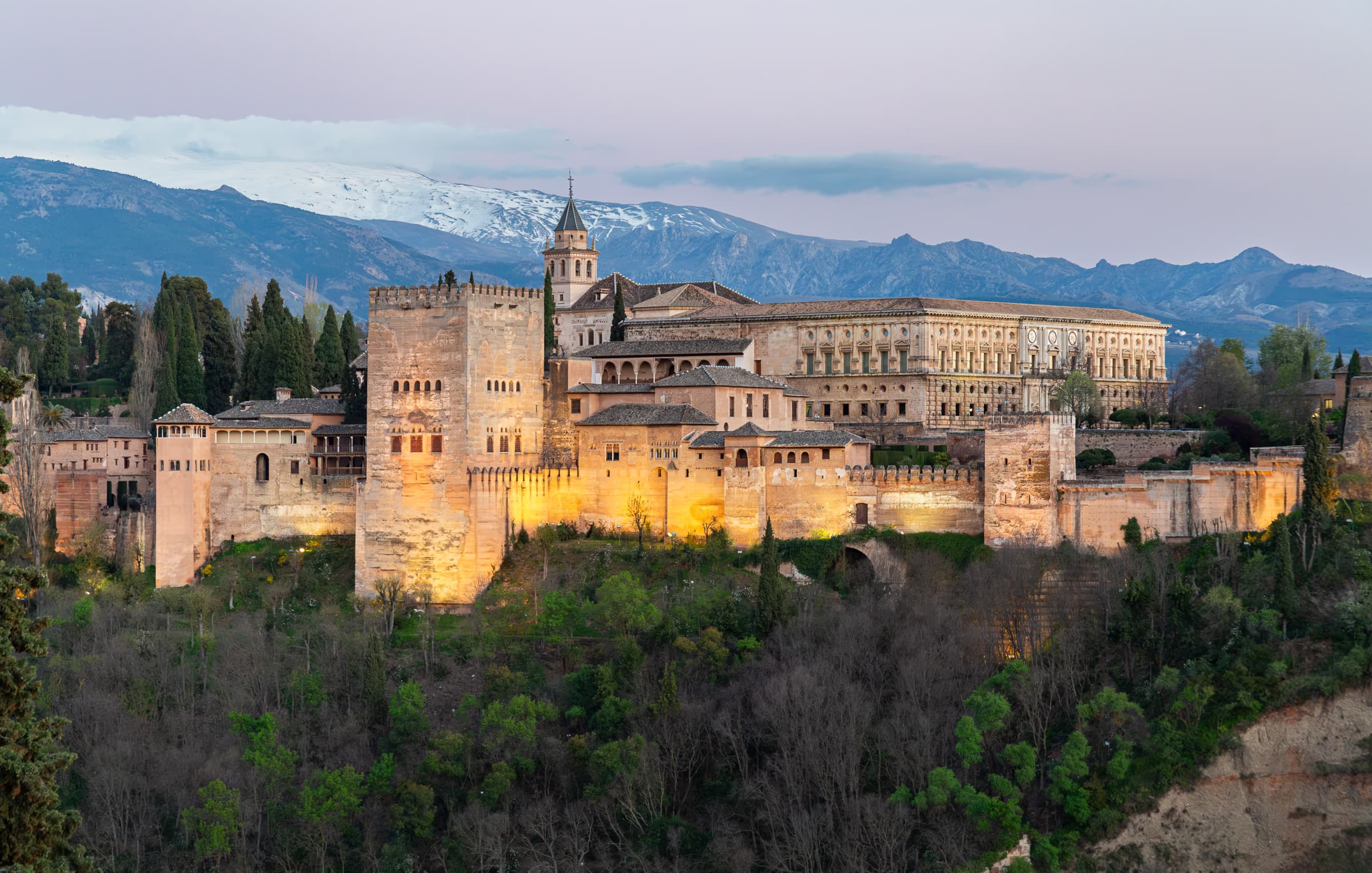
Where Stone Meets the Sierra
FCS-PH-0122
Permanent Collection
Granada, Spain
April 6, 2014
Available as a Fine Art Print
Acquire a Print ↗About the Work
The Alhambra rises above Granada beneath a pale evening sky, its warm illuminated walls set against the cool blue ridges of the Sierra Nevada. Snow remains visible along the distant mountains while the palace glows above the wooded hillside, creating a natural contrast between architecture and landscape. The photograph reflects the enduring presence of the Alhambra within its setting—stone, history, mountain, and fading light held together in one quiet view.
The Artist
Granada has always carried a particular historical significance for me.
I cannot look at the Alhambra without thinking about what this city once represented—the final Muslim kingdom on the Iberian Peninsula and the end of an era that had lasted for centuries.
Knowing that history changes the way I see this building.
The Alhambra is magnificent even without knowing anything about its past. But once I understood something of the people who built it, lived within it, and ultimately had to leave Granada behind, the palace became more than architecture to me.
I could understand why leaving a place like this would have caused such pain.
There are buildings we admire because they are beautiful, and there are others whose beauty becomes inseparable from everything that happened within and around them.
The Alhambra is one of those places for me.
I could wake up every morning and look at this view in much the same way that I could sit and watch a sunrise. I do not think I would become tired of it.
The palace alone would be enough.
But then the Sierra Nevada rises behind it.
The stone, the mountains, the remaining snow, the changing light—all of it comes together in a way that makes the Alhambra feel as though it belongs naturally to the landscape rather than simply standing in front of it.
That is what stayed with me when I made this photograph.
I was not simply looking at a historic building.
I was looking at Granada.
The Curator
Where Stone Meets the Sierra presents the Alhambra not as an isolated monument but as part of a larger geographical setting.
The architecture occupies the middle of the frame, illuminated by warm artificial light, while the Sierra Nevada extends across the background in cooler blue tones. Snow along the upper slopes reinforces the separation between the warm stone of the palace and the mountainous landscape beyond.
The wooded hillside below provides a darker visual foundation, allowing the architecture to emerge from the landscape without becoming detached from it.
The resulting composition balances built history with natural permanence.
Reflection
Some places seem to carry time differently.
Standing before the Alhambra, centuries do not feel entirely distant. The walls remain. The mountains remain. The light continues to move across them just as it did long before any of us arrived.
People built this place believing in a future they could not completely know.
Others inherited it.
Others lost it.
And still the building remained.
Perhaps that is one reason I am drawn to historic places. They remind me that we occupy only a small part of a much longer story.
The Sierra Nevada behind the Alhambra makes that idea even stronger for me. Kingdoms change. Borders change. Generations arrive and disappear.
The mountain watches all of it.
And for a moment, standing there with a camera, so do I.
The Museum
Where Stone Meets the Sierra places one of Granada's most recognizable architectural landmarks within the larger landscape that surrounds it.
Rather than concentrating exclusively on architectural detail, the photograph uses distance to establish a relationship between the illuminated Alhambra, the wooded hillside below, and the Sierra Nevada beyond.
The contrast between warm artificial illumination and cool mountain tones creates both visual and historical separation, while the broad landscape connects the monument to a geography that extends beyond the human history contained within its walls.
Within Francisco Colón's Photography Wing, the work reflects recurring interests in place, history, observation, and the persistence of landscape across time.
Technical Information
- Camera
- Canon EOS 5D Mark III
- Lens
- Canon EF 28–135mm f/3.5–5.6 IS USM
- Focal Length
- 80 mm
- Capture Date
- April 6, 2014
- Capture Time
- 8:48:11 PM local time
- Location
- Granada, Spain
- Flash
- Did not fire
- Metadata Status
- Capture date and camera-clock time verified from Lightroom metadata. Camera clock remained set to New York time.
- Supporting Documentation
- Lightroom metadata records April 6, 2014 at 2:48:11.930 PM on the camera clock. Because the camera remained set to New York time, the corresponding local time in Granada was approximately 8:48:11 PM.
Collection Record
- Accession Number
- FCS-PH-0123
- Exhibit Number
- 123
- Exhibition
- Cities
- Status
- Permanent Collection
- Original Capture
- April 6, 2014
- Studio Acquisition
- 2026
- Artist
- Francisco Colón
- Copyright
- © 2026 Francisco Colón. All rights reserved.