FCS-PH-0096
Photography Wing · Exhibit No. 96
Where the Morning Was Going
A city begins its day while one arrival gives the morning its meaning.
Where the Morning Was Going
FCS-PH-0096
Permanent Collection
Santiago, Chile
Friday, March 20, 2015
About the Work
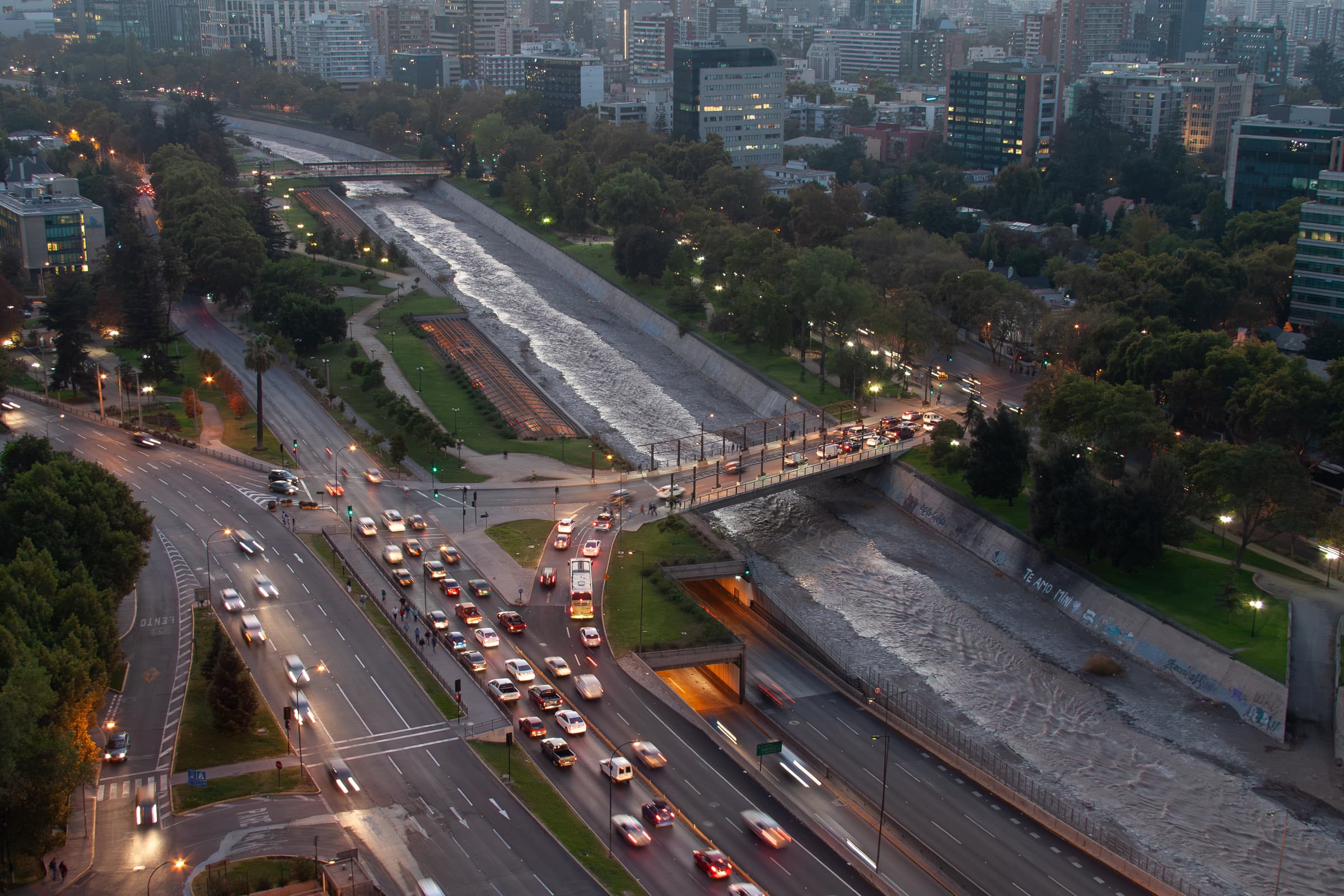
At daybreak in Santiago, traffic gathers beneath an elevated viewpoint while water runs through a channel toward the quieter buildings beyond. Francisco Colón made the photograph in March 2015, knowing that in a few hours he would be waiting for someone to arrive. The city was already moving; for him, the morning had begun moving toward her.
The Artist
I wanted to photograph Santiago as it woke up. From the window, I could see traffic building on the roads and water flowing through the city. Everyone seemed to be going somewhere. I could not know what any of them needed to do that day, but I knew why I was there.
In a few hours, I would be waiting for her to arrive. Looking toward the buildings, I thought about the people who were still asleep, and I knew she was waking up somewhere too. My clock had already begun, even though I did not feel rushed. Time felt as though it was on my side. I could stand there, watch, and let the morning unfold.
When I look at the photograph now, I think of all those separate purposes moving through one place. I fulfilled mine that day, and she fulfilled hers. I will never know whether everyone else fulfilled theirs. Their journeys were real to them, even if all I could see were the roads they traveled.
The Curator
The elevated viewpoint holds several kinds of movement in a single frame. Traffic fills the foreground and converges near the bridge. The water channel cuts diagonally through the city, carrying the eye toward the buildings in the distance. Trees and darkened windows slow the composition beyond the busy intersection.
The headlights and pale water make two visible currents. One is shaped by people choosing routes and destinations; the other follows the course of the channel. Neither reveals where an individual journey will end. That visual uncertainty allows Colón’s private anticipation to coexist with a city whose other lives remain beyond his knowledge.
Story Behind the Photograph
Francisco Colón made this photograph while visiting Santiago, Chile, in March 2015. He looked out over a road junction, bridge, water channel, trees, and buildings at daybreak because he wanted to photograph the city as it woke.
He knew that a woman he was waiting to see would arrive a few hours later. With time to spare, he watched traffic begin to move and imagined her waking somewhere in the city. He recalls feeling neither hurried nor obstructed. The morning gave him time both to make the photograph and to anticipate their meeting.
Colón connects the experience to the world of his album Fronteras y Ecos and the song “Habitación de Paso.” The photograph records the city before her arrival; his account preserves what that ordinary-looking morning meant to him.
Reflection
A city lets us witness movement while concealing its reasons. From a distance, a line of cars can look like a single current. Inside each one is a separate life, carrying an errand, an obligation, a hope, or perhaps no settled plan at all. We can see that people are going somewhere without knowing what it would mean for them to arrive.
The water offers another measure of time. It keeps moving through the frame while the roads meet, divide, and fill again. Watching both, Colón had an unusual freedom: he knew his own purpose, yet he did not have to hurry toward it. Waiting for her was already part of being with her in his thoughts. For a little while, he could let the city have his attention too.
He knows what became of his day and of hers. The other journeys remain open. That is part of what a photograph can hold: many lives sharing one moment, each moving beyond the edge of the frame toward an ending the photographer will never see.
The Museum
Where the Morning Was Going enters the Cities collection as a view of Santiago shaped by a personal appointment. The image preserves the visible city at daybreak; Colón’s account records the anticipation that cannot be seen within the frame.
The work also connects the Photography Wing to Fronteras y Ecos and “Habitación de Paso” in the Music Room. That connection does not turn the photograph into an illustration of the song. It records how a morning, a journey, and a later piece of music can carry related memories within the Studio archive.
Technical Information
- Camera
- Canon EOS Rebel T1i
- Lens
- Canon EF 28–135mm f/3.5–5.6 IS USM
- Focal Length
- 28 mm
- Capture Date
- Friday, March 20, 2015
- Capture Time
- Approximately 6:52:23 AM Santiago local time; camera recorded 5:52:23 AM New York time
- Location
- Santiago, Chile
- Flash
- Did not fire
- Metadata Status
- EXIF screenshot confirms the camera, lens, focal length, exposure, ISO, dimensions, date, camera time, and flash status. The camera clock was set to New York time; Santiago was one hour ahead on the capture date.
- Supporting Documentation
- EXIF screenshot and artist's account. Exposure: 1/4 sec at f/5.6; ISO 400. File dimensions shown: 4752 × 3168 pixels.
Collection Record
- Accession Number
- FCS-PH-0096
- Exhibit Number
- 96
- Exhibition
- Cities
- Status
- Permanent Collection
- Original Capture
- March 20, 2015
- Studio Acquisition
- Francisco Colón Studio Photography Wing
- Artist
- Francisco Colón
- Copyright
- © Francisco Colón. All Rights Reserved.