FCS-PH-0083
Photography Wing · Exhibit No. 83
Where the Mountains Hold the City
Rio awakens within the landscape that has always defined it.
Where the Mountains Hold the City
FCS-PH-0083
Permanent Collection
Hotel rooftop overlooking Copacabana, Rio de Janeiro, Brazil
Thursday, January 25, 2007
About the Work
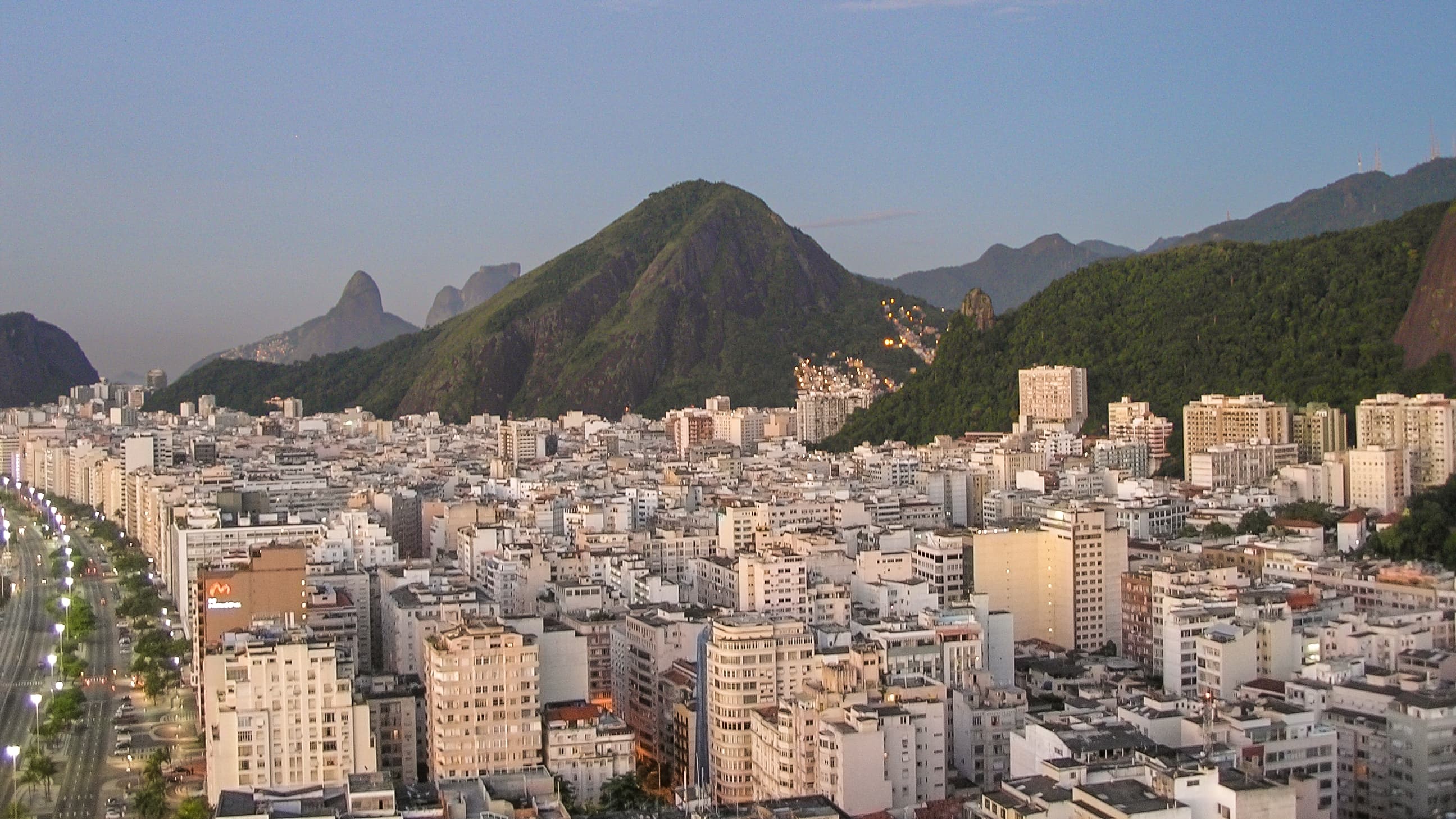
Photographed at approximately 7:23 AM from the rooftop of a hotel overlooking Copacabana, this elevated view reveals Rio de Janeiro as a city held between architecture and mountains. After receiving permission from the front desk, the photographer was escorted to the rooftop by hotel security specifically to make the image. An illuminated avenue leads through the dense arrangement of buildings toward the surrounding peaks, while scattered hillside lights remain visible in the emerging morning. The camera recorded 4:23 AM because its clock remained set to Miami time—three hours behind Rio de Janeiro on January 25, 2007.
The Artist
This was not a view available from my hotel room.
I wanted to see Copacabana from above, with enough elevation to understand how the city existed within the surrounding mountains.
I asked the front desk whether I could photograph from the hotel rooftop.
They granted permission, but I could not go alone. A member of hotel security accompanied me to the roof and remained with me while I made the photographs.
That access mattered.
From street level, Rio can feel almost endless. Buildings, traffic, sidewalks, storefronts, and people compete for attention.
From the rooftop, the structure of the city became visible.
The avenue entered the scene from the lower left, its lights still illuminated. The buildings spread across the frame in tightly arranged layers, and beyond them the mountains rose as though they were holding the city in place.
The camera recorded 4:23 in the morning because I had not changed it from Miami time. In Rio, it was approximately 7:23 AM.
The city was already awake, but traces of the night remained in the streetlights and hillside homes.
What I remember most is not simply being on the rooftop.
It is that I asked for the opportunity to see the city differently—and someone allowed me to do it.
The Curator
Where the Mountains Hold the City presents Copacabana as a landscape shaped equally by human density and natural geography.
The lower portion of the photograph is occupied by an extensive field of residential and commercial buildings. Their repeating windows, rooftops, façades, and narrow separations create a visual record of concentrated urban life.
At the left edge, an illuminated avenue forms the photograph's principal leading line. It carries the viewer from the foreground into the city before disappearing among the buildings.
The mountains establish the second major layer of the composition.
Rather than functioning as a distant background, they appear to surround and contain the city. Their irregular forms contrast with the rectangular architecture below, creating a dialogue between geological permanence and continued human construction.
Small clusters of hillside lights connect those two environments. They demonstrate that Rio does not merely stop where the mountains begin; the city continues upward into them.
The high rooftop perspective was neither accidental nor publicly accessible. It was obtained through a direct request by the photographer and under the supervision of hotel security.
That act of requesting access forms part of the work's provenance. The photograph exists because Colón sought a perspective from which the relationship between Copacabana and its landscape could be seen in a single frame.
Story Behind the Photograph
On the morning of January 25, 2007, Francisco Colón approached the front desk of the hotel where he was staying and requested permission to photograph Copacabana from the rooftop.
The rooftop was not ordinarily available as an unrestricted guest observation area.
The hotel approved the request on the condition that a member of its security staff accompany him.
Together, they went to the roof, where Colón was given the opportunity to photograph the city from an elevated position that could not be obtained from his room or from the surrounding streets.
The resulting image looks across the dense urban landscape of Copacabana toward the mountains beyond it.
Streetlights remained visible along the avenue at the left side of the frame, while smaller concentrations of light appeared among homes rising into the hills. Morning illumination had begun to reveal the buildings, vegetation, and rock formations, but the city still retained traces of the preceding night.
The camera recorded the image at 4:23:28 AM. Colón later established that the camera clock remained set to Miami time.
On January 25, 2007, Miami observed Eastern Standard Time at UTC−5. Rio de Janeiro was observing Brazilian summer time at UTC−2.
Rio was therefore three hours ahead, establishing the local capture time as approximately 7:23:28 AM.
The exact name of the hotel has not been established within the current archival record. The location is therefore documented conservatively as a hotel rooftop overlooking Copacabana.
Reflection
We usually experience a city from inside it.
We walk its streets.
We follow its traffic.
We see one building at a time and understand the landscape only in fragments.
Elevation changes that relationship.
From above, streets become lines, buildings become patterns, and mountains reveal the boundaries within which the city has learned to exist.
But this perspective was not simply discovered.
It had to be requested.
Permission had to be given.
A security officer had to accompany me.
Sometimes a photograph begins before the camera is raised.
It begins when we decide that the ordinary viewpoint is not enough and ask whether another one might be possible.
From that rooftop, Copacabana no longer appeared as an isolated collection of streets and buildings.
It appeared as a city held within the land itself.
The mountains did not stand beyond Rio.
They were part of what made Rio possible.
The Museum
Preserved as the eighty-third accessioned photograph in the Francisco Colón Studio Photography Wing, Where the Mountains Hold the City joins the Cities collection as a study of urban geography, observation, access, architecture, and the relationship between the constructed and natural landscape.
The photograph was created on January 25, 2007, from the rooftop of a hotel overlooking Copacabana in Rio de Janeiro, Brazil.
Artist provenance establishes that rooftop access was requested through the hotel front desk. Permission was granted, and the photographer was accompanied to the rooftop by a member of hotel security.
The name of the hotel has not been confirmed within the surviving archival record and is therefore not asserted in the collection entry.
The camera's embedded metadata records January 25, 2007, at 4:23:28 AM. The artist confirms that the camera remained set to Miami time.
Historical time-zone records establish that Miami observed UTC−5 while Rio de Janeiro observed summer time at UTC−2 on the date of capture. Rio was therefore three hours ahead of the camera setting, placing the local capture time at approximately 7:23:28 AM.
The image records Copacabana during the early morning. Artificial lights remain visible along the avenue and within hillside communities while increasing natural illumination reveals the city's buildings, vegetation, and surrounding mountains.
The rooftop perspective allows the photograph to document the relationship between Rio's urban density and its distinctive geological setting.
Within the Studio archive, the work also preserves an example of photographic initiative. The viewpoint was not encountered through chance or unrestricted access; it resulted from the photographer recognizing the potential of the location, requesting permission, and working within the hotel's security requirements to create the image.
Technical Information
- Camera
- Olympus C-5500 Zoom (C55Z/C5500Z)
- Lens
- Integrated Olympus zoom lens
- Focal Length
- 7.9 mm
- Capture Date
- Thursday, January 25, 2007
- Capture Time
- Approximately 7:23:28 AM Rio de Janeiro local time; camera recorded 4:23:28 AM Miami time
- Location
- Hotel rooftop overlooking Copacabana, Rio de Janeiro, Brazil
- Flash
- Did not fire (compulsory mode)
- White Balance
- Auto
- Metadata Status
- Original EXIF metadata identifies the camera as an Olympus Imaging Corp. C55Z/C5500Z and records January 25, 2007, at 4:23:28 AM. Artist provenance confirms that the camera clock remained set to Miami time. On the date of capture, Miami observed UTC−5 and Rio de Janeiro observed summer time at UTC−2, establishing the Rio local time as approximately 7:23:28 AM. EXIF also records automatic exposure, a 7.9 mm focal length, digital ESP metering, automatic white balance, standard scene capture, normal processing, gain control 1, normal sharpness, and a maximum aperture value of f/2.8.
- Supporting Documentation
- Original Olympus image file, surviving EXIF metadata, metadata screenshot, restored master, historical time-zone verification, and artist provenance narrative preserved in the Francisco Colón Studio archive.
Collection Record
- Accession Number
- FCS-PH-0083
- Exhibit Number
- 83
- Exhibition
- Cities
- Status
- Permanent Collection
- Original Capture
- January 25, 2007
- Studio Acquisition
- Francisco Colón Studio Photography Wing
- Artist
- Francisco Colón
- Copyright
- © Francisco Colón. All Rights Reserved.