FCS-PH-0127
Photography Wing · Exhibit No. 127
Where the Street Finds the Light
Where the Street Finds the Light
FCS-PH-0127
Published
Granada, Andalusia, Spain
April 8, 2014
Available as a Fine Art Print
Acquire a Print ↗About the Work
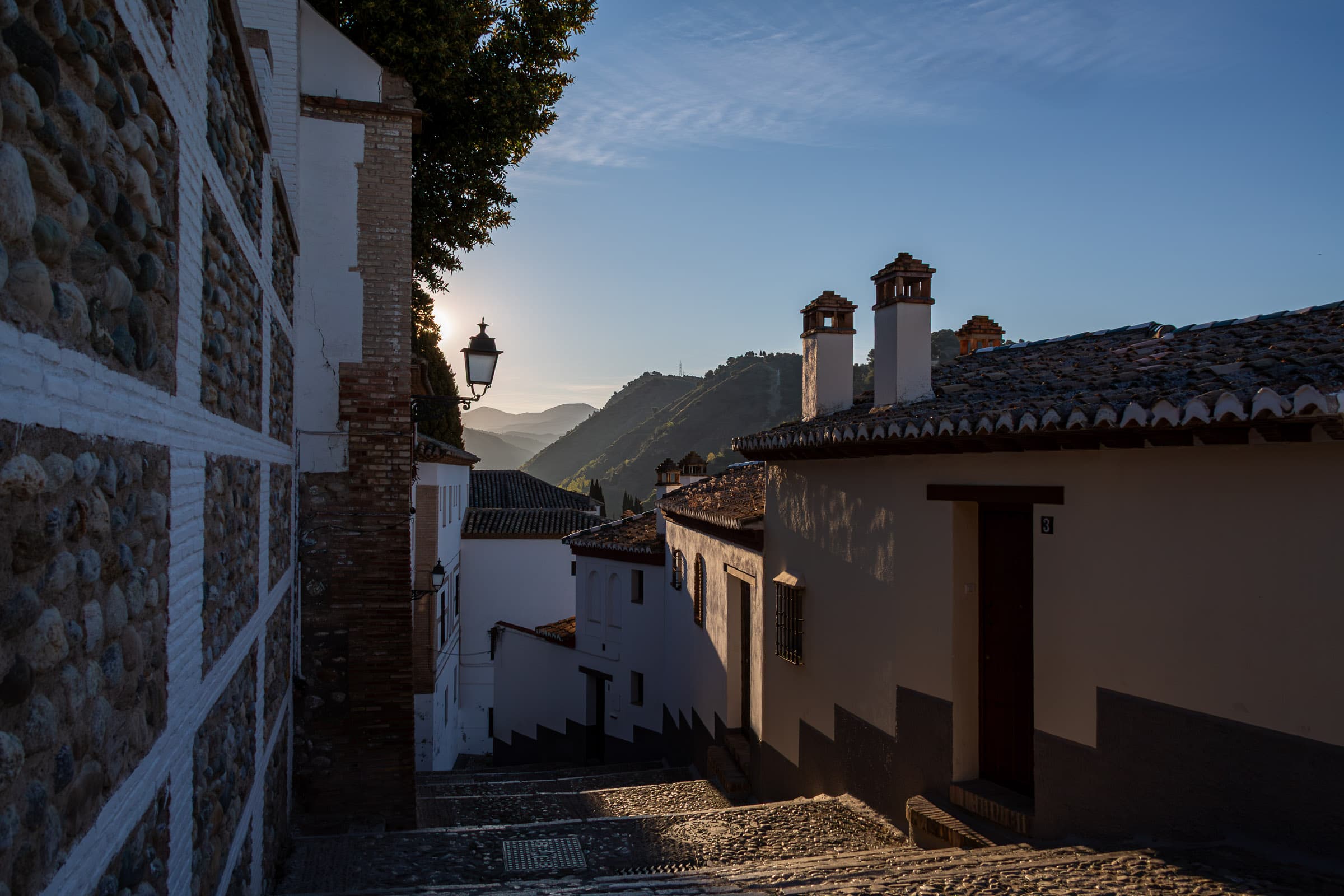
Where the Street Finds the Light looks down a narrow passage in Granada, Spain, during the early morning hours, when much of the old city still rests in shadow and the rising sun has only begun to reach the landscape beyond. Whitewashed walls, weathered stone, tiled roofs, ironwork, chimneys, and a solitary streetlamp define the architecture of the descending street, while the mountains in the distance gradually emerge through layers of morning atmosphere. The light does not fill the entire scene. Instead, it arrives selectively. It touches the edges of buildings, catches portions of the rooftops and street, and illuminates the distant hillside while large areas of the foreground remain in darkness. That division between shadow and illumination gives the photograph its character. The viewer stands within the darker, enclosed portion of the street while looking toward a landscape already beginning to receive the day. Rather than presenting Granada through one of its monumental landmarks, the photograph concentrates on a quieter experience of the city: an ordinary passage, the architecture surrounding it, and the temporary transformation created by morning light. The street becomes both a physical route through the old city and a visual passage from darkness toward illumination.
The Artist
There is a moment between darkness and light that has always held my attention—the moment when light first begins to enter a space. I did not understand for many years why that particular transition could affect me so strongly. Looking at photographs like this one, I think part of the answer reaches much farther back than my photography.
In 1975, when I was living with my father in New Jersey, there was a period when our apartment had no electricity. Night meant darkness. We had a candle, but I understood that using it also meant using it up. Sometimes I would sit in complete darkness rather than waste it. On other nights, the apartment was illuminated only by that small, flickering flame.
The windows facing the street had no curtains, and they faced the direction from which the morning light arrived. Because of that, sunrise was more than something happening outside the window. I could actually watch the light begin to enter the apartment. The room did not suddenly become bright. Shapes slowly returned. Walls became visible. Objects emerged from the darkness. Eventually the apartment belonged to the daylight again.
I remember the sense of relief that came with that transition.
Nearly four decades later, when I made this photograph in Granada, I was not consciously thinking about that apartment or those mornings with my father. I was responding to what was in front of me: the narrow street, the old buildings, the mountains beyond them, and especially the way the morning light was beginning to occupy a scene that still belonged partly to the darkness.
It was only much later, looking at the photograph, that I recognized something familiar in it. The street remains in shadow, but the darkness is no longer complete. Light has reached the mountains. It has begun touching the architecture. Slowly, the space is being returned to view.
Perhaps that is one reason I continue to notice moments like this with a camera. I am drawn not simply to beautiful light, but to its arrival—to that brief interval when darkness and illumination exist together and one begins to give way to the other.
It is the moment when the darkness begins to let the light through.
The Curator
Where the Street Finds the Light is constructed around a pronounced division between enclosure and release. The foreground is dominated by architecture: a heavily textured stone wall presses inward from the left, while the broad shadowed facade on the right occupies much of the opposite side of the frame. Together they create a narrow visual corridor through which the viewer is directed toward the center of the photograph and the landscape beyond.
The descending street provides the principal line of movement. Its irregular stone surface, steps, walls, and receding architectural forms carry the eye downward and inward before allowing it to escape toward the distant mountains. A streetlamp positioned near the opening acts as a visual hinge between the darker architecture of the foreground and the illuminated landscape beyond. Above it, the repeating chimneys create a secondary rhythm across the roofline and reinforce the vertical geometry of the surrounding buildings.
Light is used sparingly rather than uniformly. Much of the photograph remains deliberately unresolved in shadow, while selected surfaces receive the first direct illumination of morning. The distant hillside becomes particularly important because it provides one of the brightest natural passages in the composition. The viewer is therefore encouraged to move visually from the darker physical surfaces close to the camera toward increasingly open and illuminated space.
This progression gives the photograph a quality that extends beyond documentation of place. Granada remains clearly present through its architecture and landscape, but the organization of the frame allows the physical street to function metaphorically as well. The photograph becomes an observation of transition: from enclosure toward openness, from obscurity toward visibility, and from darkness toward light.
Reflection
Photographs sometimes acquire meanings that were not consciously present when they were made. At the moment of exposure, this was a morning in Granada and an arrangement of things that caught my attention: an old street descending between buildings, mountains appearing in the distance, and sunlight beginning to reach a place still largely held in shadow.
Years later, I can look at the same photograph and see another layer within it.
The light takes me back to 1975 and to an apartment in New Jersey where morning once meant something very different to me. After a night without electricity, daylight was not simply beautiful. It changed what was possible inside the room. I could see again without depending upon a candle. The familiar world slowly returned as the sun came through the uncovered windows.
There is no literal connection between that apartment and this street in Granada. They are separated by countries, decades, circumstances, and the person I was at each moment. Yet photography has a way of allowing distant experiences to meet. A photograph made for one reason can later reveal another.
That is what has happened here. I can no longer look only at the architecture or the mountains. I notice the remaining darkness and the light beginning to enter it. I recognize the feeling of waiting for illumination to reach a space.
Perhaps the photograph did not change at all. Perhaps I simply lived long enough to understand something about why I stopped to make it.
The Museum
Created in Granada, Spain, on the morning of April 8, 2014, Where the Street Finds the Light presents the historic urban landscape through the interaction of architecture, topography, and transitional morning light. Rather than centering a monumental landmark, the photograph records a narrow residential passage characterized by whitewashed and masonry surfaces, tiled roofs, chimneys, a traditional streetlamp, and the mountainous terrain visible beyond the built environment.
The composition is organized through strong spatial recession. Architecture occupies and darkens the immediate foreground, while the descending street opens progressively toward the illuminated landscape. This movement establishes a visual relationship between the enclosed character of the street and the expansive geography beyond it. The contrast is reinforced by the uneven distribution of morning light, which leaves substantial portions of the architecture in shadow while selectively revealing distant terrain and portions of the built environment.
Within the broader Francisco Colón Studio collection, the photograph contributes to recurring observations of cities encountered through movement rather than through formal portraiture of landmarks. Place is understood through passages, streets, changing weather, available light, and moments discovered while traveling. The image also participates in a recurring visual interest in thresholds: spaces where one condition has not completely ended and another has already begun.
The artist's later association of the photograph with childhood memories of mornings spent in an apartment without electricity adds an autobiographical dimension to the work without altering its documentary foundation. The photograph remains a record of Granada in 2014, while its subsequent interpretation demonstrates how an image may accumulate personal meaning over time. In this sense, Where the Street Finds the Light functions simultaneously as a document of place, a study of transitional light, and an example of photography's capacity to connect experiences separated by decades.
Technical Information
- Camera
- Canon EOS 5D Mark III
- Lens
- EF 28-135mm f/3.5-5.6 IS USM
- Focal Length
- 35mm
- Capture Date
- April 8, 2014
- Capture Time
- 8:30 AM local time
- Location
- Granada, Andalusia, Spain
- Flash
- Did not fire
- Metadata Status
- Original camera clock remained set to New York time. EXIF records 2:30:14 AM; corrected to approximately 8:30 AM local time in Granada.
- Supporting Documentation
- Original EXIF metadata retained. Local capture time corrected from camera time using the six-hour difference between New York and Granada on April 8, 2014.
Collection Record
- Accession Number
- FCS-PH-0127
- Exhibit Number
- 127
- Exhibition
- Cities
- Status
- Published
- Original Capture
- April 8, 2014
- Artist
- Francisco Colón
- Copyright
- © Francisco Colón. All rights reserved.