FCS-PH-0052
Photography Wing · Exhibit No. 52
Where the Street Turns
Paris continues beyond what the photograph reveals.
Where the Street Turns
FCS-PH-0052
Curated Studio Work
Paris, France
February 24, 2013
Available as a Fine Art Print
Acquire a Print ↗About the Work
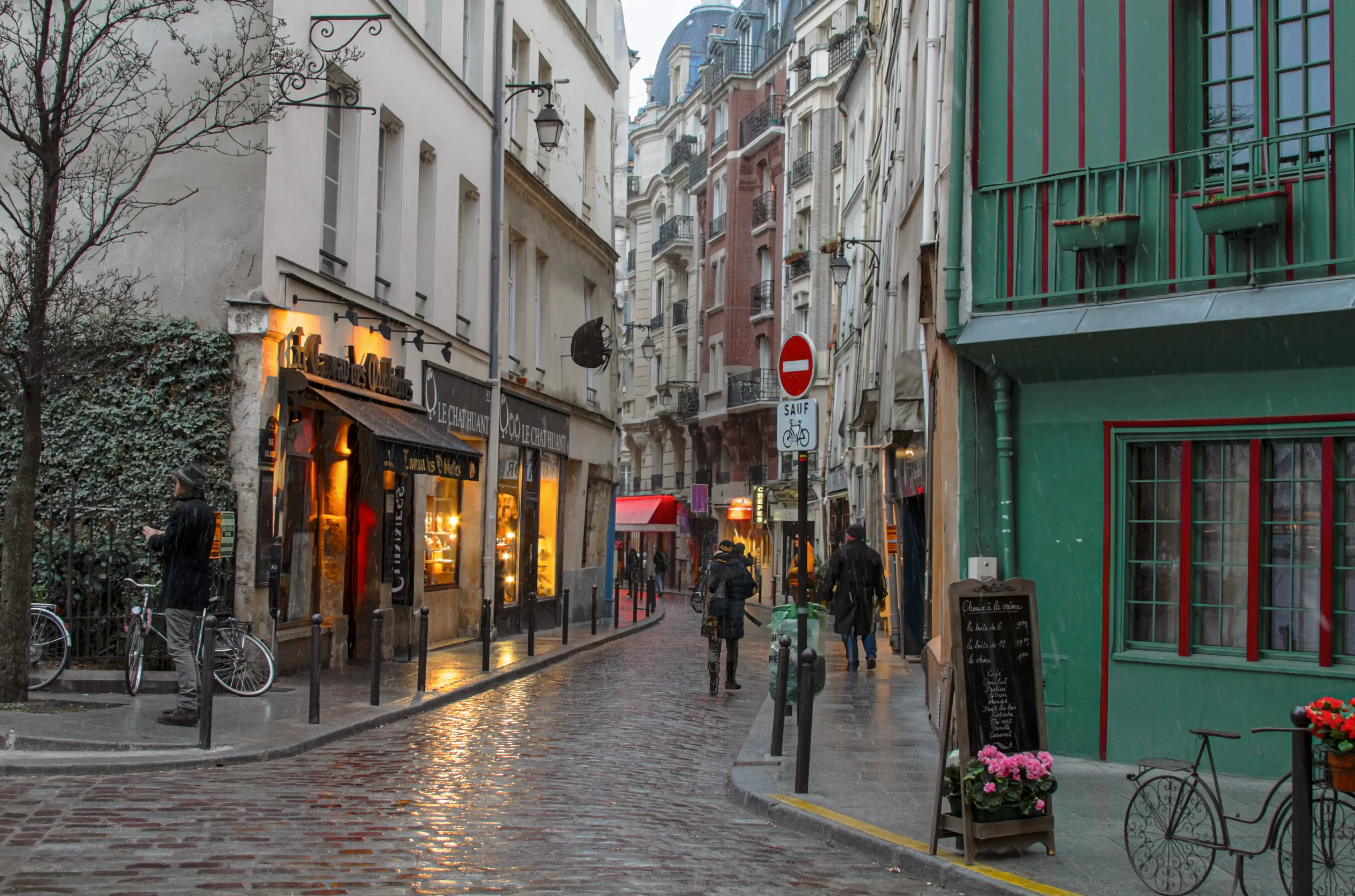
A narrow Paris street curves out of sight on a rainy February evening, as pedestrians make their way along wet cobblestones illuminated by the warm glow of nearby shops and restaurants. Photographed on February 24, 2013, while walking through Paris, the scene captures an unplanned moment encountered along the way—a small street whose turn leaves what lies beyond it unseen.
The Artist
I went to Paris wanting to experience the city on my own terms.
This was my first visit to Paris and the second stop of a photographic journey that would continue from London to Rome. On February 24, 2013, I left my hotel and began walking toward one of the city's major landmarks. I believe I may have been heading toward the Eiffel Tower or Notre-Dame.
But this photograph was not one of the destinations I had planned.
I simply came across this street.
It was small, narrow enough to feel intimate, although cars, bicycles, and motorcycles could still travel through it. People were walking ahead of me. A light rain was falling. The shops and restaurants were beginning to glow against the wet street.
What caught my attention was the street itself.
It traveled forward and then turned to the left.
I could not see where it went.
At the time, I did not think of that as part of a photographic style. I simply found the street interesting and photographed it.
Years later, while looking across photographs made in different places and at different times, I began recognizing how often I had been attracted to roads, stairways, passages, and openings that continue beyond what the camera can see.
I did not know what was around this corner.
Perhaps that was part of what made me stop.
The Curator
Where the Street Turns belongs to a recurring visual pattern within Francisco Colón's photographic archive: the observation of passages whose destinations remain outside the frame.
The photograph was made during Colón's first visit to Paris, while walking away from his hotel toward one of the city's better-known landmarks. Yet the camera turns its attention away from monumental Paris and toward an ordinary street encountered along the way.
The composition is structured around movement into uncertainty. Wet cobblestones lead toward pedestrians walking away from the photographer. Warm reflections from shops and restaurants travel along the pavement. Buildings create a narrowing corridor before the street bends left and disappears.
The photograph's significance within the archive is retrospective. There is no evidence that Colón consciously photographed the street in 2013 as part of a conceptual study of passages or unseen destinations.
He simply noticed it.
Seen alongside works made in other places and at other times, however, the photograph contributes to an increasingly visible characteristic of his observational practice: an attraction to routes that continue beyond what the photograph reveals.
Story Behind the Photograph
On February 24, 2013, Francisco Colón was in Paris during a photographic journey through Europe.
It was his first visit to Paris and the second stop of a trip that would later continue to Rome.
Rather than experiencing the city exclusively through an itinerary of landmarks, Colón spent considerable time walking and photographing whatever attracted his attention.
That evening, light rain was falling as he made his way away from his hotel toward one of the city's major destinations.
Along the way, a narrow street caught his attention.
Restaurants and shops illuminated the wet pavement. Bicycles rested along the edges of the street. Pedestrians moved away from the camera while rain remained visible against the buildings.
The street continued ahead before turning to the left.
What existed beyond that turn could not be seen.
Colón stopped and photographed it.
The image was created from bracketed exposures as part of his continuing experimentation with HDR photography and digital image processing.
At the time, the photograph was simply one of the scenes he encountered while exploring Paris.
Years later, Colón encountered the street again in an unexpected place. While watching the 2011 film Midnight in Paris, he recognized what appeared to be the same location and stopped the film to examine it. A later visual comparison showed the same distinctive storefronts, street signs, architecture, red awning, ivy-covered corner, and green-and-red façade visible in his photograph.
The discovery was incidental to the making of the photograph. Colón had not sought out a filming location or photographed the street because of its connection to the movie. He had encountered it independently while walking through Paris and photographed it simply because the street caught his attention.
More than a decade later, while reviewing his photographic archive, another connection emerged.
Photographs made in other countries and during other periods of his life contained a similar visual structure: streets, stairs, corridors, and passages leading toward places that remain unseen.
Where the Street Turns preserves an early example of that recurring observation.
Reflection
There are the places we intend to see, and there are the things we notice while trying to get there.
Paris offered monuments known throughout the world.
Yet on this evening, the camera stopped for a small street.
Nothing in the photograph explains what waits around the corner. The people continue toward it. The street continues toward it. The reflected light carries the eye toward it.
But the photograph stops before the answer.
Years later, the street revealed another part of its history when I recognized it while watching Midnight in Paris.
That discovery did not change why I made the photograph.
If anything, it reinforced it.
I had not gone looking for a movie location. I did not know that there was anything about this particular street that I was supposed to notice.
I noticed it anyway.
Years later, that simple act of noticing becomes recognizable within a larger body of work.
The destination is not always the subject.
Sometimes the subject is simply the moment when a path disappears from view.
The Museum
Created in Paris on February 24, 2013, Where the Street Turns documents both a particular moment in Colón's European travels and a period of technical experimentation in his photographic development.
The image originated as a bracketed exposure sequence intended for HDR processing. Earlier interpretations employed the pronounced tone-mapping aesthetic associated with HDR photography of the period.
In 2026, Colón returned to the source material and created a new HDR merge and interpretation in Adobe Camera Raw and Photoshop. The restoration retained the dramatic tonal range, illuminated storefronts, visible rain, and reflections of the original concept while using more restrained local contrast and color processing.
The location also carries an unexpected connection to cinema. Years after making the photograph, Colón recognized the same street while watching the 2011 film Midnight in Paris. Subsequent visual comparison with imagery from the film confirmed matching fixed features, including storefronts, street signage, architectural details, the red awning farther along the street, the ivy-covered corner, and the distinctive green façade with red trim.
The cinematic connection was discovered only after the photograph had been made. Colón had not sought the street as a filming location and was unaware of its appearance in the film when he encountered and photographed it.
The photograph therefore remains fundamentally an observational image: a place noticed independently while moving through the city.
Within the larger Francisco Colón Studio archive, the photograph also provides an example of a recurring compositional tendency subsequently identified across the work—the observation of roads and passages whose continuation remains outside the frame.
Technical Information
- Camera
- Canon EOS Rebel T1i
- Capture Date
- February 24, 2013
- Capture Time
- 11:40 AM (camera/base time)
- Location
- Paris, France
- Metadata Status
- The surviving source metadata records a capture time of 11:40 AM. The photographer intentionally maintained his camera clock in his base editing time zone while traveling rather than resetting it to local time. Artist recollection places the photograph in the Paris early evening, approximately six hours later. The image was created from bracketed exposures for HDR processing. Additional exposure and lens information should be verified from the surviving source files before being added to the permanent technical record.
- Supporting Documentation
- Original bracketed source photographs, earlier tone-mapped HDR interpretations, 2026 Adobe Camera Raw HDR merge and restored master, surviving metadata, artist provenance narrative, and visual comparison with imagery from the 2011 film Midnight in Paris preserved in the Francisco Colón Studio archival record.
Collection Record
- Accession Number
- FCS-PH-0052
- Exhibit Number
- 52
- Exhibition
- Photography Wing
- Status
- Curated Studio Work
- Original Capture
- February 24, 2013
- Studio Acquisition
- 2026
- Artist
- Francisco Colón
- Copyright
- © Francisco Colón. All rights reserved.