FCS-PH-0091
Photography Wing · Exhibit No. 91
Where the Water Catches Light
A familiar landmark, seen through a fleeting detail.
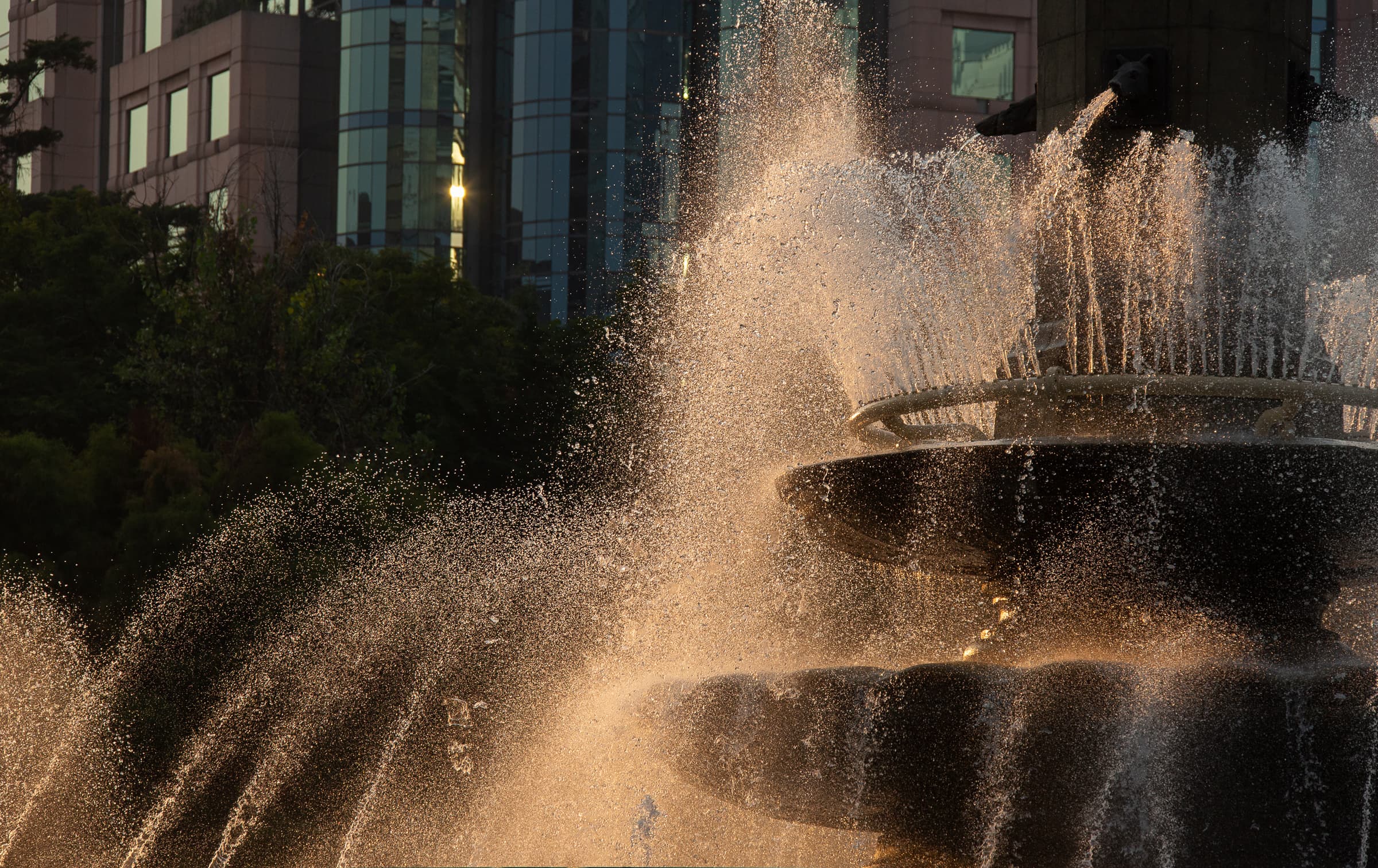
Where the Water Catches Light
FCS-PH-0091
Permanent Collection
Fuente de la Diana Cazadora, Mexico City, Mexico
November 18, 2018
Available as a Fine Art Print
Acquire a Print ↗About the Work
At the fountain of La Diana in Mexico City, Francisco Colón turned his camera toward the water rather than the statue for which the landmark is known. Late light passes through the spray, illuminating individual droplets against the dark fountain and surrounding city. The close view leaves much of the monument outside the frame, giving a familiar place a momentary appearance shaped by light and movement.
The Artist
I have photographs that show the entire fountain, including the statue. I wanted those views too. La Diana is a prominent sight in Mexico City, and when you're in that area, you can't help but see it.
But this photograph came from looking closer.
What held my attention was the water. The light was coming through the spray and picking out the droplets one by one. I could see the fountain in front of me, but through the camera I was watching something that would change from one second to the next.
I liked that the photograph didn't have to show the statue to be about my experience of La Diana. I knew where I was. I knew the larger landmark was there. For this frame, I wanted to stay with what the water and light were doing.
That is often how I photograph a place. I make the wider view, and then something within it asks me to look again.
The Curator
Where the Water Catches Light approaches a recognizable Mexico City landmark through a selective frame. The statue that ordinarily identifies La Diana is excluded. In its place, the fountain's dark tiers provide weight and structure while the spray moves across and beyond them.
The photograph depends on backlight. Against the darker trees and stone, the water resolves into many separate points rather than a single pale mass. Near the center, the denser spray becomes a luminous field; toward the edges, individual droplets and arcs are easier to distinguish. These changes in density give the still image a sense of continuing motion.
The building and small warm light in the background establish that the fountain sits within an active urban setting. That light also echoes the color of the illuminated water. The architecture remains secondary, allowing the relationship between the fixed fountain and the constantly changing spray to organize the frame.
By withholding the statue, Colón changes the viewer's first task. Recognition gives way to observation. The image asks us to look at the behavior of light and water before we name the place.
Story Behind the Photograph
Francisco Colón made this photograph at the fountain of La Diana Cazadora in Mexico City on November 18, 2018. His camera recorded 7:07:18 PM because it remained set to New York time; the corresponding local time in Mexico City was approximately 6:07:18 PM.
Colón photographed more than one view of the landmark. Other frames show the complete fountain and its statue. In this photograph, he chose a closer composition centered on the moving water, the fountain's tiers, and the light passing through the spray.
La Diana was familiar to him as a prominent sight encountered while moving through Mexico City. His account of making this image emphasizes the decision to concentrate on a detail within that larger public landmark. The frame preserves the fountain's setting through glimpses of trees and surrounding buildings, while leaving its best-known figure outside the picture.
The precise pattern of droplets existed only for the instant of exposure. That temporary arrangement is what this particular photograph records. The wider photographs document what the fountain looks like as a whole; this one documents what caught Colón's eye while he stood before it.
Reflection
We often remember a landmark by the feature that allows us to identify it. A statue, a building, or a name gives us a way to say where we were.
Yet our experience of a place may settle on something smaller.
Water passes through a fountain continuously, but it never holds the same shape twice. Light finds one spray of droplets and, a moment later, finds another. The monument remains in place while the scene within it keeps changing.
Looking closely does not diminish the larger landmark. It gives us another way to know it. The wide view tells us where we are; the detail reminds us what it was like to be there at that particular moment.
Sometimes the part of a place we carry away is the part that could not remain.
The Museum
Where the Water Catches Light is accessioned as FCS-PH-0091 in the Francisco Colón Studio Photography Wing. It is preserved within the Cities collection as an example of Colón's attention to details found inside familiar urban landmarks.
The photograph has a useful relationship to Colón's wider images of La Diana. Those views can identify and describe the monument as a whole. This work records a distinct photographic decision: to let moving water and passing light, rather than the statue, become the subject.
The archival description separates three forms of information. The fountain's identity and the camera-recorded capture details establish the documented setting. Colón's account explains what attracted his attention. The interpretation of the image's visual structure belongs to the curatorial record; it is not presented as a claim about thoughts or events that the photograph cannot verify.
Within the Studio collection, the work extends a recurring practice of looking beyond the expected view of a place. It preserves an encounter with a well-known Mexico City fountain through an appearance that lasted only a fraction of a second.
Technical Information
- Camera
- Canon EOS 5D Mark III
- Lens
- Canon EF 28–300mm f/3.5–5.6L IS USM
- Focal Length
- 35 mm
- Capture Date
- November 18, 2018
- Capture Time
- Approximately 6:07:18 PM Mexico City local time; camera recorded 7:07:18 PM New York time
- Location
- Fuente de la Diana Cazadora, Mexico City, Mexico
- Flash
- Did not fire
- Metadata Status
- The camera remained set to New York time. On November 18, 2018, Mexico City was one hour behind New York, making the local capture time approximately 6:07:18 PM.
Collection Record
- Accession Number
- FCS-PH-0091
- Exhibit Number
- 91
- Exhibition
- Photography Wing
- Status
- Permanent Collection
- Original Capture
- November 18, 2018
- Studio Acquisition
- Francisco Colón Studio Photography Wing
- Artist
- Francisco Colón
- Copyright
- © Francisco Colón. All Rights Reserved.