FCS-PH-0034
Photography Wing · Exhibit No. 34
Where Thoughts Come to Rest
The dignity of a private moment.
Where Thoughts Come to Rest
FCS-PH-0034
Permanent Collection
Bakano, Av. Cerviño 3496, Palermo, Buenos Aires, Argentina
July 2009
About the Work
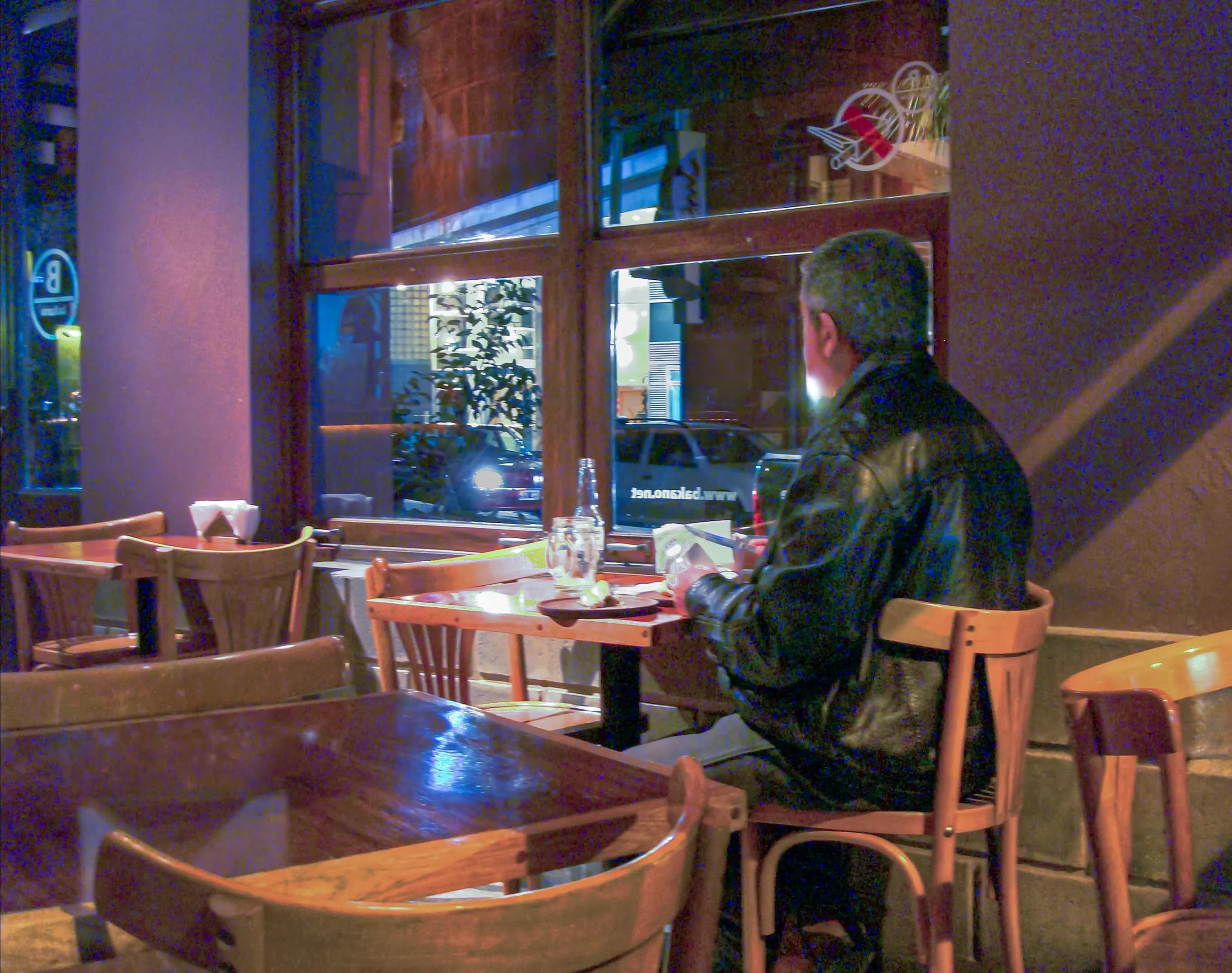
A man sits alone at a neighborhood restaurant in Palermo, Buenos Aires, absorbed in a private moment. Photographed discreetly in July 2009 while Francisco Colón was living in the city, the image observes solitude without attempting to explain it.
The Artist
I made this photograph in July 2009 while living in Palermo, Buenos Aires.
I had moved to Buenos Aires in October 2008 and would remain there until January 2010. By the time this photograph was made, this was not simply a city I was visiting. It was where I lived.
Bakano was essentially around the corner from my apartment. I would walk out of the building, turn right, walk to the corner, turn right again, and the restaurant was there across the street on the left corner.
It was part of the familiar geography of my everyday life.
On this particular occasion, I was sitting inside Bakano eating pizza and drinking Malbec when I noticed a man sitting by himself.
There was something about the way he occupied that small space that caught my attention. I did not know who he was, what he was thinking about, whether he was waiting for someone, or whether he simply preferred to be alone.
I photographed him discreetly.
I did not want to interrupt the moment or make him aware that he had become the subject of a photograph.
Looking at the image years later, I still do not know his story.
And I think that matters.
The photograph does not give me the right to invent one.
What I photographed was not necessarily loneliness.
It was a private moment.
Whatever thoughts occupied him belonged to him.
My responsibility was simply to preserve the dignity of that moment.
The Curator
Where Thoughts Come to Rest examines the distinction between solitude and loneliness.
The photograph was made in July 2009 while Francisco Colón was living in Palermo, Buenos Aires. Colón had moved to the city in October 2008 and remained there until January 2010.
This biographical context is significant. The photograph was not created during a brief encounter with Buenos Aires as a tourist or traveler. It emerged from the ordinary geography of Colón's daily life in the neighborhood he called home.
The unidentified man was seated alone at Bakano, a restaurant located just around the corner from Colón's apartment.
An empty chair and place setting introduce the possibility of another person, but the image provides no evidence from which to construct a narrative.
The subject may have been waiting.
He may have recently finished a conversation.
He may simply have chosen to sit alone.
Colón deliberately refuses to resolve that uncertainty.
Rather than assigning sadness, abandonment, or isolation to the subject, the photograph allows the man's interior life to remain private.
This restraint is central to the work.
The camera observes without claiming to know.
The resulting image becomes less a portrait of loneliness than an acknowledgment that another person's thoughts can remain beyond our reach.
Story Behind the Photograph
In October 2008, Francisco Colón moved to Buenos Aires, Argentina.
He made his home in Palermo and would live in the city until January 2010.
By July 2009, when Where Thoughts Come to Rest was created, Buenos Aires had become part of the rhythm of his everyday life.
Bakano was a neighborhood restaurant essentially around the corner from his apartment.
The route was simple and familiar.
Leaving the apartment building, Colón would turn right, walk to the corner, turn right again, and find Bakano across the street on the left corner.
On this particular occasion, he was sitting inside the restaurant eating pizza and drinking Malbec.
While dining, he noticed another customer.
A man sat alone at a nearby table.
There was nothing theatrical about the scene. No visible event explained why the man was alone or what occupied his attention.
He was simply there.
Colón raised his camera and photographed him discreetly, preserving the scene without interrupting it.
The photograph contains clues that invite interpretation. An empty chair remains beside the man. A place setting occupies the table. His posture suggests thought or attention directed somewhere beyond the camera.
But none of those details provides an answer.
The photographer never spoke with him.
His name is unknown.
His reason for being there is unknown.
What he was thinking remains unknown.
Years later, while revisiting the photograph, Colón resisted the temptation to turn those unanswered questions into a story.
The man may have been lonely.
Or he may have been perfectly content.
The distinction belongs to him.
Where Thoughts Come to Rest therefore preserves something photography often encounters but cannot explain: the private interior world of another person.
Reflection
There is a difference between being alone and being lonely.
A photograph cannot always tell us which one we are seeing.
We look at someone sitting by himself and instinctively begin constructing explanations.
Perhaps he is waiting.
Perhaps someone has left.
Perhaps something is troubling him.
Perhaps none of those things are true.
Sometimes solitude is not an absence.
Sometimes it is simply a space a person occupies for himself.
The man in this photograph never told me what he was thinking.
Years later, I still do not know.
And perhaps the photograph is stronger because I don't.
Not every mystery needs to be solved.
Not every silence needs an explanation.
Sometimes the most respectful thing an observer can do is recognize that another person's inner world belongs to them.
The camera can preserve the moment.
It does not have to explain it.
The Museum
Where Thoughts Come to Rest was created in July 2009 at Bakano, a neighborhood restaurant on Avenida Cerviño in Palermo, Buenos Aires.
At the time, Buenos Aires was Colón's home. He had moved to the city in October 2008 and would remain there until January 2010.
Bakano was located essentially around the corner from his apartment and formed part of the immediate geography of his everyday life in Palermo.
The precise restaurant and its relationship to Colón's former residence were reconstructed in 2026 while he revisited the locations associated with his photographic archive.
This recovered geographic context adds biographical precision without changing the central subject of the photograph.
The identity, circumstances, and thoughts of the photographed man remain unknown.
Within the Francisco Colón Studio archive, the work is distinguished by its refusal to transform observation into unsupported biography. Its unresolved quality preserves what Colón later described as the dignity of a private moment.
The reconstruction of its location also illustrates a broader function of the Studio archive: photographs can preserve not only what stood before the camera, but fragments of the physical geography through which a life was lived.
Technical Information
- Capture Date
- July 2009
- Location
- Bakano, Av. Cerviño 3496, Palermo, Buenos Aires, Argentina
- Metadata Status
- The photograph is documented through the surviving original source image and artist provenance narrative. The precise restaurant was identified in 2026 as Bakano on Avenida Cerviño in Palermo, Buenos Aires. Artist recollection establishes that Colón was living around the corner from the restaurant during this period, having moved to Buenos Aires in October 2008 and remained there until January 2010. Exact capture date, camera, lens, and exposure information require verification from surviving source metadata.
- Supporting Documentation
- Original source photograph, artist provenance narrative, 2026 identification of Bakano, and reconstructed geographic relationship between the restaurant and the photographer's former Palermo residence preserved in the Francisco Colón Studio archive.
Collection Record
- Accession Number
- FCS-PH-0034
- Exhibit Number
- 34
- Exhibition
- Reflections
- Status
- Permanent Collection
- Original Capture
- July 2009
- Studio Acquisition
- 2026
- Artist
- Francisco Colón
- Copyright
- © Francisco Colón. All rights reserved.