FCS-PH-0023
Photography Wing · Exhibit No. 23
Within the Heart of the Alhambra
The geometry of history.
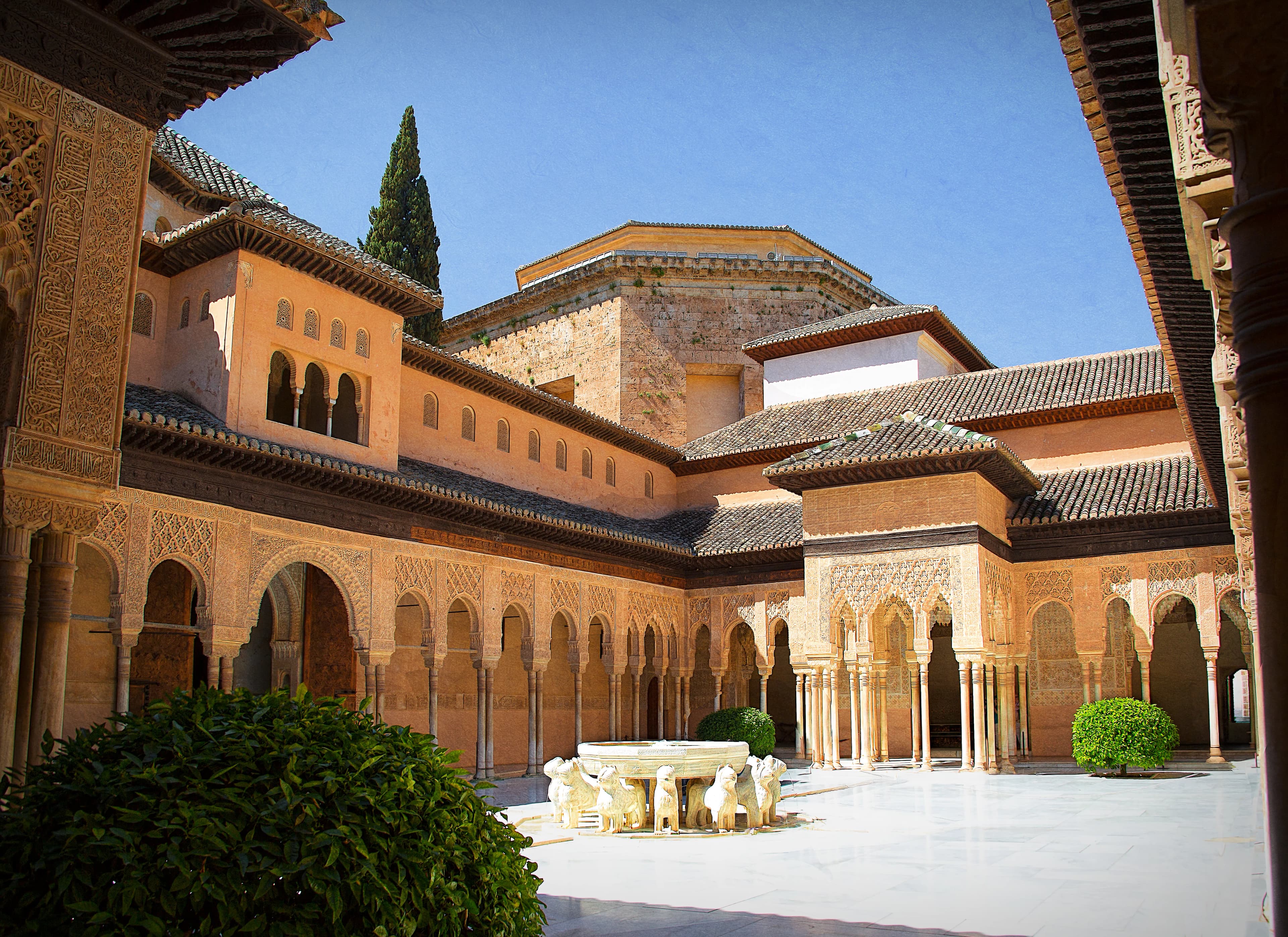
Within the Heart of the Alhambra
FCS-PH-0023
Permanent Collection
Court of the Lions, Alhambra, Granada, Spain
April 2014
Available as a Fine Art Print
Acquire a Print ↗About the Work
A panoramic view within the Court of the Lions shifts attention from the celebrated fountain toward the corridors, arches, waterways, and intersecting geometry that give the Alhambra its enduring spatial harmony.
The Artist
I spent an entire day inside the Alhambra, from the moment it opened until it closed, without feeling that I had seen everything.
What drew me to this courtyard was not primarily the Fountain of the Lions.
It was everything surrounding it.
The corridors.
The colors.
The openness.
The changing levels.
The arches.
The straight lines meeting graceful curves.
I waited in a corner for the visitors to dissipate and then worked quickly to create a panoramic composition before the space filled again.
During editing, I removed remaining people so that the architecture could speak without distraction.
Standing there, I imagined King Ferdinand and Queen Isabella walking these corridors, and perhaps Christopher Columbus explaining why another route to India should be funded.
Looking back, I realize I was not photographing the fountain.
I was photographing the geometry of history.
The Curator
Within the Heart of the Alhambra examines architecture through rhythm, proportion, and spatial continuity.
The famous lions occupy the center, but the artist deliberately directs attention toward the surrounding walkways, waterways, arches, and intersecting planes.
The completed panorama restores the visual stillness that first attracted him, allowing architecture and history to become inseparable parts of the same composition.
Curatorially, Within the Heart of the Alhambra is strongest when read through the discipline of noticing what might otherwise pass without emphasis. The composition does not require a dramatic event to justify its place in the collection; its meaning develops through relationships inside the frame—distance, scale, structure, atmosphere, and the distribution of visual weight. That restraint is important. It allows the photograph to carry the theme of observation through form as well as through biography, giving the work an independent visual life while remaining connected to the artist’s experience.
Story Behind the Photograph
This panorama was created during a full day spent exploring the Alhambra in Granada.
The artist waited patiently for a brief interval when visitors no longer dominated the courtyard.
The composition had to be made quickly and later required careful removal of remaining figures.
Although the Court of the Lions provided the location, the deeper subject was the organization of space itself: corridors meeting courtyards, curves meeting lines, and water connecting opposite ends of the architecture.
The photograph preserves both the structure and the historical imagination it awakened.
The photograph’s significance did not end when the shutter closed. What was encountered in Court of the Lions, Alhambra later became part of a larger personal record, and the surviving frame now connects the circumstances of the exposure with the perspective gained afterward. That distinction matters: the image documents what was physically present, while the story records what the moment came to mean. Keeping those two forms of evidence together—without confusing one for the other—is central to the way this work is preserved.
Reflection
Every great building tells two stories.
One is written by history.
The other is written by light, space, and the people who continue walking through it.
Long after rulers and travelers have gone, the corridors remain.
Perhaps great architecture is not remembered only because it survives time.
Perhaps it survives because each generation learns to see it differently.
The photograph ultimately raises a question about how attention can transform an ordinary scene without altering it. A camera can hold the appearance of a moment, but it cannot hold the entire experience surrounding it. That limitation gives Within the Heart of the Alhambra much of its power. What is absent is not a flaw to be repaired; it is the space in which memory continues to work. The image remains fixed while the person returning to it does not.
The Museum
Preserved as the twenty-third accessioned photograph in the Francisco Colón Studio Photography Wing, Within the Heart of the Alhambra expands the Cities collection through a panoramic study of architecture, historical imagination, and patient observation.
Within the Francisco Colón Studio Photography Wing, Within the Heart of the Alhambra is retained as part of the archive as evidence of the photographer’s recurring way of seeing. Its importance is therefore not measured only by subject matter or visual appeal. The work helps establish a recurring Studio principle: personal history can be preserved with emotional depth while the archive remains disciplined about the difference between what the photograph shows, what the artist remembers, and what later interpretation can responsibly infer.
Technical Information
- Capture Date
- April 2014
- Location
- Court of the Lions, Alhambra, Granada, Spain
- Metadata Status
- Month, year, location, panoramic method, and editing history preserved. Exact day and equipment require verification.
- Supporting Documentation
- Original panorama source files, edited master, and artist provenance narrative preserved in the Francisco Colón Studio archive.
Collection Record
- Accession Number
- FCS-PH-0023
- Exhibit Number
- 23
- Exhibition
- Cities
- Status
- Permanent Collection
- Original Capture
- April 2014
- Studio Acquisition
- Francisco Colón Studio Photography Wing
- Artist
- Francisco Colón
- Copyright
- © Francisco Colón. All Rights Reserved.